DRS: Draft Registration Statement
Published on
Confidential Draft No. 1 as confidentially submitted to the Securities and Exchange Commission on February 13, 2026. This draft registration statement has not been filed publicly with the Securities and Exchange Commission and all information herein remains strictly confidential.
Registration No. 333-
UNITED STATES
SECURITIES AND EXCHANGE COMMISSION
Washington, D.C. 20549
__________________________________________
FORM S-1
REGISTRATION STATEMENT
Under
The Securities Act of 1933
__________________________________________
Standard Nuclear, Inc.
(Exact name of registrant as specified in its charter)
__________________________________________
|
Delaware |
4911 |
99-3989746 |
||
|
(State or other jurisdiction of |
(Primary standard |
(I.R.S. employer |
200 Europia Ave
Oak Ridge, TN 37830
845-258-0016
(Address, including zip code, and telephone number, including area code, of registrant’s principal executive offices)
__________________________________________
Kurt Terrani
Chief Executive Officer
200 Europia Ave
Oak Ridge, TN 37830
845-258-0016
(Name, address, including zip code, and telephone number, including area code, of agent for service)
__________________________________________
Copies to:
|
James D. Evans Albert W. Vanderlaan Mark Mushkin Montana Ware Orrick, Herrington & Sutcliffe LLP 405 Howard Street San Francisco, CA 94105 (415) 773-5700 |
Derek Dostal Yasin Keshvargar Davis Polk & Wardwell LLP New York, NY 10017 (212) 450-4000 |
__________________________________________
Approximate date of commencement of proposed sale to the public: As soon as practicable after the effective date of this registration statement.
If any of the securities being registered on this Form are to be offered on a delayed or continuous basis pursuant to Rule 415 under the Securities Act of 1933, check the following box. ☐
If this Form is filed to register additional securities for an offering pursuant to Rule 462(b) under the Securities Act, please check the following box and list the Securities Act registration statement number of the earlier effective registration statement for the same offering. ☐
If this Form is a post-effective amendment filed pursuant to Rule 462(c) under the Securities Act, check the following box and list the Securities Act registration statement number of the earlier effective registration statement for the same offering. ☐
If this Form is a post-effective amendment filed pursuant to Rule 462(d) under the Securities Act, check the following box and list the Securities Act registration statement number of the earlier effective registration statement for the same offering. ☐
Indicate by check mark whether the registrant is a large accelerated filer, an accelerated filer, a non-accelerated filer, smaller reporting company, or an emerging growth company. See the definitions of “large accelerated filer,” “accelerated filer,” “smaller reporting company,” and “emerging growth company” in Rule 12b-2 of the Exchange Act.
|
Large accelerated filer |
☐ |
Accelerated filer |
☐ |
|||
|
Non-accelerated filer |
☒ |
Smaller reporting company |
☐ |
|||
|
Emerging growth company |
☒ |
If an emerging growth company, indicate by check mark if the registrant has elected not to use the extended transition period for complying with any new or revised financial accounting standards provided pursuant to Section 7(a)(2)(B) of the Securities Act ☐
__________________________________________
The registrant hereby amends this registration statement on such date or dates as may be necessary to delay its effective date until the registrant shall file a further amendment which specifically states that this registration statement shall thereafter become effective in accordance with Section 8(a) of the Securities Act of 1933 or until the registration statement shall become effective on such date as the Commission, acting pursuant to said Section 8(a), may determine.
EXPLANATORY NOTE
Pursuant to the applicable provisions of the Fixing America’s Surface Transportation Act, we are omitting our consolidated financial statements as of and for (i) the fiscal year ended December 31, 2023 and (ii) the nine months ended September 30, 2025 and 2024, because they relate to historical periods that we believe will not be required to be included in the prospectus at the time of the contemplated offering. We intend to amend this registration statement to include all financial information required by Regulation S-X at the date of such amendment before distributing a preliminary prospectus to investors.
The information in this prospectus is not complete and may be changed. We may not sell these securities until the registration statement filed with the Securities and Exchange Commission is effective. This prospectus is not an offer to sell these securities and we are not soliciting offers to buy these securities in any jurisdiction where the offer or sale is not permitted.
Subject to completion, dated , 2026
Preliminary Prospectus
Shares

Class A Common Stock
This is the initial public offering of shares of Class A common stock of Standard Nuclear, Inc. We are offering shares of our Class A common stock in this offering.
Prior to this offering, there has been no public market for our Class A common stock. It is currently estimated that the initial public offering price per share of our Class A common stock will be between $ and $ .
We intend to apply to list our Class A common stock on the under the symbol “ .”
We have two classes of authorized common stock, Class A common stock and Class B common stock. The rights of the holders of Class A common stock and Class B common stock are identical, except with respect to voting and conversion. Each share of Class A common stock is entitled to one vote per share. Each share of Class B common stock is entitled to votes per share and is convertible into one share of Class A common stock at the option of the holder. Outstanding shares of Class B common stock will represent approximately % of the voting power of our outstanding capital stock immediately following this offering, with our directors, executive officers, and principal stockholders representing approximately % of such voting power.
Upon the completion of this offering, Thomas Hendrix, our Founder and Executive Chairman of our board of directors, will beneficially own approximately % of the voting power of our common stock (or approximately % if the underwriters exercise their option to purchase additional shares of our Class A common stock in full). As a result, we will be a “controlled company” within the meaning of the corporate governance standards of . See “Management — Controlled Company Exemption.”
We are an “emerging growth company” as defined under the federal securities laws and, as such, will be subject to certain reduced public company reporting requirements for this prospectus and future filings. See “Prospectus Summary — Implications of Being an Emerging Growth Company.”
__________________________________________
Investing in our Class A common stock involves risks. See “Risk Factors” beginning on page 16 to read about factors you should consider before buying shares of our Class A common stock.
__________________________________________
Neither the SEC nor any other regulatory body or state securities commission has approved or disapproved of these securities or passed upon the adequacy or accuracy of this prospectus. Any representation to the contrary is a criminal offense.
__________________________________________
|
Per Share |
Total |
|||||
|
Initial public offering price |
$ |
$ |
||||
|
Underwriting discounts and commissions(1) |
$ |
$ |
||||
|
Proceeds, before expenses, to us |
$ |
$ |
||||
____________
(1) See “Underwriting” for additional disclosure regarding underwriting discounts and commissions and estimated offering expenses.
We have granted the underwriters the right to purchase up to an additional shares of our Class A common stock to cover over-allotments, if any.
The underwriters expect to deliver the shares of common stock to purchasers on or about , 2026.
__________________________________________
BofA Securities
__________________________________________
Prospectus dated , 2026
|
Page |
||
|
ii |
||
|
iv |
||
|
v |
||
|
1 |
||
|
16 |
||
|
46 |
||
|
48 |
||
|
49 |
||
|
50 |
||
|
52 |
||
|
Management’s Discussion and Analysis of Financial Condition and Results of Operations |
54 |
|
|
64 |
||
|
79 |
||
|
86 |
||
|
90 |
||
|
94 |
||
|
95 |
||
|
101 |
||
|
Material U.S. Federal Income Tax Considerations for Non-U.S. Holders |
103 |
|
|
107 |
||
|
115 |
||
|
115 |
||
|
F-1 |
________________
We have not, and the underwriters have not, authorized anyone to provide you with additional information or information that is different from, or to make any representations other than those contained in, this prospectus or in any free-writing prospectus prepared by or on behalf of us to which we may have referred you in connection with this offering. We and the underwriters take no responsibility for, and can provide no assurances as to the reliability of, any other information that others may give you. We are offering to sell, and seeking offers to buy, our Class A common stock only in jurisdictions where offers and sales are permitted. The information contained in this prospectus is accurate only as of the date of this prospectus, regardless of the time of delivery of this prospectus or of any sale of our Class A common stock. Our business, financial condition, results of operations and future growth prospects may have changed since that date.
Unless the context requires otherwise, the words “we,” “us,” “our,” the “Company” and “Standard Nuclear” refer to Standard Nuclear, Inc. and its subsidiaries taken as a whole. For purposes of this prospectus, unless the context otherwise requires, the term “stockholders” shall refer to the holders of our Class A common stock and Class B common stock, collectively, and “common stock” shall refer to our Class A and Class B common stock, collectively.
Through and including , 2026 (the 25th day after the date of this prospectus) U.S. federal securities laws may require all dealers that effect transactions in our Class A common stock, whether or not participating in this offering, to deliver a prospectus. This is in addition to the dealers’ obligation to deliver a prospectus when acting as underwriters and with respect to their unsold allotments or subscriptions.
For investors outside the United States, neither we nor any of the underwriters have done anything that would permit this offering or possession or distribution of this prospectus in any jurisdiction where action for that purpose is required, other than in the United States. Persons who come into possession of this prospectus in jurisdictions outside the United States are required to inform themselves about and to observe any restrictions as to this offering and the distribution of this prospectus and any such free-writing prospectus outside the United States. See “Underwriting.”
i
The future of human prosperity depends on energy abundance. Global energy demand is accelerating as artificial intelligence, electrification, and industrial baseload requirements converge into an unprecedented need for continuous, large-scale power availability. Technological advancement, industrial development, and global stability are all reliant on our capacity to generate safe, reliable, and scalable baseload power.
I. Nuclear energy is no longer optional.
Nuclear fission represents one of the most concentrated and enduring sources of power ever harnessed, offering a path to scalable energy production without the constraints of intermittency or the carbon footprint associated with many alternatives. I believe nuclear is uniquely positioned to provide clean baseload power for a world that increasingly depends on resilient energy systems.
The next chapter of human progress — artificial intelligence, advanced manufacturing, sovereign industrial capacity, resilient grids, and space exploration — will be enabled by one fundamental input: boundless energy. This future will require more than new reactor designs. It will require the industrial supply chains that make safe, modern nuclear systems real: the fuels, materials, and distribution networks that enable deployment at scale and at costs that support broad commercial adoption.
More than an engineering or technology challenge, this is an industrial and strategic imperative. Energy security and national security are inherently inseparable, and the ability to deploy nuclear power at scale will depend on domestic capacity to produce the fuels and materials that underpin the entire sector. The United States can only meet twenty-first century power demands by reducing reliance on fragmented legacy fuel infrastructure and foreign-controlled supply chains for critical nuclear inputs.
II. A new standard for nuclear energy.
Standard Nuclear is building America’s advanced nuclear fuel and materials company. We design, manufacture, and deliver advanced nuclear fuel and critical components across the most valuable segments of the nuclear energy supply chain. Our work supports the foundational building blocks of nuclear power generation and a secure energy future, addressing what we believe is the most critical bottleneck in advanced nuclear deployment: the industrialization of fuel and materials at scale.
We are defining a new category in American energy. Rather than operating within legacy silos of fuel or materials supply chains, Standard Nuclear is creating an integrated advanced nuclear fuel platform designed for industrial throughput. The materials we fabricate are essential to the future of nuclear deployment across the United States and beyond. Our growth is driven by America’s accelerating demand for abundant, reliable energy.
We are not building for a single reactor design or one generation of technology, but for the broader nuclear ecosystem that must emerge to support sustained national energy expansion. By integrating advanced chemical processing, precision manufacturing, and gold standard nuclear operations into a unified platform, we are establishing the backbone required for repeatable, high-volume fuel production — and setting a new standard for what it means to deliver nuclear capability with speed, rigor, and credibility.
III. Technology and regulatory convergence.
Delivering advanced nuclear fuel at scale requires deep capability across chemical processing, precision manufacturing, advanced materials science, and compliance-grade safety and quality control. Standard Nuclear is building this infrastructure as a unified platform — enabling faster iteration, tighter process and safety control, and a clear path from early production to full industrial deployment.
Today, Standard Nuclear operates a fully licensed facility under Department of Energy (DOE) regulation and is currently processing HALEU fuel. We are an active participant in the U.S. DOE’s Fuel Pilot Program, providing fuel for reactor demonstrations in the near term while retaining commercial independence to sell fuel directly to reactor developers in the long term. Simultaneously, we will be operating under Nuclear Regulatory Commission (NRC) authority through a joint venture with Framatome Inc. — one of the most established and experienced
ii
nuclear fuel manufacturers globally — using existing facilities licensed under the NRC. This structure provides a clear and credible dual path for operations under both DOE and NRC oversight, and is an output of our commitment to working hand in hand with regulators to deliver nuclear supply chain infrastructure.
Fabrication of advanced nuclear fuel is among the most technically demanding and highly regulated industrial undertakings in the world today. Progress in this sector is not measured in intent, but in demonstrated operational capability under real regulatory oversight. Safety, quality assurance, and regulatory compliance are not constraints on our work — they are our core operating principles and prerequisites for earning and preserving public trust for the entire industry. Our mission is to produce the most critical, highest value materials necessary for a safe and sustainable energy future for the United States and beyond.
Safe, reliable, scalable — this is the New Standard.
Thomas Hendrix
Founder & Executive Chairman
Standard Nuclear, Inc.
iii
TRADEMARKS, TRADE NAMES AND SERVICE MARKS
“Standard Nuclear,” our logo, and our other registered or common law trademarks, tradenames and service marks appearing in this prospectus are our property. Solely for convenience, our trademarks, tradenames and service marks referred to in this prospectus appear without the ®, ™ and SM symbols, but those references are not intended to indicate, in any way, that we will not assert, to the fullest extent under applicable law, our rights to these trademarks and tradenames. This prospectus contains additional trademarks, tradenames and service marks of other companies that are the property of their respective owners.
NON-GAAP FINANCIAL MEASURES
This prospectus contains certain financial measures, including and , which are not presented in accordance with GAAP. We refer to these measures as “non-GAAP” financial measures. These non-GAAP financial measures are being presented because they provide our management and readers of this prospectus with additional insight into our operational performance relative to earlier periods and relative to our competitors. These non-GAAP financial measures are not a substitute for, and should not be considered as superior to, any GAAP financial information. Readers of this prospectus should use these non-GAAP financial measures only in conjunction with the comparable GAAP financial measures.
This prospectus contains estimates and information concerning our industry, our business, and the market for our products and solutions, including our general expectations of our market position, market growth forecasts, our market opportunity, and size of the markets in which we participate, that are based on industry publications, surveys, and reports that have been prepared by independent third parties. This information involves a number of assumptions and limitations, and you are cautioned not to give undue weight to these estimates. Although we have not independently verified the accuracy or completeness of the data contained in these industry publications, surveys, and reports, we believe the publications, surveys, and reports are generally reliable, although such information is inherently subject to uncertainties and imprecision. The industry in which we operate is subject to a high degree of uncertainty and risk due to a variety of factors, including those described in the section titled “Risk Factors.” These and other factors could cause results to differ materially from those expressed in these publications and reports.
The source of certain statistical data, estimates, and forecasts contained in this prospectus are the following industry publications or reports that have been prepared by independent third parties:
• United States Department of Energy, “Pathways to Commercial Liftoff: Advanced Nuclear,” September 2024 (accessed on February 11, 2025)
• United States Nuclear Regulatory Commission, “Fuel Fabrication,” last updated June 26, 2023 (accessed on February 11, 2025)
• United States Department of Energy, “TRISO Particles: The Most Robust Nuclear Fuel on Earth,” July 19, 2019 (accessed on February 11, 2025)
iv
The following are abbreviations, acronyms, and definitions of certain terms used in this prospectus:
“2025 Stock Plan” means the Standard Nuclear, Inc. 2025 Equity Incentive Plan.
“2026 Plan” means our 2026 Equity Incentive Plan.
“Advanced Reactors” refers to a new class of nuclear reactors, including SMRs and microreactors, designed to be safer, more efficient, and more flexible than traditional nuclear reactors.
“Bonus Plan” means our 2026 Executive Incentive Bonus Plan.
“Code” refers to the Internal Revenue Code of 1986, as amended.
“DGCL” means the Delaware General Corporation Law.
“DOE” means the United States Department of Energy.
“Enrichment” means the enrichment of uranium hexafluoride, which involves increasing the proportion of fissile isotope U-235 to higher concentrations by separating it from the more abundant Uranium-238 through gas centrifuge or gaseous diffusion methods, which exploit the mass difference between the isotopes.
“ESPP” means our 2026 Employee Stock Purchase Plan.
“Exchange Act” means the Securities Exchange Act of 1934, as amended.
“Framatome Inc.” means Framatome Inc., a Delaware corporation that is a U.S. company and a subsidiary of Framatome SAS headquartered in France.
“Fuel Fabrication” means the process of converting enriched uranium (like HALEU) into finished fuel forms (like TRISO fuel).
“GAAP” means U.S. generally accepted accounting principles.
“HALEU” means High-Assay Low-Enriched Uranium, which is uranium enriched to between 10% and 20% U-235. HALEU is a feedstock, not a fuel form. It is used to manufacture advanced fuels, like TRISO fuel.
“HTGRs” means high-temperature gas-cooled reactors.
“Idaho Facility” means the Company’s fuel line facility to be built in Idaho on DOE property in Idaho pursuant to the OTA.
“IRS” means the United States Internal Revenue Service.
“JOBS Act” means the Jumpstart Our Business Startups Act of 2012.
“kgU” means kilogram of uranium, which is a unit for measuring uranium mass quantity. It is a common measurement for fuel pricing and offtake agreements. See also “MTU.”
“LEU+” means Low-Enriched Uranium Plus, which is uranium enriched above 5% but below 10% U-235. It is being explored as an interim fuel option for some Advanced Reactors.
“MTU” means metric ton of uranium, which is a unit for measuring uranium mass quantity. It is a common measurement for fuel pricing and offtake agreements. 1 MTU = 1,000 kgU.
“NRC” means the United States Nuclear Regulatory Commission.
“OTA” means the Other Transaction Agreement for Fuel Production Line Authorization, dated as of September 26, 2025, between the Company and the DOE.
“Oak Ridge SN-0” refers to the Company’s existing fuel line facility in Oak Ridge, TN that is currently operational.
v
“Oak Ridge SN-TN” refers to the Company’s new production facility in Oak Ridge, TN that is anticipated to become operational prior to the completion of this offering.
“Oak Ridge Facilities” refers to Oak Ridge SN-0 and Oak Ridge SN-TN facilities, collectively.
“R&D” means research and development.
“restated bylaws” means our amended and restated bylaws which will become effective immediately prior to the completion of this offering.
“restated certificate of incorporation” means our amended and restated certificate of incorporation which will become effective immediately prior to the completion of this offering.
“Richland SN-F Facility” means Framatome Inc.’s NRC-licensed fuel cycle facility in Richland, Washington.
“Sarbanes-Oxley Act” means the Sarbanes-Oxley Act of 2022.
“SEC” means the United States Securities and Exchange Commission.
“Securities Act” means the Securities Act of 1933, as amended.
“SMRs” means small modular reactors.
“TRISO” stands for “tristructural-isotropic” and refers to poppyseed-sized fuel particles made from enriched uranium and coated in ceramic layers and used to fuel many Advanced Reactors.
“TWh” means terawatt-hours.
“Voting Threshold Date” means the first date falling after 11:59 p.m. (Eastern Time) on the date on which the outstanding shares of our Class B common stock represent less than a majority of the combined voting power of our then-outstanding Class A common stock and Class B common stock entitled to vote generally in the election of directors.
“U-235” means Uranium-235, which is a naturally occurring isotope of uranium that can sustain a nuclear chain reaction, making it essential for nuclear fuel.
“USNC” refers to Ultra Safe Nuclear Corporation and its subsidiaries., from whom we purchased specific nuclear fuel — related assets through a Section 363 auction process under the U.S. Bankruptcy Code.
vi
This summary highlights information contained in greater detail elsewhere in this prospectus. This summary is not complete and does not contain all of the information you should consider in making your investment decision. You should read the entire prospectus carefully before making an investment in our common stock. You should carefully consider, among other things, our consolidated financial statements and related notes and the sections titled “Risk factors,” “Special Note Regarding Forward-Looking Statements” and “Management’s Discussion and Analysis of Financial Condition and Results of Operations” included elsewhere in this prospectus.
Our Mission
Our mission is to supply advanced nuclear fuels that enable safe, reliable and scalable nuclear power generation. We aim to support the re-emergence of the U.S.’s newbuild nuclear infrastructure, strengthen domestic energy security and meet the nation’s growing demand for safe, reliable and clean baseload power.
Company Overview
Standard Nuclear is a leading, independent advanced nuclear fuel company and the only company with industrial-scale TRISO manufacturing facilities in the United States. We design, engineer, and manufacture advanced nuclear fuels with a primary focus on TRISO fuel that is utilized by Advanced Reactors.
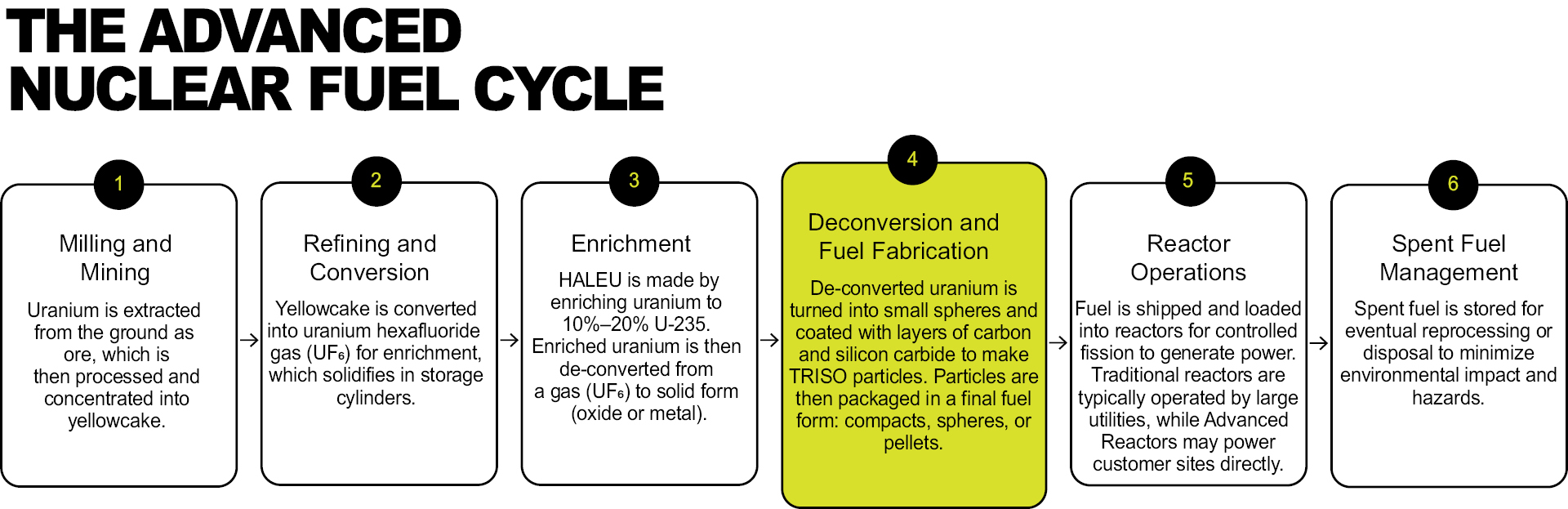
Our capabilities position us at the fuel manufacturing layer of the nuclear value chain, supporting Advanced Reactor developers and end customers with scalable domestic fuel supply solutions. Our disciplined, repeatable and reliable manufacturing process converts enriched uranium feedstock into finished fuel products in accordance with nuclear-grade safety, quality, and regulatory frameworks.
We do not design, own or operate nuclear reactors. Instead, our nuclear fuel products are engineered to be compatible with a broad range of reactor designs, including Advanced Reactors, and can be used by reactor owners and operators, utilities, hyperscale data center operators, and domestic and international government entities that own or operate such reactors. We believe we are well positioned to capture a meaningful share of this market given our current and planned industrial-scale operating capacity, technology platform, secured licenses, and cost advantages derived from a modular manufacturing architecture.
In addition, we do not directly procure or source uranium for the nuclear fuel we manufacture. Our customers are generally responsible for procuring enriched uranium feedstock, which we then convert into nuclear fuel for our customers to use in their reactors for their various commercial needs. Our business model is based on long-term fuel supply arrangements under which our customers deliver feedstock to us and purchase finished fuel products, typically priced on a kgU basis and adjusted for enrichment level, final fuel form, and other specified requirements. We expect long-term unit economics to improve through automation, yield optimization, and replication of standardized fuel manufacturing modules that we have developed. We do not take direct commercial exposure to uranium price volatility, focusing instead on margin-driven deconversion, fabrication and fuel engineering services within the nuclear fuel value chain.
1
The Role of TRISO Fuel
Nuclear fuel that powers the existing U.S. fleet of light-water reactors consists of ceramic uranium dioxide (UO₂) pellets stacked inside long zirconium-alloy metal tubes (or cladding) that form fuel rods. Multiple fuel rods are bundled together to form fuel assemblies. The zirconium alloy cladding provides the primary barrier to fission product release, while water serves as both coolant and moderator and safety depends heavily on maintaining cladding integrity and active cooling.
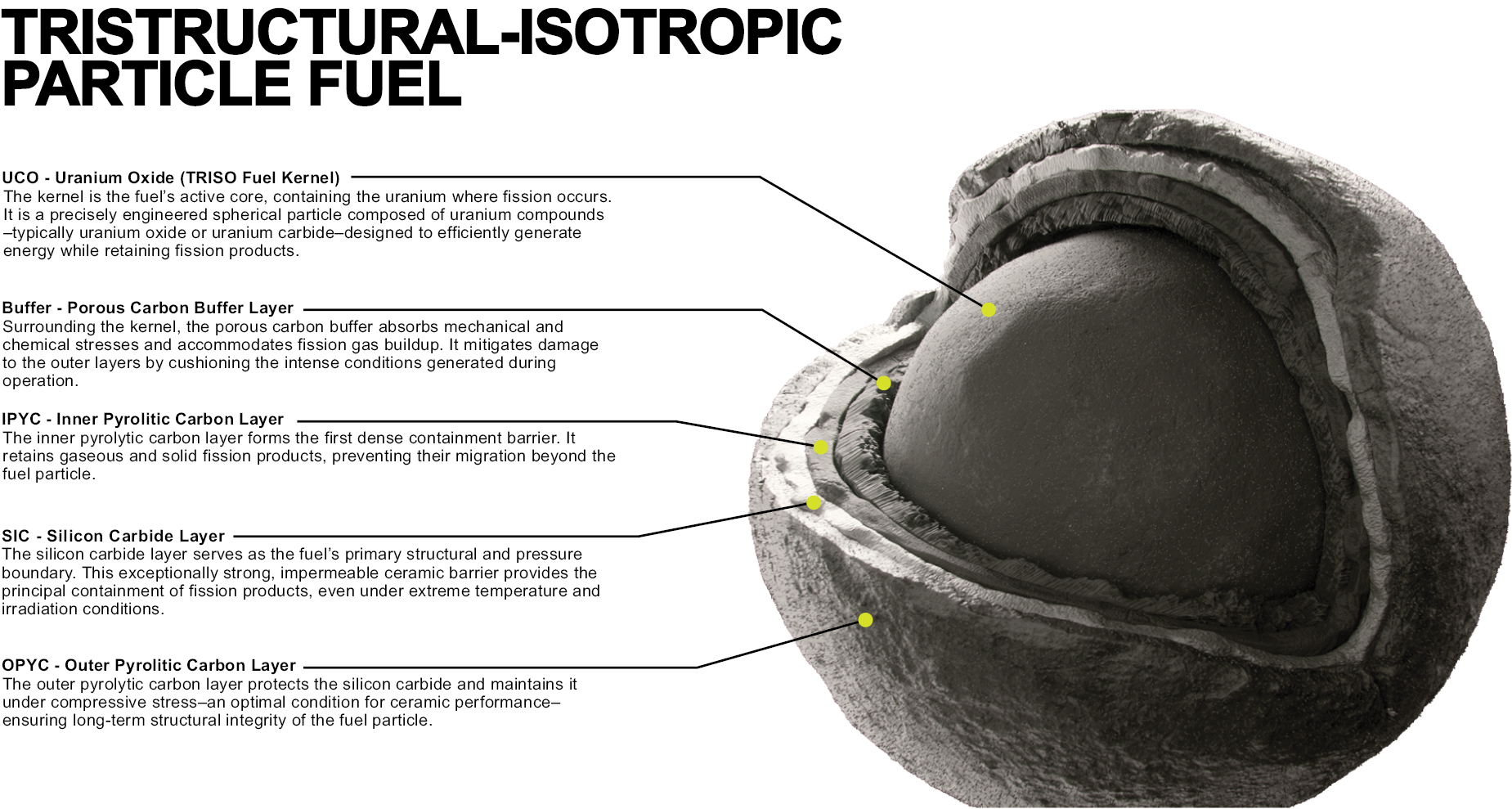
TRISO fuel is a coated fuel particle architecture originally developed for HTGRs and is known as the “most robust nuclear fuel on earth” according to the DOE. TRISO is designed so that each particle functions as a self-contained containment system: multiple ceramic coating layers surround a fuel kernel and are intended to retain fission products during normal operation and under severe off-normal conditions.
The all-ceramic TRISO architecture enables Advanced Reactor designs to operate at higher temperatures and achieve higher burnup than conventional light-water reactors, which may reduce reliance on large-scale water cooling and high-pressure containment structures in certain reactor configurations. This can significantly reduce nuclear plant capital costs and simplify the engineering required for safe and reliable reactor operation.
Our Manufacturing Process
By combining a proven TRISO architecture with an industrial, manufacturing-first approach, we are positioned to produce fuel products that meet reliability, quality and traceability requirements of commercial customers (including U.S. government-authorized exports to overseas markets) and government customers. Our strategy is focused on commercial-scale production with manufacturing systems designed to support near-term fuel qualification and longer-term cost reduction as production volumes increase.
Our TRISO fuel manufacturing platform is designed as a modular, repeatable process built around (i) controlled production units, (ii) automated inspection and monitoring, (iii) data-driven quality controls and (iv) comprehensive documentation and traceability. This modular design is intended to support consistent product quality, scalability across facilities, and compliance with applicable regulatory, security, and safety frameworks. Our processes also incorporate an in-line scrap fuel recycling loop intended to recover and reintroduce usable uranium material, improving material utilization and reducing waste. Our team includes industry-leading TRISO fuel experts with more than 150 years of collective experience in TRISO fuel production and testing within the U.S. National Laboratory system.
2
Our manufacturing sequence consists of following principal stages:
1. Deconversion — Converting the enriched uranium hexafluoride (UF₆) we receive from customers into uranium oxide feedstock to be used in subsequent fabrication steps.
2. Kernel Formation — Forming the uranium oxide feedstock into high-density spherical fuel kernels with controlled geometry and material properties tailored to specifications provided to us by our customers.
3. TRISO Coating — Applying successive coating layers (including carbon and silicon carbide layers) to the fuel kernels using high-temperature coating systems to create the structural and containment architectures of the TRISO particles. We monitor the coating thickness, uniformity, and defect rates to ensure conformance with customer specifications.
4. Fuel Form Fabrication — Converting the coating particles into the customer-specified fuel form (e.g., compacts, pebbles or other geometries), including embedding particles in a matrix where required. We inspect the finished fuel forms using destructive and/or non-destructive methods, as appropriate and required by the final fuel form specification.
5. Characterization and Certification — Performing testing and analysis throughout the entire manufacturing process to verify that the fuel forms meet the intended specifications and to support quality documentation, traceability and regulatory requirements.
6. Packaging and Shipment — Packaging finished fuel forms in approved fissile material containers designed to meet applicable NRC, DOE, and/or other regulatory requirements and delivering these fuel forms to our customers.
Our Facilities
We launched our commercial journey by establishing operations at the historic K-25 Site in Oak Ridge, TN — the site of the world’s first large-scale uranium enrichment. Our Oak Ridge SN-0 facility, which is operational today, is equipped with specialized infrastructure, a workforce experienced in regulated nuclear operations, and an operating environment with deep institutional familiarity with nuclear materials, safety, and compliance. Since beginning our operations, we are continuously looking to expand our manufacturing capabilities and facilities, and anticipate bringing our Oak Ridge SN-TN production facility online in the near term. We also have a planned facility in Idaho Falls, Idaho, and plan to operate an additional facility in Richland, Washington with our joint venture partner, Framatome Inc.
We are licensed under the DOE to operate at our Oak Ridge Facilities and our planned Idaho Facility, and we intend to leverage an existing NRC license granted to our joint venture partner, Framatome Inc., at the Richland SN-F Facility, pending regulatory approval to amend Framatome Inc.’s existing NRC license to permit the manufacturing of our advanced fuel products, including TRISO, at that facility.
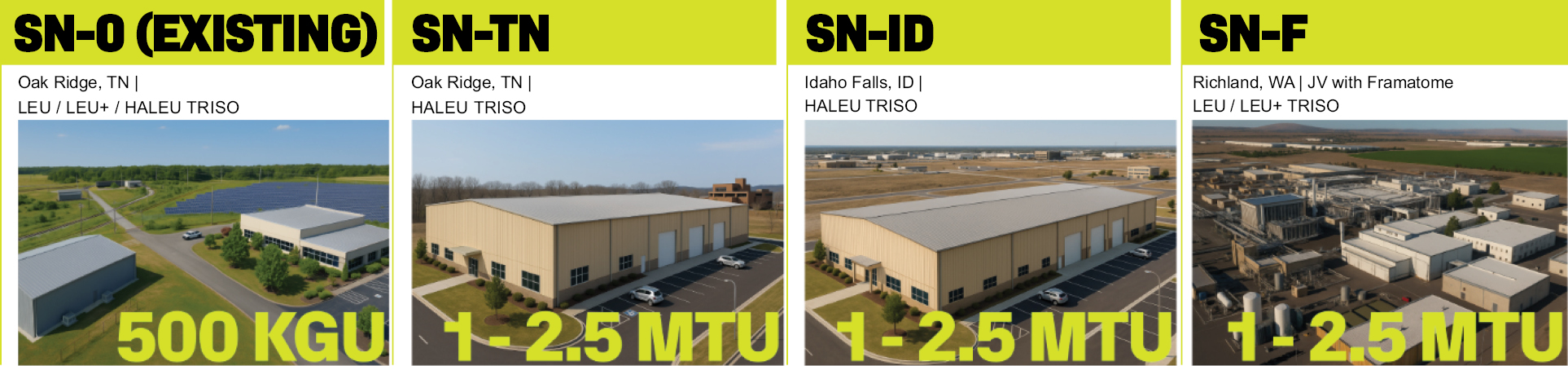
• Oak Ridge SN-0 Facility: Located in Oak Ridge, Tennessee, our Oak Ridge SN-0 production facility is operational today and can produce 500 kgU of finished fuel per year
• Oak Ridge SN-TN Facility: Located in Oak Ridge, Tennessee, our Oak Ridge SN-TN production facility is anticipated to come online in the near term. While it is currently slated to produce 1,000 kgU (1 MTU) of finished fuel per year, once operational, SN-TN’s footprint is designed for seamless scaling, allowing for a potential capacity of 2.5 MTU per year without requiring additional land
3
• Idaho SN-ID Facility: Located in Idaho Falls, Idaho, SN-ID has been designed to be a carbon copy of our Oak Ridge SN-TN facility. It mirrors the 1 MTU anticipated initial capacity at Oak Ridge SN-TN with the same 2.5 MTU peak potential. We intend to operate our Idaho facility on DOE land pursuant to a long-term lease, which allows us to plug directly into the DOE contracting complex and provide streamlined nuclear fuel support for the DOE, Department of War, NASA, and other critical government missions
• Richland SN-F Facility: In Richland, Washington, we have established Standard Nuclear × Framatome LLC, a joint venture with Framatome Inc. We believe the Richland SN-F Facility will benefit from our modular equipment to also establish 2.5 MTU peak potential, while leveraging Framatome Inc.’s decades of experience in light-water reactor fuel production. In addition, by utilizing Framatome Inc.’s existing infrastructure and commercial relationships, Standard Nuclear × Framatome LLC can help integrate Standard Nuclear into an established global value chain
Our expansion strategy, “Replicate, Don’t Redesign,” emphasizes repeatable, licensed, building blocks rather than bespoke scale-ups. This strategy is intended to increase throughput by deploying our existing standardized, reliable manufacturing modules at new and existing sites, reducing technical and licensing risk. Modules can operate on independent shift schedules while sharing centralized utilities, analytical lab support and waste-management systems, enabling incremental capacity additions within an established licensing and operating framework. This architecture is designed for sustained commercial production, not pilot-scale demonstration.
Our Customers
Our existing customer base spans two principal categories:
• Developers of Advanced Reactors designing SMRs and microreactors that require TRISO fuel. Engagements often begin with Fuel Development Agreements (e.g., consulting, testing, and sample production) and progress to Fuel Sales Agreements for metric tons of fuel. Our Fuel Sales Agreements typically include non-refundable deposits and milestone payment obligations for our customers.
• Federal agencies pursuing HALEU-fueled demonstration reactors and mobile microreactor systems, including mission deployments (e.g., space power and forward operating deployments). These contracts often involve specialized fuel development and long-term production commitments.
Our Competitive Strengths
Our key competitive strengths include:
1. U.S.’s Only Industrial-Scale Advanced Nuclear Fuel Company
We believe we are the only company in the United States with industrial-scale TRISO fuel fabrication capabilities. Our Oak Ridge SN-0 facility is operational today and our Oak Ridge SN-TN and Idaho facilities, once operational, will operate under DOE authorization alongside our Oak Ridge SN-0 facility. In addition, our Richland SN-F Facility will operate under NRC authorization pursuant to our joint venture with Framatome Inc., pending regulatory approvals. Once all facilities are operational, based on our assumptions that each TRISO production line is constructed, online, and operating at intended production capacity, we expect the combined run-rate annual capacity of our facilities to be 3.5 MTU of TRISO fuel, sufficient to support roughly 5,600 GWh of energy output from Advanced Reactors.
2. Technology-Agnostic Approach Driving Large and Growing TAM
We operate a technology-agnostic advanced nuclear fuel manufacturing model that allows us to serve customers utilizing various reactor designs, rather than being vertically integrated with a single proprietary reactor design.
By decoupling fuel fabrication from reactor ownership, we can operate as an independent advanced fuel supplier, aligning commercial and operational incentives with reactor vendor and plant operator customers, avoiding the conflict of interest commonly associated with vertically integrated fuel-reactor models.
4
By serving multiple reactor developers across different designs and deployment timelines, we reduce reliance on any single reactor program and can benefit from a diversified customer portfolio, reducing customer concentration risk and smoothing demand.
3. Specialization in TRISO, a Highly Configurable Fuel That Can Enable the Nuclear Renaissance
We are primarily focused on TRISO fuel due to its inherent robustness and fuel-level containment characteristics, which support simplified reactor designs, passive safety performance and predictable operation.
TRISO fuel incorporates multiple concentric containment layers, designed to retain fission product under high temperatures and a wide range of operating conditions. These fuel-level characteristics provide intrinsic performance and safety benefits that reduce or eliminate the need for reliance on complex and active safety systems at the reactor level, which are typically needed for conventional light-water reactors.
The DOE describes TRISO fuel as the “most robust nuclear fuel on Earth,” noting that TRISO particles are more stable than traditional nuclear fuels and cannot melt under non-normal operating conditions.
These attributes are designed to translate to enhanced overall safety, lower capital intensity, reduced construction risk and improved schedule certainty relative to more system-dependent fuel technologies.
4. Competitive Intellectual Property Moat Built for Scalability
We retain ownership of our proprietary manufacturing processes, quality systems and operational know-how required to produce the TRISO-based fuels that meet our customers’ unique specifications, including the final attributes and characteristics of the fuel products we deliver. Each step of our manufacturing process is protected by our intellectual property or other proprietary rights, which we believe gives us a competitive advantage over other companies that may rely on third-party input or licenses. While our customers define the specifications for the final fuel products they receive (the ‘what’), we retain ownership of the underlying manufacturing methodologies, proprietary processes, and technical know-how (the ‘how’) utilized to arrive at those specifications.
This differentiation is based less on any one or more standalone patents and more on our process expertise, including equipment configuration, process control and monitoring parameters, quality assurance methodologies and manufacturing expertise accumulated over repeated production cycles.
Our competitive advantage is driven by our accumulated manufacturing experience, process control expertise and regulatory qualifications embedded in our platform, which we believe are hard to replicate and can improve with scale.
We expect this approach to reduce customer capital and execution risk while potentially creating high switching costs and durable differentiation as the nuclear industry evolves.
5. Purpose-Built, Efficient Operational Facilities
Our facilities are purpose-built for advanced nuclear fuel manufacturing, with an emphasis on centralized process control, regulatory rigor and scalable operations. We have invested in specialized equipment, integrated quality systems, and experienced operating teams to support repeatable production, continuous improvement and consistent performance as volume increases. We believe this disciplined, infrastructure-oriented approach positions our facilities at the leading edge of advanced nuclear fuel manufacturing and will support the market as it transitions into commercial deployments.
We have been deliberate about leaving the laboratory setting and operating at industrial scale. This head start has allowed us to internalize critical lessons and refine risk-mitigation strategies that only come from real-world, high-volume production operations.
5
6. Strong Backlog Visibility
We benefit from enhanced visibility into our customer pipeline due to long lead times and the technical specificity associated with our customers’ fuel requests. This visibility is further enhanced by our value proposition as the only independent advanced fuel supplier that is currently able to operate at-scale, ensuring trust and alignment with our customers, and early alignment with our customers enables a head start on any future competition. Fuel specifications are typically defined early in the reactor development process and require close coordination, resulting in structured commercial arrangements that may include Fuel Development Agreements and Fuel Offtake Agreements with non-refundable deposits entered into well ahead of fuel delivery.
Fuel Sales Agreements require deposit payments upon order (which could be up to 24 months in advance of fuel delivery), milestone-based payments throughout the process and penalty payments should a customer choose to cancel early. These payments are intended to support our engineering, qualification and production planning activities. We believe this commercial structure supports disciplined capacity planning and reduces demand uncertainty.
7. Significant Government Support
We participate in U.S. government initiatives designed to strengthen the domestic advanced nuclear fuel supply chain. We were selected by the DOE as the first recipient of the Fuel Line Pilot Program contract to support the development and operation of TRISO fuel fabrication capabilities, and we have entered into an OTA as a prime contractor to the DOE. We believe participation in these programs reflects our alignment with U.S. domestic energy policy and security priorities and supports the development and operation of TRISO fuel fabrication capabilities, including scale up and readiness for commercial deployment.
Our customers also include other U.S. government agencies (e.g., NASA), other DOE prime contractors, and national defense programs, who we support through the development and supply of advanced nuclear fuels required to power critical infrastructure both on Earth and in space, informing the future of our energy independence and national security.
8. World-Class Management Team
Our management team brings significant execution-oriented experience and extensive track record in advanced nuclear fuel and infrastructure development and manufacturing which helps us reduce technical and operational risk at scale. Our leadership and technical staff include engineers and operators with prior experience in nuclear fuel fabrication, materials science, manufacturing scale-up and engagement with U.S. government agencies and national laboratories.
Unlike competitors where teams are focused on both reactor design and research, our workforce is oriented toward building, deploying and producing nuclear fuel cycle facilities and infrastructure at industrial scale.
Industry
According to the U.S. Energy Information Administration, total U.S. electricity demand is projected to increase from approximately 4,000 TWh in 2023 to more than 5,300 TWh by 2035 — a 33% increase that reverses decades of relatively flat consumption. This expected growth reflects not only population and economic expansion, but a fundamental change in how energy is consumed, as industrial processes, transportation systems, and digital infrastructure become increasingly electrified. For example, next-generation artificial intelligence (“AI”) training clusters and inference farms require sustained, high-density electricity supply. Large hyperscale data center campuses can draw more than 500 megawatts of continuous load, operating at utilization levels that strain existing generation and transmission infrastructure. Industry roadmaps and operator disclosures indicate AI compute demand approximately doubles every 24 months. This pace of load growth significantly exceeds planned additions of firm, dispatchable generation and cannot be met through intermittent resources alone.
6
Advanced Reactors, including SMRs and microreactors, have re-emerged as leading candidates to meet this requirement. These reactor designs are intended to operate at higher temperatures and achieve higher fuel burnup levels than traditional light-water reactors, improving efficiency. More importantly, these systems are designed to be passively safe, enhancing their siting flexibility and safety characteristics. These performance attributes require advanced fuel forms, most notably, TRISO fuel, which is engineered to retain radioactive fission products at extremely high temperatures, providing a level of inherent safety that conventional fuels cannot achieve.
The DOE has set a deployment target of ~35 GW of additional nuclear capacity by 2035 and to achieve a sustained pace of 15 GW per year by 2040, encompassing traditional large reactors, SMRs, and microreactors. The addressable market for advanced-reactor fuel can be estimated by linking projected reactor deployments to their ongoing refueling requirements.
Under a deployment mix in which SMRs and microreactors supply a meaningful share of incremental capacity, advanced reactor deployment at this scale implies recurring annual demand on the order of tens to hundreds of MTU, depending on the ultimate technology mix and refueling profiles.
U.S. regulatory and policy frameworks increasingly support the deployment of advanced nuclear technologies and the development of domestic fuel-manufacturing capacity, including committing agencies to coordinate review and provide expedited pathways for DOE-authorized advanced reactor designs and DOE-authorized nuclear fuel cycle facilities, as well as project-specific interagency engagement to support the transition from DOE authorization to NRC licensing. Additionally, the NRC is aiming to streamline its licensing reviews for advanced reactor and fuel cycle projects that have already been authorized and reviewed by the DOE, enabling reliance on DOE technical reviews where appropriate.
Federal policy support for nuclear fuel development accelerated following Executive Orders 13990, 13992, and 13999 (2021) and subsequent Trump Administration-era nuclear supply-chain directives that explicitly identified domestic nuclear fuel production as a national security priority. These directives underpinned the DOE’s Advanced Reactor Demonstration Program (ARDP) and the HALEU Availability Program, which together created direct federal demand signals for domestically manufactured advanced fuel.
Collectively, these regulatory and policy initiatives establish a durable framework intended to support domestic fuel manufacturing, facilitate advanced reactor deployment, and sustain fuel demand over multi-decade operating lifetimes. For fuel suppliers capable of meeting regulatory, quality, and security requirements, this alignment creates a long-term, government-supported foundation for commercial participation in the advanced nuclear ecosystem, enabling distribution that ensure flexibility and resiliency as it supplies the advanced nuclear fleet.
Our Strategic Partnerships
Department of Energy
In August 2025, the DOE announced Standard Nuclear as the first U.S. company selected under its newly established Fuel Line Pilot Program, marking the first pilot project for advanced nuclear fuel lines, and we entered into an OTA as a prime contractor to the DOE in September 2025 to build, operate, and commission advanced fuel fabrication facilities at our Oak Ridge Facilities and Idaho Facility. The DOE stated that this initiative was issued in accordance with President Trump’s Executive Order Deploying Advanced Nuclear Reactors for National Security and is designed to strengthen domestic nuclear fuel supply chains and “help eliminate America’s reliance on foreign sources of enriched uranium and critical materials,” while enabling private-sector investment in U.S. nuclear energy development.
Additionally, the DOE fuel line pilot program directly supports DOE’s Reactor Pilot Program, which aims to have at least three advanced reactor designs achieve criticality by July 4, 2026, and both pilot programs advance the implementation of executive orders designed to reform reactor testing and deploy nuclear technologies for national security.
7
In parallel, the DOE’s Loan Programs Office has signaled support for domestic nuclear manufacturing under its Title XVII authority, reflecting a policy emphasis on rebuilding U.S. nuclear supply-chain infrastructure. The Department of War is also advancing microreactor demonstration and deployment programs, including initiatives at Idaho National Laboratory, further reinforcing demand for qualified advanced nuclear fuel.
Framatome
Our strategic partnership with Framatome Inc. at the Richland SN-F Facility, Standard Nuclear × Framatome LLC, is a joint venture in which the Richland SN-F Facility benefits from our modular equipment while leveraging Framatome Inc.’s decades of experience in light-water reactor fuel production. By utilizing Framatome Inc.’s existing infrastructure and commercial relationships, Standard Nuclear × Framatome LLC can help integrate Standard Nuclear into an established global value chain.
Risks Related to Our Business and Investment in Our Class A Common Stock
Investing in our Class A common stock involves a high degree of risk. You should carefully consider the risks highlighted in the section titled “Risk Factors” immediately following this prospectus summary before making an investment decision. We may be unable for many reasons, including those that are beyond our control, to implement our business strategy successfully. Some of these risks are:
• We are an early-stage company with a limited operating history, which makes it difficult to evaluate our prospects and increases the risk of your investment.
• Successful execution of our business model is dependent upon public support for nuclear power in the United States and other countries.
• The market for alternative carbon-free energy generation technologies has not yet been established and may not achieve the potential we expect or may grow more slowly than expected.
• If the price of non-nuclear energy sources falls, whether as the result of government policy or otherwise, there could be an adverse impact on nuclear energy, which would have a material adverse effect on our operations.
• We are dependent on management and key personnel for our success, and the loss of any such individuals could have a material adverse effect on our business.
• Our TRISO fuel production is dependent on our customers receiving enriched uranium (including HALEU) from third-party suppliers, and any difficulty in our customers obtaining these materials could adversely affect our business, financial condition, and results of operations.
• The financial difficulties experienced by, and operating conditions of, our customers and suppliers could adversely affect our results of operations and financial condition.
• If we infringe, misappropriate or otherwise violate, or are alleged to infringe, misappropriate or otherwise violate, intellectual property or other proprietary rights of third parties, our business, financial condition, and results of operations could be adversely affected.
• If we are unable to obtain, maintain, protect or enforce our intellectual property and similar proprietary rights, including trade secrets relating to our technology, the commercial value of our technology and our business, financial condition and results of operations may be adversely affected.
• The occurrence of cybersecurity incidents or disruptions to or involving our information technology systems or those of our service providers, or a deficiency in our cybersecurity or the cybersecurity of our service providers, could negatively impact our business, financial condition, and results of operations.
• The nuclear power industry is a highly regulated industry and evolving regulations may impose additional compliance costs or require design modifications.
• Safeguards and security requirements for special nuclear material impose significant ongoing operational burdens and costs.
8
• Our operations involve the use, transportation and disposal of toxic, hazardous and/or radioactive materials and could result in liability without regard to fault or negligence.
• Despite acquiring the Ultra Safe assets “free and clear” of any specified claims and interests, we could still be responsible for successor, statutory, or other legacy liabilities associated with the acquired assets.
• We may discover title defects, unreleased liens, real property restrictions, or breaks in intellectual property chain of title (including with respect to the assets acquired from Ultra Safe) that require costly remediation and could constrain operations.
• Environmental conditions, waste liabilities, or decommissioning obligations associated with the acquired assets may exceed our estimates.
• Most members of our management team have limited experience managing a public company.
• If we fail to maintain an effective system of internal controls, our ability to produce timely and accurate financial statements or comply with applicable regulations could be impaired.
• The market price of our Class A common stock may be volatile or may decline steeply or suddenly regardless of our operating performance.
• New investors in our Class A common stock will suffer immediate and substantial dilution in the book value of the shares purchased in this offering.
• In order to fulfill our business plan, we may require additional funding, and our ability to obtain such funding will be dependent on market conditions and the progress of our business, and we may not be able to obtain such funding on favorable terms or at all.
• Our business and operations could be negatively affected if we become subject to any securities litigation or stockholder activism, which could cause us to incur significant expense, hinder execution of business and growth strategy, and impact our stock price.
• Sales of substantial amounts of our Class A common stock could cause the market price of our Class A common stock to decline.
• Some provisions of Delaware law and our restated certificate of incorporation and restated bylaws may deter third parties from acquiring us and diminish the value of our Class A common stock.
• Our restated certificate of incorporation will designate the Court of Chancery of the State of Delaware as the exclusive forum for certain litigation that may be initiated by our stockholders and the federal district courts of the U.S. as the exclusive forum for litigation arising under the Securities Act.
• The dual class structure of our common stock has the effect of concentrating voting control with our Founder and Executive Chairman of the board of directors, Thomas Hendrix; this will limit or preclude your ability to influence corporate matters.
• We are a “controlled company” within the meaning of the rules and, as a result, qualify for, and will rely on, exemptions from certain corporate governance requirements.
• We may issue shares of preferred stock in the future, which could make it difficult for another company to acquire us or could otherwise adversely affect holders of our Class A common stock.
• We do not intend to pay dividends on our Class A common stock.
• For as long as we are an EGC, we will not be required to comply with certain reporting requirements, including those relating to accounting standards and disclosure about our executive compensation, that apply to other public companies.
If we are unable to adequately address these and other risks we face, our business, results of operations, financial condition, and prospects may be adversely affected.
9
Corporate Information
We were incorporated in Delaware on July 15, 2024 as a corporation and ultimately commenced operations on January 13, 2025. Our principal executive offices are located at 200 Europia Ave., Oak Ridge, TN 37830 and our telephone number is 845-258-0016. Our website address is www.standardnuclear.com. The information on, or that can be accessed through, our website is not incorporated by reference into this prospectus and should not be considered part of this prospectus.
Channels for Disclosure of Information
Following the completion of this offering, investors, the media, and others should note that we intend to announce material information to the public through filings with the SEC, the investor relations page on our website, press releases, public conference calls, and webcasts.
The information disclosed by the foregoing channels could be deemed to be material information. As such, we encourage investors, the media, and others to follow the channels listed above and to review the information disclosed through such channels.
Any updates to the list of disclosure channels through which we will announce information will be posted on the investor relations page on our website.
Implications of being a controlled company
Upon the completion of this offering, Thomas Hendrix, our Founder and Executive Chairman of our board of directors, will beneficially own approximately % of the voting power of our common stock (or approximately % if the underwriters exercise their option to purchase additional shares of our Class A common stock in full). As a result, we will qualify for, and intend to rely on, exemptions from certain corporate governance requirements, and you will not have the same protections as those afforded to stockholders of companies that are subject to such governance requirements. See “Management — Controlled Company Exemption” and “Risk Factors — We are a “controlled company” within the meaning of the rules and, as a result, qualify for, and will rely on, exemptions from certain corporate governance requirements.”
Implications of Being an Emerging Growth Company
As a company with less than $1.235 billion in revenues during our last completed fiscal year, we qualify as an “emerging growth company” as defined in the JOBS Act. An emerging growth company may take advantage of specified reduced reporting requirements that are otherwise applicable generally to public companies. These reduced reporting requirements include:
• reduced obligations with respect to financial data requiring us to present only two years of audited financial statements (instead of three years), in addition to any required unaudited interim financial statements, with correspondingly reduced “Management’s Discussion and Analysis of Financial Condition and Results of Operations” disclosure in our initial registration statement;
• an exemption from compliance with the auditor attestation requirement on the effectiveness of our internal control over financial reporting pursuant to the Sarbanes-Oxley Act;
• an exemption from compliance with any requirement that the Public Company Accounting Oversight Board may adopt regarding a supplement to the auditor’s report providing additional information about the audit and the financial statements;
• reduced disclosure about our executive compensation arrangements in our periodic reports, registration statements, and proxy statements;
• an exemption from the requirements to obtain a non-binding advisory vote on executive compensation or a stockholder approval of any golden parachute arrangements; and
• extended transition periods for complying with new or revised accounting standards.
10
We will remain an emerging growth company until the earliest to occur of: (i) the end of the first fiscal year in which our annual gross revenues are $1.235 billion or more; (ii) the end of the first fiscal year in which we are deemed to be a “large accelerated filer,” as defined in the Exchange Act; (iii) the date on which we have, during the previous three-year period, issued more than $1.0 billion in non-convertible debt securities; and (iv) the end of the fiscal year during which the fifth anniversary of this listing occurs. We may choose to take advantage of some, but not all, of the available benefits under the JOBS Act. We are electing to use the extended transition periods available under the JOBS Act for complying with new or revised accounting standards, and we currently intend to take advantage of the other exemptions discussed above. Accordingly, the information contained herein may be different from the information you receive from other public companies in which you hold stock.
11
The Offering
|
Class A common stock offered by us |
shares |
|
|
Underwriters’ option to purchase additional shares of Class A common stock |
|
|
|
Class A common stock to be outstanding after this offering |
|
|
|
Class B common stock to be outstanding after this offering |
|
|
|
Total Class A and Class B common stock to be outstanding upon completion of this |
|
|
|
Use of proceeds |
We intend to use the net proceeds of this offering for working capital and other general corporate purposes. We may also use a portion of the net proceeds to acquire or invest in complementary businesses, products, services, technologies or assets. See “Use of Proceeds.” |
|
|
Voting Rights |
Upon completion of this offering, we will continue to have two authorized classes of voting common stock, Class A common stock and Class B common stock. Each share of Class A common stock is entitled to one vote per share and each share of Class B common stock is entitled to votes per share. Holders of Class A common stock and Class B common stock vote together as a single class on all matters (including the election of directors) submitted to a vote of stockholders, unless otherwise required by law or specified in our restated certificate of incorporation to be in effect upon the completion of this offering. Upon the completion of this offering, Thomas Hendrix, our Founder and Executive Chairman of our board of directors, will beneficially own approximately % of the total combined voting power of our outstanding common stock (and approximately % of the total combined voting power of our outstanding common stock if the underwriters exercise their option to purchase additional shares of our Class A common stock in full). As a result, current and future holders of the outstanding shares of Class B common stock will have the ability to control the outcome of matters submitted to our stockholders for approval, including the election of our directors and the approval of any change of control transaction. See “Description of Capital Stock — Class A Common Stock and Class B Common Stock — Voting Rights” for more information. |
|
|
Conversion and Related Rights |
Our Class A common stock is not convertible into any other class of shares. Our Class B common stock is convertible into shares of our Class A common stock on a one-for-one basis at the option of the holder. In addition, each share of Class B common stock will automatically convert into one share of Class A common stock upon the occurrence of certain events described in “Description of Capital Stock — Class A Common Stock and Class B Common Stock — Conversion.” |
12
|
Dividend Policy |
We currently anticipate that we will retain our future earnings to fund the development and growth of our business and do not anticipate declaring or paying any cash dividends on our capital stock in the foreseeable future. Therefore, there can be no assurance that we will pay any dividends to holders of our common stock, or as to the amount of any such dividends. Any future determination to pay dividends on our common stock will be at the discretion of our board of directors and will depend upon, among other factors, our financial condition, operating results, earnings, current and anticipated liquidity and capital requirements, plans for expansion, level of indebtedness, contractual restrictions with respect to payment of dividends, restrictions imposed by Delaware law, general business conditions, and any other factors that our board of directors deems relevant in making such a determination. See “Dividend Policy.” |
|
|
Controlled company |
Upon completion of this offering, Thomas Hendrix, our Founder and Executive Chairman of our board of directors, will own % of the voting power of our shares of common stock eligible to vote in the election of our directors (or % if the underwriters exercise their option to purchase additional shares of our Class A common stock in full). As a result, we will be a “controlled company” as defined under the corporate governance rules of the and, therefore, will qualify for, and intend to rely on, exemptions from certain corporate governance requirements of the . See “Management — Controlled Company Exemption.” As long as Mr. Hendrix beneficially owns a majority of the voting power of our outstanding shares of common stock, he will generally be able to control the outcome of matters submitted to our shareholders for approval, including the election of directors, without the approval of our other shareholders. See “Risk Factors — We are a “controlled company” within the meaning of the rules and, as a result, qualify for, and will rely on, exemptions from certain corporate governance requirements.” |
|
|
Risk factors |
See “Risk Factors” beginning on page 16 and other information included in this prospectus for a discussion of factors that you should consider carefully before deciding to invest in our Class A common stock. |
|
|
Proposed ticker symbol |
“ ” |
The number of shares of our Class A common stock and Class B common stock to be outstanding upon the completion of this offering is based on shares of Class A common stock and shares of Class B common stock outstanding as of , and excludes:
• shares of our Class B common stock issuable upon the exercise of stock options outstanding as of , with a weighted-average exercise price of $ per share, granted under the 2025 Stock Plan;
• shares of Class B common stock reserved for future issuance under the 2025 Stock Plan; and
• shares of our Class A common stock reserved for future issuance under the 2026 Plan and shares of Class A common stock reserved for future issuance under our ESPP, which plans will become effective in connection with this offering and contain provisions that will automatically increase their share reserves each year, as more fully described in “Executive Compensation — Employee Benefit Plans.”
13
Except as otherwise indicated, all information in this prospectus assumes:
• a -for- stock split of our capital stock that was effected on , 2026 (the “Stock Split”);
• the automatic conversion of outstanding shares of our convertible preferred stock outstanding as of into an aggregate of shares of Class A common stock immediately prior to the completion of this offering (the “Preferred Conversion”);
• no exercise or cancellation of outstanding options or repurchase of restricted stock by the Company pursuant to any applicable repurchase options subsequent to ;
• an initial public offering price of $ per share of Class A common stock, which is the midpoint of the price range set forth on the cover page of this prospectus;
• the filing and effectiveness of our restated certificate of incorporation and the adoption and effectiveness of our restated bylaws, each of which will occur immediately prior to the completion of this offering; and
• no exercise by the underwriters of their option to purchase up to an additional shares of our Class A common stock in this offering.
14
Summary Consolidated Financial Data
The following tables summarize our consolidated financial data. We have derived the summary consolidated statement of operations data for the years ended December 31, 2024 and December 31, 2025 and the summary consolidated balance sheet data as of December 31, 2025 from our audited consolidated financial statements included elsewhere in this prospectus. You should read the following summary consolidated financial data in conjunction with “Management’s Discussion and Analysis of Financial Condition and Results of Operations” and our consolidated financial statements and related notes included elsewhere in this prospectus. Our historical results are not necessarily indicative of the results to be expected for any other period in the future.
Consolidated Statement of Operations Data
|
For the |
For the |
|||||
|
Revenue |
$ |
— |
|
|||
|
General and administrative costs |
|
669,774 |
|
|||
|
Asset retirement obligation accretion expense |
|
859 |
|
|||
|
Research and development expense |
|
30,297,773 |
|
|||
|
Loss from operations |
|
(30,968,406 |
) |
|||
|
Other expense: |
|
|
||||
|
Change in fair value of SAFE Notes |
|
25,628,000 |
|
|||
|
Loss before income tax expense |
|
(56,596,406 |
) |
|||
|
Income tax benefit |
|
— |
|
|||
|
Net loss |
|
(56,596,406 |
) |
|||
Consolidated Balance Sheet Data
|
For the fiscal |
|||
|
Cash and cash equivalents |
$ |
||
|
Total assets |
|
||
|
Total liabilities |
|
||
|
Total Shareholders’ (deficit) equity |
|
||
15
Investing in our Class A common stock involves a high degree of risk. You should carefully consider the risks described below, as well as the other information in this prospectus, including our consolidated financial statements and the related notes and “Management’s Discussion and Analysis of Financial Condition and Results of Operations,” before deciding whether to invest in our Class A common stock. The occurrence of any of the events or developments described below could materially and adversely affect our business, financial condition, results of operations and growth prospects. If any such events or developments occurs, the market price of our common stock could decline, and you may lose all or part of your investment. Additional risks and uncertainties not presently known to us or that we currently believe are not material may also impair our business, financial condition, results of operations and growth prospects.
Risks Related to Our Business and Industry
We are an early-stage company with a limited operating history, which makes it difficult to evaluate our prospects and increases the risk of your investment.
Our company was built on the basis of certain nuclear-fuel related assets purchased at auction in late 2024 following the bankruptcy of the Ultra Safe Nuclear Corporation and we have a limited operating history upon which investors can evaluate our business and prospects. While we have commenced commercial operations, our business model and operating assumptions remain unproven at the commercial scale we are targeting, and we may not achieve the growth, yields, or profitability that we expect. As we transition from our initial development and commercial activities to regulated manufacturing of nuclear fuels at scale, we must continue to establish repeatable processes, qualify suppliers, and demonstrate compliance programs across our existing and planned facilities.
There are significant operational, regulatory, and supply chain risks inherent to scaling nuclear fuel manufacturing. Building and operating a nuclear-grade fuel manufacturing organization presents unique execution risks not faced by many early-stage companies, including mandatory third-party audits and regulator inspections tied to the quality assurance programs and constrained logistics for nuclear material. For example, we are required to maintain a nuclear-grade quality assurance program at our facilities and any failure to establish, implement or maintain an acceptable quality program in compliance with industry standards and regulatory requirements could have a material adverse effect on our business. See also “— Failure to maintain an effective nuclear-grade quality assurance program could disqualify us from supplying customers.” Our limited operating track record increases the risk that our compliance and quality assurance efforts may not be effective as we scale our operations across multiple manufacturing sites. In addition, our actual results of operations could differ materially from our expectations due to factors such as deviations from our standard operating protocols or processes (including, for example, deviations arising from equipment calibration failures, power outages or human error), longer-than-expected qualification timelines, rework and compliance program ramp-up, all of which could lead to yield loss and an increase in our production of products which do not conform to the specifications required, which could have an adverse effect on our customer relationships and financial results.
We may also need to change or supplement our manufacturing flows, facility layout, or staffing model as we scale, which can disrupt operations and require additional capital. As a result, our historical results may not be indicative of future performance, and investors should not rely on them as evidence of our ability to execute our business plan.
We have incurred net losses and negative cash flows and we may never achieve or sustain profitability.
We have historically incurred significant operating losses and negative cash flows as we invested in R&D, facilities, and commercialization of our nuclear fuel manufacturing and products. For the year ended December 31, 2025, we had an accumulated deficit of $ and negative operating cash flow. We expect our expenses to increase substantially in the near term as we expand headcount, continue to implement safeguards and security programs, and commission additional specialized equipment. Our ability to achieve and sustain profitability will depend on, among other things, successful development, licensing, qualification, and commercialization of our products, sufficient access by our customers to enriched uranium (including HALEU) to enable our manufacturing activities, and continued development by our customers of advanced nuclear reactors that may be powered by the nuclear fuel we manufacture, any of which may not occur on the timeline or at the cost we anticipate, if at all. In addition,
16
even if we achieve positive revenues, we may not achieve or sustain positive gross margins due to, among other things, learning-curve effects, yield loss, rework and scrap, under-utilization during our ramp-up efforts, fixed-cost absorption, inability to achieve throughput improvements, or pricing pressure from customers, particularly if the nuclear fuel we manufacture becomes more broadly available from our competitors or other sources in the future. Fixed costs associated with facility leases, depreciation of specialized equipment, security staffing, and compliance functions may require sustained high utilization to achieve breakeven, which we may not reach. We may also face cost inflation for specialty inputs, utilities, security, and waste management that outpaces our ability to increase prices or pass through costs under existing contracts. Further, we may elect to continue to make significant investment in R&D or capital expenditures, which could impact our ability to achieve or sustain profitability, positive revenues or positive gross margins, any of which factors could significantly delay or render unachievable our path to profitability.
Successful execution of our business model is dependent upon public support for nuclear power in the United States and other countries.
Our business is dependent, in part, upon public and political support for nuclear power in the United States and other countries. Adverse public reaction, increased regulatory scrutiny, and related litigation has in the past contributed to extended licensing and construction periods for nuclear power facilities, sometimes severely delaying construction schedules, or even shutting down operations at already-constructed nuclear power facilities. Currently, public support for nuclear power is influenced by its role as a source of carbon free baseload electricity and growing concerns regarding climate change associated with fossil fuels. Public opinion regarding nuclear energy, however, has historically fluctuated and remains subject to change. Future shifts in public sentiment, whether driven by political, environmental, safety-related or other factors, could result in increased opposition to nuclear power, which could adversely affect regulatory policies, licensing, operations and the overall demand for nuclear energy. Any of these effects could materially and adversely affect our business, financial condition, and results of operations.
The risks associated with uses of radioactive materials in our nuclear fuel manufacturing facilities and the nuclear power generation facilities of our customers, and the public perception of those risks, can directly and indirectly affect our business and the business of our customers. In addition, journalists, trade press and other third parties, potentially including one or more of the agencies with regulatory jurisdiction over us, may publish statements that negatively affect the public or political perception of us. We may also face adverse public or political perception due to a variety of environmental and social factors, which could increase as relevant standards continue to evolve. Stakeholder and policymaker expectations on such matters are not uniform, and any failure to successfully navigate such expectations may result in various adverse impacts. This includes potential pressure from investors, who may divest from or decline to invest in nuclear-related businesses due to concerns over waste, security and the long-term impact on local communities, thereby restricting our access to capital. Furthermore, nuclear fuel fabrication and the use of new nuclear fuels in reactors must be performed under the jurisdiction of the NRC or DOE and equivalent governmental authorities around the world. In many countries, the licensing process includes public hearings in which opponents of the use of nuclear power might be able to cause the issuance of required licenses to be delayed or denied. Such opposition by third parties can delay or prevent the licensing and construction of new nuclear facilities, including nuclear fuel manufacturing facilities, or the restart of existing nuclear facilities, result in increased regulatory requirements and costs or increase the likelihood that our operations could become subject to liabilities or adverse claims. Any reduction or elimination of our ability to further scale our nuclear fuel manufacturing facilities or to maintain and satisfy our existing customer contracts or enter into future customer contracts as a result of lower public support, less raw materials, lower demand, increased regulation, or increased costs could adversely affect our business, financial condition, and results of operations.
Our future performance is dependent on the commercialization timelines of advanced reactor developers, which are subject to uncertainty and factors outside of our control.
Our future growth and financial performance depend heavily on our current and potential customers’ successfully developing and commercializing advanced nuclear reactors. These reactor technologies are in early stages of development and have not yet been deployed at commercial scale. A wide range of technical, regulatory, financial and operational factors influence the commercialization timelines of advanced reactor companies. As a result, the timing and success of our customers’ reactor programs are subject to significant uncertainty and forces outside of our control, and we have limited ability to influence the pace at which advanced reactors are commercialized. If our customers are unable to reach commercial scale, our anticipated revenues and results of operations could be adversely affected.
17
Changes in our customers’ fuel specifications could increase costs, delay deliveries and adversely affect our business and customer relationships.
The value we bring to our customers is concentrated in our ability to fabricate TRISO fuel to meet their unique specifications. Because the advanced reactor designs of our customers are still in progress, their TRISO fuel specifications may change over time. Such changes could require us to modify our manufacturing processes or overcome regulatory approvals in ways we cannot anticipate and are not equipped to handle. If we cannot meet these unanticipated customer specifications, we could face increased costs, delayed deliveries and a decrease in number of customers willing to use us for their TRISO fuel requirements.
Negative publicity or adverse media coverage could damage our reputation and harm our business.
Our business depends on the confidence of customers, regulators, partners, investors, and local communities. Negative publicity, whether accurate or not, concerning our industry, our company, our management team, our safety and security practices, environmental impacts of nuclear fuel, or the use of HALEU, uranium or other nuclear fuel as a whole could harm our reputation, reduce demand in our products, decrease our revenue and growth prospects, impair our ability to recruit and retain personnel, and adversely affect our relationships with regulators and communities. Public attention to nuclear issues can be intense following industry incidents or geopolitical events, and misinformation can spread quickly on social media or elsewhere, potentially prompting regulatory attention, protests, or delays in permitting or logistics. Adverse media coverage can also increase scrutiny from counterparties and insurers, delay approvals, and escalate community opposition, any of which can increase costs and timelines and reduce our ability to operate.
Failure to maintain an effective nuclear-grade quality assurance program could disqualify us from supplying customers.
Many of our customers require compliance with nuclear-grade quality standards for procurement. Such programs are mandated by the Quality Assurance Criteria for Nuclear Power Plants and Fuel Reprocessing Plants promulgated by the NRC, which sets out 18 basic criteria governing every step from initial design and procurement to final testing and records. The industry’s practical guide for meeting these criteria is the American Society of Mechanical Engineers’ Nuclear Quality Assurance (NQA-1) Standard and our customers will conduct rigorous audits to verify our compliance with these standards. Failure to establish, implement, and maintain an acceptable quality program, or lapses in oversight and documentation, could lead to disqualification, rework, recalls, field corrective actions, or claims, and could have an adverse effect on our business and operations. If we discover that our fuel does not conform to the specifications provided to us by a customer, we will be required to send such customer a nonconformance report (“NCR”) detailing such nonconformance. Rejection of our fuel by a customer upon receipt of an NCR could materially and adversely affect our business, financial condition, and results of operations, and corrective actions may require re-inspection or re-testing of delivered product, interruption of production, and independent third-party audits, increasing costs and damaging our reputation.
The market for alternative carbon-free energy generation technologies has not yet been established and may not achieve the potential we expect or may grow more slowly than expected.
The viability and continued growth in demand for alternative carbon-free energy generation technologies, and in turn, our business, may be impacted by many factors outside of our control, including market acceptance of nuclear power; cost competitiveness, reliability and performance of our technologies compared to conventional and renewable energy sources and products; availability and amount of financing to support the development and deployment of our TRISO fuel; the extent to which the nuclear power industry and broader energy industries are deregulated to permit broader adoption of nuclear electricity generation; the cost and availability of key materials and components used in the production of our TRISO fuel; prices of traditional utility-provided energy sources; and the emergence, continuance, or success of, or increased government support for, other alternative energy generation technologies and products. Reduction in energy demand or changes in climate-related policies may change market conditions, reducing our product’s competitiveness and affecting our performance. Our sale projections are directly related to demand for advanced nuclear power which may not materialize or materialize slower than we expect. If demand does not grow, our business and operations could suffer, which would have an adverse impact on our
18
ability to grow our business and we could be unable to achieve or maintain profitability. Even where policy support for nuclear energy generation increases, customers may prioritize other resources if perceived total cost, timing, or regulatory risk for advanced nuclear is higher than alternatives.
If we fail to manage our growth effectively, we may be unable to execute our business plan, which could have a material adverse effect on our business prospects, financial condition, results of operations, and cash flows.
We intend to expand our operations significantly to address our target market of advanced-reactor developers and customers with scalable domestic fuel supply solutions. To properly manage our growth, we will need to hire and retain additional personnel, upgrade our existing operational management and financial and reporting systems, and improve our business processes and controls. Our future expansion will include hiring and training new personnel; developing or expanding the supply chain necessary to supply components for our TRISO fuel; continuing to develop processes and technologies to transport radiological materials; continuing to develop and advance our operational capabilities and functions necessary to produce TRISO fuel; controlling expenses and investments in anticipation of expanded operations; upgrading our existing operational management and financial reporting systems and team to comply with requirements as a public company; and implementing and enhancing administrative infrastructure, systems, and processes. If our operations continue to grow, we will need to continue to expand our sales and marketing, R&D, customer and commercial strategy, permitting and licensing, products and services, manufacturing, supply, and operations functions. These efforts will require us to invest significant financial and other resources, including in industries and sales channels in which we have limited experience to date. We will also need to continue to develop our manufacturing and operational systems and processes, and there is no guarantee that we will be able to scale our business as currently planned or within the planned timeframe. The continued expansion of our business will also require additional manufacturing and operational facilities, as well as space for administrative support, and there is no guarantee that we will be able to find suitable locations for such facilities. Our continued growth could increase the strain on our resources, and we could experience operating difficulties, including difficulties in hiring and training employees, delays in production, challenges in sourcing adequate supplies and raw materials. These difficulties may divert the attention of management and key employees and impact financial and operational results. If we are unable to drive commensurate growth, these costs, which include lease commitments, headcount, and capital assets, could result in decreased margins, which could have a material adverse effect on our business, financial condition, and results of operations.
Disruptions or temporary shutdowns at any of our manufacturing facilities could materially and adversely affect our business.
We currently conduct nuclear fuel manufacturing operations at our Oak Ridge SN-0 facility and plan to conduct operations at our Oak Ridge SN-TN facility, Idaho Facility and Richland SN-F Facility, once operational. Since our production is concentrated to a limited number of facilities, a disruption or temporary shutdown at any of our manufacturing facilities, whether due to a catastrophic event such as a fire, explosion, natural disaster or other environmental factors, equipment malfunction (including power outage, system failure, telecommunication failure or other loss or malfunction of information technology assets), industrial accident, cyber incident (including computer viruses, social engineering, phishing attacks, ransomware attacks, malicious code, distributed denial of service attacks or credential stuffing attacks), human error, physical or electronic break-ins, intentional attacks, security breach or other cause, could materially impair our ability to manufacture and deliver our nuclear fuel products in a timely manner. In the event of a significant disruption at one of our manufacturing facilities, such facility could be unavailable for a period of time due to damage, remediation, regulatory review, investigations, decontamination, staffing constraints or other operational or compliance-related requirements, which can be costly and time-consuming, and insurance may not fully cover the associated losses. Further, there is a risk that our other manufacturing facilities could be shut down as well due to various regulatory considerations.
Even a temporary shutdown of any one of our manufacturing facilities could place strain on our overall manufacturing capacity, limit our ability to meet customer commitments and delay or prevent fulfillment of existing or future orders. Although in such event we may seek to shift production to other areas in the facility or move feedstock to one of our other facilities, such alternatives may not be immediately available and may require additional time, expense and regulatory or customer qualification under applicable nuclear quality, safety and licensing requirements. In addition, if we were to move feedstock to another one of our facilities, such facility may not be capable of producing products at required volumes, specifications or timelines. Any disruption or temporary
19
shutdown at one or more of our manufacturing facilities, particularly if prolonged or occurring at multiple facilities simultaneously, could adversely affect our revenues, customer relationships, reputation, competitive position, financial condition and results of operations.
Competition from existing or new competitors or technologies domestically and internationally could cause us to experience downward pressure on prices, fewer customer orders, reduced margins, the inability to take advantage of new business opportunities, and the loss of market share.
We operate in a highly competitive energy market and expect to be subject to intense competition based upon product design, performance, technology, pricing, quality, and services from competing nuclear fuel suppliers, as well as from alternative means of producing electricity and/or heat, which may reduce demand for nuclear power generation and our nuclear fuel. Our fuel products and services will conform to more exacting specifications and may carry a higher price than competing non-nuclear products due to the highly regulated nature of the U.S. nuclear industry. Other companies providing competing technologies in the nuclear sector, such as companies utilizing light water reactor designs, could capture customers or market share from us, which could have a material adverse effect on our business, financial condition, and results of operations.
Moreover, our competitors in both the nuclear and non-nuclear sectors may develop or adopt technologies that are superior, more efficient, more effective, or more attractive to prospective customers compared to our technologies, or may adapt more quickly to leverage new or emerging technologies or meet new or evolving regulatory requirements in our target markets. We will need to anticipate and respond to these changes by enhancing our offerings and/or internal processes in order to maintain our competitive position, but we may not be successful in doing so. For sales and/or deployments of our nuclear fuel to customers that do not operate in jurisdictions with highly developed nuclear regulatory frameworks, we may be unable to compete effectively with current or future foreign competitors which may benefit from permissive regulatory and licensing regimes, as well as potential protective measures by their countries of origin, where governments are providing financial support, including significant investments in the development of new technologies. Such competitors may gain an advantage if they are able to obtain approvals which we are unable to, or unable to do so quickly, or if they can demonstrate to potential customers the value and benefits of their products and services, particularly in jurisdictions that have less stringent nuclear regulatory requirements. These competitors may have access to greater sources of funding to develop and commercialize their nuclear or non-nuclear fuel than we do, whether as a result of potential competitive advantages or from supportive national governments. This market environment may result in increased pressures on our pricing and other competitive factors.
We believe our ability to compete successfully in designing, engineering and manufacturing our nuclear fuel products and services depends on a number of factors, which may change in the future due to increased competition. If we are unable to compete successfully, our business, financial condition, results of operations, and cash flows would be adversely affected.
If the price of non-nuclear energy sources falls, whether as the result of government policy or otherwise, there could be an adverse impact on nuclear energy, which would have a material adverse effect on our operations.
In certain markets with a diversified energy base, decisions on new-build power plants are largely affected by the economics of various energy sources. If prices of non-nuclear energy sources fall, it could limit the deployment of new-build nuclear power facilities or advanced reactors in such markets. This could reduce the size of the potential market for our nuclear fuel technology.
In addition, the U.S. federal government and many states have historically adopted a variety of government subsidies and utility incentives to allow renewable energy sources, such as biofuels, wind, and solar energy, to compete with conventional sources of energy that have historically been less expensive, such as fossil fuels and nuclear power. We may face additional indirect competition from providers of renewable energy sources, particularly in wind and solar energy, if government subsidies and utility incentives for those sources of energy remain or increase or if such sources of energy are mandated. Additionally, the availability of subsidies and other incentives from utilities or government agencies to install alternative renewable energy sources may negatively impact our potential customers’ desire to purchase our products and services, or may be utilized by our existing or new competitors to develop a competing business model or products or services that may be potentially more attractive to customers than ours, any of which could have a material adverse effect on our results of operations or financial condition.
20
The cost of electricity generated from nuclear sources may not be cost competitive with other electricity generation sources in some markets, which could materially and adversely affect demand for our nuclear fuel and our business.
Many U.S. electricity markets price electric energy, capacity, and/or ancillary services on a competitive basis, with market prices subject to substantial fluctuations. Other markets remain heavily regulated by state or local utility regulatory authorities, with power purchase decisions by electric utilities subject to various competitiveness or prudence tests. As a result of competitive pressures, some electricity markets experience low marginal energy prices at certain times due to a combination of subsidized generating resources, competitors with low-cost or no-cost fuel sources, or market-design features that create incentives for certain attributes or deliver revenue in unpredictable ways over time. If electricity generated from nuclear sources is not cost competitive in these markets, including due to the benefits of the low-carbon, reliable and/or resilient energy generation provided by nuclear power being sufficiently valued, it could constrain the demand for such nuclear power generation and, as a result, for our nuclear fuel from customers or potential customers that service such markets.
We are dependent on management and key personnel for our success, and the loss of any such individuals could have a material adverse effect on our business.
Our business depends upon the recruitment and continued service of highly skilled, educated, and trained employees, including our management team, and the loss of, or the inability to attract and retain, qualified personnel could have a material adverse effect on our business. There is a limited number of qualified nuclear professionals with the skills and expertise to design, engineer, and manufacture advanced nuclear fuel. Our ability to attract, motivate, compensate, and retain highly qualified employees is necessary to support and achieve business objectives. Competition for skilled employees in our industry can be intense, and any uncertainty surrounding future employment opportunities, organizational and reporting structures, and related concerns may impair our ability to attract and retain qualified employees.
The loss of the services of qualified employees and any inability to recruit effective replacements or to otherwise attract, motivate, train, or retain highly qualified employees could have a material adverse effect on our business, financial condition, and results of operations. Any significant leadership change and accompanying senior management transition involves inherent risk, and any failure to ensure a smooth transition could hinder our strategic planning, execution, and future performance. Changes to our senior management team may cause uncertainty among investors, employees, and others concerning our future direction and performance. If we fail to effectively manage any leadership changes, including organizational and strategic changes, such failure could have a material adverse effect on our ability to successfully attract, motivate, and retain highly qualified employees, as well as our business, financial condition, and results of operations.
Nuclear power generation projects can have long development cycles which, if they do not result in the completion of the project, could impact customer demand for our nuclear fuel products and adversely affect our business, financial condition and results of operations.
The development cycles for our customers’ nuclear power generation projects vary substantially and can take many months or years to mature to a nuclear power generation facility that is ready to begin operation and consume nuclear fuel at commercial scale. Many of our potential customers require project financing, regulatory approvals, and long-term offtake arrangements to proceed with reactor deployment. Changes in electricity market design, demand forecasts, competing generation costs, or customer credit quality may further impact our customers’ ability to enter into contracts to purchase our nuclear fuel products.
A customer may also cancel or fail to proceed with a project after work has already commenced due to various reasons including changes in business priorities, financial constraints (including an inability to obtain cost recovery, tax incentives, or financing on acceptable terms), regulatory changes or a failure to obtain necessary licenses or approvals. While our customer contracts typically require down payments and cancellation penalties upon termination, such failed projects could result in a diversion of our time and resources in helping to develop nuclear fuel to specifications appropriate for a terminated project or constrain or eliminate future demand for our nuclear fuel products from such customers. Any loss of planned customers may negatively impact our reputation and future business prospects and the failure of nuclear power generation projects to reach completion could adversely impact the reputation of the nuclear power industry as a whole, any of which could have a material adverse effect on our business, financial condition and results of operations.
21
Our cost estimates are derived from our current small-scale manufacturing operations and our forecasts are subject to significant uncertainty and are based on assumptions that may not materialize.
Our internal projections depend on assumptions related to the timely achievement of development, licensing, customer qualification, and supply chain milestones, as well as market acceptance and the status of certain governmental policies, and, as a result, our forecasts are subject to significant uncertainty and are based on assumptions that may not materialize. Delays or shortfalls in any of these areas could cause our actual results to differ materially from our expectations, potentially leading to negative market reactions and impaired access to capital. In addition, because TRISO fuel is generally untested at commercial scale, there is limited data regarding the full cycle economics of manufacturing, marketing, pricing and selling TRISO fuel and, as a result, we have limited visibility into the prices our customers are willing to pay for our products and the cost structures that are required to ensure positive profit margins. Our dependence on decisions made by third parties, including regulators, nuclear power facility and advanced reactor developers, and our customers, make forecasting particularly challenging, which is further complicated by potential step-changes in capacity and unit economics as we scale production and by commodity price volatility in the uranium fuel cycle.
While we expect to realize meaningful cost efficiencies as we expand to larger-scale production, there can be no assurance that such efficiencies will be achieved, or that they will be achieved within the anticipated timeframe. Actual costs at commercial scale may be materially higher than we project due to technical, operational, supply-chain, or capital-related factors, some of which may be out of our control. In order to grow our business, we will need to continually evolve and scale our business and operations to meet customer and market demand. We have never sold our product at large-scale commercial levels. Evolving and scaling our business and operations places increased demands on our management as well as our financial and operational resources to:
• attract new customers and grow our customer base;
• effectively manage organizational change;
• design scalable processes;
• accelerate and/or refocus R&D activities;
• increase sales and marketing efforts;
• broaden customer support and services capabilities; and
• maintain or increase operational efficiencies.
If we cannot evolve and scale our business and operations effectively, we may not be able to execute our business strategies in a cost-effective manner and our business, financial condition and results of operations could be adversely affected.
Our TRISO fuel production is dependent on our customers obtaining enriched uranium (including HALEU) from third-party suppliers, and any difficulty in our customers obtaining these materials could adversely affect our business, financial condition, and results of operations.
Our production of TRISO-based nuclear fuel is dependent on our customers’ ability to obtain nuclear material, including HALEU, from third-party suppliers, which our customers deliver to us to process and manufacture into TRISO nuclear fuel. This enriched uranium (including HALEU) must meet required isotopic, chemical, and impurity specifications for each customers’ nuclear power generation needs, and such supply of enriched uranium, and specifically HALEU, is currently limited and we do not know when, or if, supplies will increase. For example, for our customers that have reactors that require HALEU, there is presently no commercial supply of HALEU available in the United States and HALEU can only be sourced in limited quantities from the DOE.
Further, global sanctions, trade restrictions, or other geopolitical developments affecting enrichment, conversion, transport, or related specialty services could reduce availability, increase prices, or limit the ability of our customers to access enriched uranium (including HALEU). Counterparty concentration and limited competition in this emerging market exacerbate these risks, and our customers may be unable to secure sufficient supply on
22
acceptable terms or at all. If our customers are unable to obtain enriched uranium (including HALEU) meeting their unique specifications, it would constrain demand for our nuclear fuel manufacturing capabilities and could have a material adverse effect on our business, results of operations and financial condition.
The occurrence of a nuclear safety incident or nuclear accident, whether it results in release of radiation to the public, or otherwise, can greatly change the course of the overall industry and our business with significant adverse effects.
Incidents involving nuclear energy facilities, including accidents, terrorist acts or other high profile events involving radioactive materials, could materially and adversely affect the public perception of the safety of nuclear energy, and such adverse effects could decrease demand for nuclear energy, increase regulatory requirements and costs, or result in liability or claims that could materially and adversely affect our business. Successful execution of our business model is dependent upon public support for nuclear power in the United States and other countries. Any significant incident affecting a nuclear energy facility could materially damage public perception of nuclear power. In the past, adverse public reaction to such incidents (for example, incidents involving the Fukushima nuclear power plant in Japan, and incidents at Three Mile Island and Chernobyl) led to increased public and regulatory scrutiny, which contributed to extended licensing and construction periods for new nuclear power plants, sometimes delaying construction schedules by decades or more or even shutting down operations at already-constructed nuclear power facilities. Any such incident could also impact consumers’ demand for heat, electricity, or fuel derived from nuclear energy and, as a result, impact demand for our nuclear fuel products. Any of these effects could materially and adversely affect our business prospects, financial condition, results of operations and cash flows.
The occurrence of adverse events, cancellations of significant projects, delays in project timelines, adjustments in cost structures, and other negative developments announced by competitors could have an impact on our operations, financial performance, and future prospects.
The occurrence of newsworthy events in the nuclear industry as a whole, including, but not limited to the delay of major projects, inflated cost adjustments, fluctuations in product pricing strategies, cancellations of public offerings, customer withdrawals, or disruptions in supply chain may adversely affect our business in several ways. For example:
• Negative news or events associated with industry peers may lead to decreased investor confidence in the sector, which could impact the broader stock market performance of companies operating within the industry, including us. This could result in fluctuations or declines in our stock price irrespective of our internal performance.
• Adverse events in competitor firms may also alter the competitive landscape, affecting market share dynamics, pricing strategies, and overall positioning within the industry. This could impact our ability to retain or expand our market presence.
• Changes in market dynamics influenced by competitors’ actions, such as inflated cost adjustments or potential cancellations, could have an adverse impact on our financial stability and profitability, influencing our financial metrics and potentially impacting investor perceptions.
There is no guarantee that we will be insulated from the adverse effects of the foregoing events and the occurrence of any of these events could negatively impact our business operations and financial condition.
The OTA we are party to with the DOE may be terminated at any time, which could materially disrupt our operations and business prospects.
Our operations at our Oak Ridge SN-0 facility and our planned operations at our Oak Ridge SN-TN facility and Idaho Facility are governed by the OTA with the DOE, which provides DOE authorization to build, operate, and commission advanced fuel fabrication facilities at our Oak Ridge Facilities and Idaho Facility. Under the terms of the OTA, the agreement may be terminated by either party at any time upon thirty (30) days’ written notice, with or without cause. In addition, the DOE may terminate the agreement immediately in the event of a material breach by us, our insolvency or bankruptcy, or other specified events. Under the OTA, our activities at our Oak Ridge Facilities and Idaho Facilities are subject to comprehensive DOE oversight and a regulatory framework designed to ensure nuclear safety, security, and environmental protection. If the OTA is terminated for any reason, our authority to
23
operate under DOE jurisdiction would immediately cease, and we would be required to obtain alternative regulatory approvals — such as a license from the NRC — before resuming operations. There can be no assurance that we would be able to obtain such approvals in a timely manner, on acceptable terms, or at all. Termination of the OTA could require us to suspend or discontinue operations, decommission facilities, incur significant costs, or experience substantial delays in our business plan, any of which could have a material adverse effect on our business, financial condition, and results of operations.
In addition, if in the future we enter into any other agreements with applicable regulators or any government funding instruments, we may similarly be subject to audit and cost allowability rules, termination for convenience, and specific rights in data and inventions developed with federal funds. These requirements can result in reduced payments, repayment obligations, or limits on our ability to commercialize, enforce or protect intellectual property and similar proprietary rights arising from federally funded work, and may also require domestic sourcing, labor standards, or public-access data requirements that may increase costs or limit flexibility.
Our planned operations at our Richland SN-F Facility rely on our joint venture partner Framatome’s NRC license, and any delay or denial of the required NRC amendment to such license could materially adversely affect our business, prospects, and results of operations.
We intend to conduct advanced nuclear fuel manufacturing at our joint venture partner Framatome’s NRC-licensed facility in Richland, Washington. Our ability to operate at the Richland SN-F Facility is contingent upon obtaining an amendment to Framatome’s existing NRC license to permit the manufacturing of our advanced fuel products, including TRISO, at the facility. There can be no assurance that the NRC will approve the requested license amendment on the anticipated timeline, or at all. NRC review processes are complex, subject to significant regulatory scrutiny, and may be affected by factors outside of our control, including changes in NRC policy, public opposition, or new regulatory requirements.
If the NRC delays or denies the amendment, we would not be able to operate under Framatome’s NRC license as planned and would be required to explore other manufacturing alternatives to the Richland SN-F Facility, including utilizing a different facility qualified under DOE standards or obtaining our own NRC license, a process that is costly, time-consuming, and subject to substantial uncertainty. In addition, our agreement with Framatome provides that the joint venture’s use of the Richland SN-F Facility is subject to Framatome’s ongoing compliance with NRC license conditions and site policies. If Framatome’s NRC license is suspended, revoked, or otherwise restricted, or if Framatome is unable or unwilling to support the joint venture’s activities, our ability to operate at the Richland SN-F Facility could be materially impaired or terminated. The loss of access to the Richland SN-F Facility, or the inability to operate under NRC jurisdiction as planned, could have a material adverse effect on our business, financial condition, results of operations, and prospects.
The timing and size of contract awards and project milestones associated with a limited number of large contracts may cause our quarterly results to vary significantly.
A significant portion of our revenues are currently, and may in the future be, attributable to a limited number of large customer contracts and, as a result, our quarterly results may fluctuate significantly due to the timing, value and size of contract awards and project milestones, which can cause bookings to vary materially from one quarter to the next. In addition, our revenue and profit margins may be affected by the schedule of project execution and contractual milestones as well as required customer activities and approvals. Accordingly, our quarterly revenue, gross margin and results of operations are subject to certain volatility if viewed on a quarterly basis, which could make period-to-period comparisons difficult and adversely affect the trading price of our Class A common stock.
The financial difficulties experienced by, and operating conditions of, our customers and suppliers could adversely affect our results of operations and financial condition.
Potential events that could affect either our customers or suppliers under current or future contracts with us or the nuclear industry as a whole include:
• armed conflicts, government actions, pandemics, and other events that disrupt supply chains, production, transportation, payments and importation of nuclear materials or other critical supplies or services;
• natural or other disasters impacting nuclear facilities or involving shipments of nuclear materials;
24
• changes in U.S. or foreign government policies and priorities;
• regulatory actions or changes in regulations by nuclear regulatory bodies applicable to us, our suppliers or our customers;
• decisions by agencies, courts or other bodies under trade and other laws applicable to us, our suppliers, or our customers;
• disruptions in other areas of the nuclear fuel cycle, such as uranium supplies or conversion;
• civic opposition to, or changes in government policies regarding, nuclear operations;
• business decisions concerning reactors or reactor operations;
• the financial condition of reactor owners and operations;
• the need for generating capacity; or
• consolidation within the electric power industry.
These events could adversely affect us to the extent they result in, among other things, lower demand; burdensome regulation, disruptions of shipments, production importation or payment; increased competition from third parties; increased costs or difficulties; or increased liability for actual or threatened property damage or personal injury. Additionally, customers may face financial difficulties, including from factors unrelated to the nuclear industry, that could affect their willingness or ability to make purchases. We cannot provide any assurance that events will not prevent or delay us from making deliveries to our customers or increase our costs or that our customers, suppliers, or contractors will not default on their obligations to us or file for bankruptcy protection. If a customer files for bankruptcy protection, for example, we likely would be unable to collect all, or even a significant portion, of amounts that are owed to us. A default and bankruptcy filing by one or more customers or suppliers, or events such as those listed above which prevent or limit our or our customers’ ability to obtain raw materials or our ability to sell our nuclear fuel products, could have a material adverse effect on our business, financial position, results of operations, or cash flows.
The ability to compete in certain foreign markets may be limited for legal, political, economic, or other reasons.
Doing business in foreign markets poses additional risks and challenges. Agreements for cooperation between the U.S. government and various foreign governments or governmental agencies control the export of nuclear materials, including nuclear fuel, from the United States. We are unable to supply fuel for foreign reactors unless there is an agreement for cooperation in force. If an agreement with a country in which one or more of our customers is located were to lapse, terminate, or be amended, our sales or deliveries could be curtailed or terminated, adversely affecting our business, results of operations, and prospects. Moreover, the lack of such agreements for cooperation between the U.S. government and those governments or agencies in emerging markets may restrict our ability to sell into such markets. Further, certain foreign markets lack a comprehensive nuclear liability law that protects suppliers by channeling liability for injury and property damage suffered by third persons from nuclear incidents at a nuclear facility to the facility’s operator. The lack of legal protection for suppliers could adversely affect our ability to compete for sales in these markets, which could have an adverse impact on our financial condition and results of operations.
If we infringe, misappropriate or otherwise violate, or are alleged to infringe, misappropriate or otherwise violate intellectual property or other proprietary rights of third parties, our business, financial condition, and results of operations could be adversely affected.
We have in the past, and may in the future, be subject to claims that we or our business operations infringe, misappropriate or otherwise violate the patents, trademarks or other intellectual property or proprietary rights owned by others. For example, our nuclear fuel designs may infringe, or be claimed to infringe, patents or patent applications under which we do not hold licenses or other rights. Third parties may own or control these patents and patent applications in the United States and elsewhere. Third parties could bring claims of patent infringement or other violation of intellectual property or other proprietary rights against us that would cause us to incur substantial
25
expenses (and, if successfully asserted against us, could cause us to pay substantial damages if we are found to have willfully infringed certain intellectual property of others), which could materially impact our business, financial condition, and results of operations.
If an intellectual property suit were brought against us, we could be forced to stop or delay development, use, or commercialization of our fuel design or other technology (or a component thereof) that is the subject of the suit, could be required to redesign all or a portion thereof, or, if the claims in such suit were to involve our trademarks, could be required to change our branding. As a result of intellectual property-related claims, or in order to avoid potential claims, we may choose or be required to seek a license from the third party and be required to pay license fees, royalties, or both. These licenses may not be available on acceptable terms, or at all. Even if we were able to obtain a license, the rights may be nonexclusive, which could result in our competitors gaining access to the same intellectual property. Ultimately, we could be forced to cease some aspect of our business operations if, as a result of actual or threatened intellectual property-related claims, we are unable to enter into licenses on acceptable terms or at all. This could significantly and adversely affect our business, financial condition, and results of operations. In addition to infringement claims against us, we may become a party to other types of intellectual property litigation and other proceedings, including interference proceedings declared by the United States Patent and Trademark Office regarding intellectual property rights with respect to our nuclear fuel designs or other technologies. The cost to us of any intellectual property litigation or other proceeding, even if resolved in our favor, could be substantial. Some of our competitors may be able to sustain the costs of such litigation or proceedings more effectively than we can because of their greater financial resources. Further, the defense costs and settlements for intellectual property-related lawsuits may not be covered by insurance, and may not be adequate to indemnify us for all liability that may be imposed. Intellectual property infringement lawsuits can take years to resolve. Uncertainties resulting from the initiation and continuation of intellectual property litigation or other proceedings could have a material adverse effect on our ability to compete in the marketplace. Intellectual property litigation and other proceedings may also absorb significant management time.
If we are unable to obtain, maintain, protect or enforce our intellectual property and similar proprietary rights, including trade secrets relating to our technology, the commercial value of our technology and our business, financial condition and results of operations may be adversely affected.
Our success and ability to compete depends in part upon our ability to obtain and maintain intellectual property and proprietary right protection in the United States and other countries for our nuclear fuel designs, technologies and products and related methods, procedures, processes and documentation. We rely on, and expect to continue to rely on, a combination of patents, trademarks, copyrights, trade secrets, confidentiality agreements and license agreements to establish, maintain, and protect our intellectual property and proprietary rights. Our efforts to establish, maintain, protect, and enforce our intellectual property and proprietary rights may not be sufficient or effective. There can be no assurance that our intellectual property or proprietary rights will be sufficient to protect against others offering products, services or technologies that are substantially similar to ours and that compete with our business. Our failure to obtain or maintain adequate protection for, or to protect and enforce, our intellectual property and other proprietary rights for any reason could have a material adverse effect on our business, financial condition, and results of operations.
We own a variety of patents and patent applications in the United States, as well as corresponding patents and patent applications in several other jurisdictions. We have not obtained patent protection in each market in which we plan to compete or in which our products may be developed, manufactured, sold or used. Furthermore, our patents, trade secrets, information and intellectual property may be the subject of infringement, misappropriation or other violation by third parties, or may be challenged in ways that could result in them being narrowed in scope or declared invalid. We do not know how successful we would be should we choose to assert our patents or other intellectual property or proprietary rights against suspected infringers, misappropriators or violators. Our pending and future patent applications may not issue as patents or, if issued, may not issue in a form that will be advantageous to us. Even if issued, patents may be opposed, contested, abandoned, challenged, narrowed, invalidated, infringed, designed around or circumvented, which could limit our ability to stop competitors from marketing similar products or limit the length of term of patent protection we may have for our products. There can be no assurance that any patents currently issued or issued to us in the future will be of sufficient scope or strength to provide us with meaningful protection. Further, the patenting process is expensive, time-consuming and complex, and we may not be able to file and/or prosecute all necessary or desirable patent applications at a reasonable cost or in a timely manner
26
or pursue or obtain patent protection in all relevant markets. Our existing patents will all eventually expire, after which we will not be able to prevent our competitors from using our previously patented technologies, which could materially adversely affect our competitive advantage stemming from the applicable products and technologies. We also cannot assure you that we will have adequate resources to enforce our patents. Changes in patent laws or in interpretations of patent laws in the United States and other countries may also diminish the value of our intellectual property or narrow the scope of our patent protection, which could in turn adversely affect our business, financial condition, and results of operations.
We also utilize and rely on a significant number of unpatented proprietary technologies, such as our proprietary methods of manufacturing, processing and operation. It is possible that others will independently develop the same or similar technologies or otherwise obtain access to our unpatented technologies. To protect our patented and unpatented proprietary technologies, including trade secrets and other proprietary information, we require employees, consultants, advisors, suppliers and other third parties with whom we do business to enter into confidentiality and invention assignment agreements as we deem appropriate. However, we cannot assure you that we have entered into, or will be able to enter into, such agreements with each party that has or may have had access to our trade secrets, know-how, confidential or proprietary information or that has developed any intellectual property on our behalf, or that these agreements will provide meaningful protection for our intellectual property in the event of any unauthorized use, misappropriation or disclosure of our trade secrets, know-how or other proprietary information or ownership disputes with inventors of any intellectual property developed by them on our behalf. If we are unable to maintain the proprietary nature of our technologies, we could be materially adversely affected.
Furthermore, we rely, and may continue in the future to rely on, certain IP developed or licensed by third parties and the licenses we receive to such intellectual property or other proprietary rights may not provide exclusive or unrestricted rights in all territories in which we may wish to develop or commercialize our products in the future and may restrict our rights to offer certain products in certain markets or impose other obligations on us in exchange for our rights to the licensed intellectual property. If we violate the terms of any of our license agreements, a licensor may have the right to terminate our license. Even if we comply with all the terms of a license agreement, we cannot guarantee that we will be able to renew an agreement when it expires even if we desire to do so. The failure to maintain or renew our material license agreements could result in a loss of revenue and negatively impact our results of operations. Because of the rapid pace of technological change, we may not be able to obtain or continue to obtain licenses and technologies from relevant third parties on reasonable terms, or at all, and our inability to license this technology could harm our ability to compete. In addition, we may be required to license additional technology from third parties to develop and market new capabilities, and we cannot assure you that we could license that technology on commercially reasonable terms or at all, and our inability to license this technology could harm our ability to compete.
Additionally, we rely on our trademarks, trade names or brand names to distinguish our products and business from the products and business of our competitors, and have registered or applied to register several of these trademarks. However, we have not yet applied to register a trademark in our name or logo in the United States or elsewhere. We cannot assure you that any trademark applications we have filed or may file in the future will be approved. Third parties may oppose our trademark applications, or otherwise dilute, challenge our use of or otherwise violate our trademarks. In the event that our trademarks are successfully challenged, we could be forced to rebrand our company or our products, which could result in loss of brand recognition, and could require us to devote resources to developing, advertising and marketing new brands. If our trademarks are not adequately protected, or if we are unable to successfully register our trademarks and establish name recognition based on our trademarks, we may not be able to compete effectively and our business may be adversely affected. Further, we cannot assure you that competitors will not infringe our trademarks or otherwise adopt trademarks similar to ours, or that we will have adequate resources to maintain and enforce our trademarks.
Many companies have encountered significant problems in protecting and defending intellectual property rights in foreign jurisdictions. Because of the differences in foreign patent, trademark and other laws concerning intellectual property and other proprietary rights, our intellectual property and other proprietary rights may not receive the same degree of protection in foreign countries as they would in the United States. The legal systems of certain countries, particularly certain developing countries, do not favor the enforcement of patents, trade secrets, and other intellectual property protection, which could make it difficult for us to stop the infringement of our patents or other intellectual property or use or marketing of competing products in violation of our intellectual property and proprietary rights generally, and could adversely affect our competitive position.
27
Significant resources may be required to monitor and protect our intellectual property and proprietary rights, and despite such efforts, we may not be able to detect infringement, misappropriation or other violations of our intellectual property or proprietary rights by third parties. Litigation or proceedings may be necessary in the future to enforce and protect our intellectual property and proprietary rights and such litigation or proceedings could result in substantial costs and divert our efforts and attention from other aspects of our business, could put our patents at risk of being invalidated or interpreted narrowly, could put our patent or other intellectual property applications at risk of not issuing, could result in the impairment or loss of portions of our intellectual property or proprietary rights and could provoke third parties to assert claims, defenses and suits against us attacking the ownership, scope, validity and enforceability of our intellectual property or proprietary rights. Third parties may also separately challenge the validity and enforceability of our intellectual property in administrative and other legal proceedings. We may not prevail in any lawsuits that we initiate, and the damages or other remedies awarded, if any, may not be commercially meaningful. An adverse determination of any litigation proceedings could put our intellectual property at risk of being invalidated, deemed unenforceable or reduced in scope. Furthermore, because of the substantial amount of discovery that may be required in connection with intellectual property litigation, there is a risk that some of our proprietary or confidential information could be compromised by disclosure during this type of litigation. Our inability to protect our proprietary technology and other intellectual property against infringement, misappropriation or other violations, as well as any costly litigation or diversion of our management’s attention and resources, could allow competitors to develop and commercialize services or products similar to ours and thereby reduce demand for our offerings, could delay future sales and introductions of new products, result in our substituting inferior or more costly technologies into our business, or injure our reputation. Accordingly, our efforts to enforce our intellectual property and proprietary rights around the world may be inadequate to obtain a significant commercial advantage from the intellectual property that we develop or license.
The U.S. government may exercise march-in rights which could result in compulsory licensing of certain of our owned or licensed intellectual property.
We have licensed and may in the future develop, acquire or license, certain intellectual property that have been generated through the use of U.S. government funding or grants. As a result, the U.S. government may have certain rights to inventions developed using such government funding or grants. These U.S. government rights include non-exclusive, non-transferable, irrevocable, paid-up, worldwide licenses to use such inventions for any governmental purpose. In addition, the U.S. government may have the right, under certain limited circumstances, to require the granting of exclusive, partially exclusive or non-exclusive licenses to any of such inventions to a third party if it determines that: (1) adequate steps have not been taken to commercialize the invention, (2) government action is necessary to meet public health or safety needs or (3) government action is necessary to meet requirements for public use under federal regulations (also referred to as “march-in rights”). If the U.S. government exercised its march-in rights in respect of our intellectual property or those of our licensors that have been generated through the use of U.S. government funding or grants, we or they could be forced to license or sublicense such intellectual property on terms unfavorable to us, and there can be no assurance that we would receive compensation from the U.S. government for the exercise of such rights. The U.S. government also has the right to take title to these inventions if they are not properly disclosed to the U.S. government or an application to register the intellectual property is not filed within specified time limits. Intellectual property generated under a government funded program is also subject to certain reporting requirements, compliance with which may require us or our applicable licensors to expend substantial resources. In addition, the U.S. government requires that any products embodying any such inventions or produced through the use of any such inventions be manufactured substantially in the United States, subject to certain exceptions.
If we fail to keep pace with rapidly evolving technological developments in AI, our competitive position and business may suffer.
As with many new and emerging technologies, AI presents numerous risks and challenges that could adversely affect our business. The development, deployment, and use of AI technology remains in early stages and ineffective or inadequate development or application practices by us or third parties that we may use in the future may result in unintended consequences. For example, models underlying AI may be incorrectly designed or implemented and AI may trained or reliant on incomplete, inadequate, inaccurate, biased or otherwise poor quality data, used without sufficient oversight and governance, and/or adversely impacted by unforeseen technical or cybersecurity issues, among other things.
28
If we fail to keep pace with rapidly evolving technological developments in AI, our competitive position and business may suffer. Our competitors or other third parties may adopt AI capabilities more quickly or more effectively than we do, which could adversely impact our ability to compete. In addition, developing, testing, and deploying resource-intensive AI solutions may require additional investment and increase our costs. Any of the foregoing may adversely affect our business, financial condition, results of operations and prospects.
Further, the legal and regulatory landscape surrounding AI is rapidly evolving and uncertain, including in the areas of intellectual property, cybersecurity, privacy, and data protection. For example, there is uncertainty around the validity and enforceability of intellectual property rights related to use or development of AI tools. Compliance with new or changing laws, regulations or industry standards related to AI may impose significant operational costs and may limit our ability to develop, deploy or use AI technologies in certain use cases. Failure to appropriately respond to this evolving landscape may result in legal liability, regulatory action, or reputational harm.
The direct and indirect impact on us and our customers from severe weather and other effects of climate change and the economic impacts of the transition to non-carbon based energy, could adversely affect our financial condition, results of operations, and cash flows.
Our operations and properties, and those of our customers, may in the future be adversely impacted by flooding, wildfires, high winds, drought and other effects of severe weather conditions that may be caused or exacerbated by climate change. Any significant damage to such properties could force us or our customers to suspend operations at such properties, which may in turn limit demand for our nuclear fuel products. Even if these events do not directly impact us or our customers they may indirectly impact us and our customers through increased insurance, energy or other costs. In addition, although the ongoing transition to non-carbon based energy is creating significant opportunities for us and our customers, the transition also presents certain risks, including macroeconomic risks related to higher energy costs and energy shortages, among other things. These direct and indirect impacts from climate change could adversely affect our financial condition, results of operations, supply chain and cash flows.
Our business, financial and results of operations could be adversely affected by epidemics and other health related issues.
National or global health related outbreaks could disrupt supply chains and our day-to-day operations and those of our suppliers, our contractors, and our customers, which could materially adversely affect our operations, including increasing our costs. Government-mandated quarantines, slowdowns or shutdowns, border closings, and travel restrictions resulting from a global pandemic or health crisis could all materially disrupt global supply chains and the timely availability of products or product components. Further, impacts of such health crises on our management and workforce, or of the workforces of our suppliers, contractors, or customers, could adversely impact our business and we may be unable to mitigate such impacts.
If a health crisis prevents our employees or our contractors from working in-person at our site or our suppliers are unable to provide goods and services on the schedules we anticipated, the impacts on our production capabilities and costs could be material.
Actual costs and timelines around the production of advanced fuels and radioisotope power systems using non-uranium feedstocks may materially exceed estimates.
It is possible to produce advanced fuels and radioisotope power systems using non-uranium feedstocks. While we do not utilize such non-uranium feedstock today, if we were to produce advanced fuels and radioisotope power systems using non-uranium feedstocks (including, for example, transuranic elements) in the future, such potential plans would be dependent on the availability, cost, and regulatory accessibility of such materials, as well as our ability to design, license, and deploy dedicated processing facilities, which may need to be separate and distinct from our uranium-based operations. The development, permitting, construction, and operation of these facilities may require substantially greater time, capital, and technical effort than currently anticipated, and actual costs and timelines may materially exceed our estimates. The costs to develop and commercialize advanced fuels and radioisotope power systems using non-uranium feedstocks would require a substantial amount of investment over a period of years, and commercialization would also require authorizations from government agencies. If we elect to pursue such technologies and the development of such products, there can be no assurance that we will
29
be successful in addressing all of the challenges inherent in developing and commercializing this technology or in obtaining the required governmental authorizations. The potential also exists for competitors to emerge with alternative technologies. We can provide no assurance that those competitors will not develop and commercialize similar or superior technologies, including such technologies that compete with, and potentially reduce demand for, our uranium based nuclear fuel products, sooner than we can or at a significant cost or price advantage.
The occurrence of cybersecurity incidents or disruptions to or involving our information technology systems or those of our service providers, or a deficiency in our cybersecurity or the cybersecurity of our service providers, could negatively impact our business, financial condition, and results of operations.
We retain highly confidential, sensitive and proprietary information, including personal data of our employees, in our systems and databases on third-party network providers. Although we maintain security features in our systems designed to protect confidential, sensitive and proprietary information and prevent data loss and other cybersecurity incidents, such measures cannot provide absolute security and our operations have been and may in the future be susceptible to incidents affecting our systems, networks or databases, or those of third parties that we rely on, including from circumvention of security systems, denial of service attacks or ransomware, hacking, computer viruses or malware, social-engineering attacks (including through deep fakes, which may be increasingly more difficult to identify as fake, and phishing attacks), credential stuffing attacks, credential harvesting, supply-chain attacks, software bugs, software or hardware failures, technical malfunction, employee error or noncompliance, malfeasance, technical errors, physical breaches, natural disasters, terrorist attacks and other system disruptions. We outsource certain functions, including IT functions, and these relationships allow for the storage and processing of our information, as well as customer, counterparty, and employee information.
While we engage in actions to reduce our exposure resulting from outsourcing, ongoing threats may result in unauthorized access, loss, exposure, destruction or other processing of data, or other cybersecurity incidents, with increased costs and other consequences, including those described below. The third parties with which we outsource certain of our IT functions utilize a variety of systems and cybersecurity capabilities, but such third parties may not be successful in preventing a cybersecurity incident. In some cases, we may not be aware of cybersecurity incidents for a long time as we rely on such third parties to inform us of a cybersecurity incident that could affect our information contained in their systems. Further, our information, facilities and systems and those hosted or supported by third parties on our behalf could also be impacted by the intentional or unintentional improper conduct of our employees, vendors or others who have access to and may mishandle or misappropriate sensitive, confidential or proprietary information. Any such actual or perceived event could cause us to lose potential customers, investors, government contracts and governmental approvals, become subject to regulatory actions, litigation, sanctions, requirements or other statutory penalties, disrupt our operations, and have a material adverse effect on our business, results of operations and financial condition.
Cybersecurity incidents may jeopardize the security, trade secrets, confidential, sensitive or proprietary data, or other information stored in and transmitted through our systems or the systems of third parties. In addition, cybersecurity incidents may cause extended disruptions to systems and operations and thus could impact our ability to develop products and conduct research and development. This may have a material adverse effect on our business, results of operations and financial condition.
The techniques used to obtain unauthorized, improper or illegal access to systems and information (including confidential, sensitive and proprietary information), disable, or degrade service, or sabotage systems, change frequently, may be difficult and/or costly to detect for a long time, and often are not recognized until after data has been taken or significant systems or information are compromised. Evolving technologies, such as the use of AI, also pose new threats to cybersecurity. Certain threats are designed to remain dormant or undetectable until launched against a target, and we may not be able to implement adequate preventative measures. Even when a cybersecurity incident is detected, the full extent of the incident may not be determined immediately. Certain efforts may be nation-state sponsored and/or supported by significant financial and technological resources and therefore may be even more difficult to detect. Cybersecurity incidents may cause outages and disruptions of our systems. Certain types of security incidents could harm us even if our systems are left undisturbed. For example, data breaches, cyberattacks or other security incidents may be designed to deceive employees and service providers into releasing control of our systems or data to a hacker while others may aim to introduce computer viruses or malware or other corruptants into our systems with a view to stealing confidential, sensitive or proprietary data.
30
We, or the third parties with whom we contract, may not anticipate these techniques or implement adequate preventive measures. We currently expend and may be required to further expend significant additional capital and other resources to protect against or respond to cybersecurity incidents. Despite our efforts, we may not have implemented all systems, security tools, measures, and processes that are consistent with industry standards and there can be no assurance that the security measures we have developed and implemented, or that we may develop and implement in the future, will provide absolute security or prevent data breaches, cyberattacks or other security incidents. It may be difficult and/or costly to detect, investigate, mitigate, contain, and remediate a security incident, and our efforts to do so may not be successful. Actions taken by us or the third parties with whom we work to detect, investigate, mitigate, contain, and remediate a security incident could result in outages, data losses, and disruptions of our business. Threat actors may also gain access to other networks and systems after a compromise of our networks and systems. Our insurance coverage may be inadequate to compensate us for any related losses we incur and, in some cases, our insurance coverage may not cover the cybersecurity incident at all. These issues are likely to become more difficult as we expand our operations. Any breach of our security measures or other cybersecurity incident, or even a perceived breach of our security measures or other perceived cybersecurity incident, could cause us to lose potential customers, investors, government contracts and governmental approvals; suffer material harm to our business, reputation, financial condition, results of operations, and reputation, be subject to regulatory actions, litigation, sanctions, requirements or other statutory penalties, disrupt our operations, and have a material adverse effect on our business, results of operations, and financial condition.
Our information technology assets, including those we acquired out of bankruptcy, may contain cybersecurity risks and vulnerabilities, which may be undetected, unidentified or unknown. In addition, future or past business transactions (such as acquisitions or integrations) could expose us to additional cybersecurity risks and vulnerabilities, as our systems could be negatively affected by vulnerabilities present in acquired or integrated entities, systems and technologies. Furthermore, we may discover additional cybersecurity issues that were not found during due diligence of such acquired or integrated assets and entities. It may also be difficult to integrate companies into our information technology environment and security program.
Risks Related to Legal, Regulatory and Compliance Matters
Government policy, laws, or requirements (including environmental and operational mandates) may change drastically from one administration to another, and in doing so significantly burden or impair our operations.
We are subject to a wide variety of laws and regulations relating to various aspects of our business, including with respect to use and possession of radioactive materials; design, manufacture, operations, marketing and transportation of nuclear fuel; import or export of nuclear technology, material, fuel or equipment; and environmental issues. Laws and regulations at the federal, state and local levels are subject to change, including changes in administrative or judicial interpretation and/or changes in implementation through executive orders or agency guidelines. Changes in laws and regulation are especially likely in relation to new and emerging industries and in the event of a change in administration at the state or federal levels, and we cannot always reasonably predict the impact from, or the ultimate cost of compliance with, current or future regulatory or administrative changes. While we monitor these developments and devote a significant amount of management’s time and external resources towards compliance with these laws, regulations and guidelines, we cannot guarantee that these measures will be satisfactory to regulators or other third parties, such as our customers, who are also subject to extensive governmental regulation. Our efforts to comply with new and changing laws and regulations may result in increased general and administrative expenses, including implementation of complex compliance programs, qualification and training of personnel, and periodic inspections and audits, and a diversion of management time and attention. While recent executive actions prioritize nuclear deployment and fuel supply over certain other forms of energy generation, subsequent administrations or agencies may alter or reverse these priorities, creating planning uncertainty or requiring us to materially modify how we operate our business. For example, our Oak Ridge Facilities and Idaho Facility are under DOE authorization based on a combination of executive orders and the OTA, which together provide a regulatory pathway for pilot fuel production lines outside the traditional NRC licensing process. Under the OTA, we are required to transition key operational elements to full DOE oversight and away from NRC jurisdiction. This provision was incorporated into the OTA to foster nuclear innovation and reduce the time needed to bring advanced nuclear technologies into production. Any future reinstatement of the requirement that nuclear fuel production facilities be under NRC jurisdiction (whether by a future administration, new legislation or otherwise) could result in significant costs, delays, and uncertainties, and could adversely affect
31
our ability to timely commercialize our products and achieve our business objectives. More generally, any changes in law or administration, the imposition of new or additional regulations or the enactment of any new or more stringent legislation that impacts our business could require us to change the way we operate and could have a material adverse effect on our sales, profitability, cash flows, financial condition, and lead to regulatory delays that could impact our ability to obtain licenses, certifications, authorizations, permits, and/or approvals from regulatory agencies. Failure to comply with these laws may also result in civil and criminal penalties or private lawsuits, or the suspension or revocation of regulatory approvals, which would prevent us from operating our business.
Our operations and business plans could be significantly impacted by changes in federal, state, and local government policies and priorities.
Changes in support, in policies, or in priorities by the legislative or executive branch for nuclear fuel, including changes at the NRC, the DOE, the U.S. Department of Homeland Security, the U.S. Environmental Protection Agency, or any other federal agency that affects policy related to nuclear power could impact our operations and business plans. Each of these agencies themselves may experience changes in policies and priorities that impact our operations and business plans. Federal, state, and local policies and priorities could affect regulatory oversight, supply chain availability, tax and other financial incentives or costs, availability of financing, labor force initiatives or restrictions, and many other possible areas. Both the NRC and the DOE have authority to issue new regulatory requirements or to change existing requirements. Changes to any regulatory requirements we are or could be subject to could require us to incur additional expenses to bring our facilities into compliance or could otherwise adversely affect our results of operations and financial condition. Additionally, changes in federal, state, or local government policies and priorities can impact our nuclear fuel operations. These could include changes in interpretations of regulatory requirements, increased inspection or enforcement activities, changes in budgetary priorities, changes in tax laws and regulations and other government actions or inaction. Any of these local, state, and federal agencies may have the authority to impose civil penalties and additional requirements, which could adversely affect our results of operations.
The nuclear power industry is a highly regulated industry and evolving regulations may impose additional compliance costs or require design modifications.
All entities that operate nuclear fuel manufacturing facilities and transport nuclear materials are subject to the jurisdiction of the NRC, the DOE and/or their counterparts around the world. Our fuel designs differ significantly in some aspects from the fuel used today by commercial nuclear power plants. Extensive testing and performance demonstration may delay approvals or reveal deficiencies. There is a risk that regulators may require additional information from us or our customers regarding our fuel product’s behavior or performance which necessitates additional, unplanned analytical and/or experimental work which could cause program schedule delays and require more R&D funding. In addition, entities within the nuclear industry may be hesitant to invest in Advanced Reactors such as those that use our nuclear fuel, which has limited history of commercial use. Furthermore, our fuel development timeline relies on the relevant nuclear regulator accepting and approving technical information and documentation about our nuclear fuel that is generated during fuel testing and qualification. Although recent U.S. policy actions aim to streamline licensing and accelerate reactor deployment, these initiatives may not translate into shorter or less costly licensing processes for our specific fuels.
Safeguards and security requirements for special nuclear material impose significant ongoing operational burdens and costs.
Handling HALEU and other nuclear materials requires robust security measures, including physical protection, cyber-physical integration, insider threat and access authorization programs, and continuous monitoring and recordkeeping and may be compromised by, among other things, accidents, acts of terrorism or war, physical or electronic break-ins and theft, other intentional conduct, or similar events or incidents. While we have built operational processes and programs that are intended to meet rigorous safety standards, there can be no assurance that we will not experience operational or process failures or other problems that could result in potential safety risks. These programs are capital- and labor-intensive, require specialized personnel, and are subject to frequent audit and inspection. Any failure to implement or maintain these programs could result in enforcement actions or operational restrictions, which would significantly adversely affect our business, financial condition, and results of operations. Security requirements can also constrain operating hours, logistics windows, and staffing models, and
32
they may necessitate upgrades over time as threat assessments evolve, each of which increases costs. Even with ongoing investments in compliance and security programs and a culture of continuous improvement, the complexity of safeguards may limit operational flexibility and raise costs.
Limitations or modifications to indemnification regulations of the United States or foreign countries could adversely affect our business.
The Price-Anderson Nuclear Industries Indemnity Act, commonly called the Price-Anderson Act, is a U.S. federal law, which, among other things, regulates radioactive materials and the nuclear energy industry, including liability and compensation in the event of nuclear related incidents. The Price-Anderson Act provides certain protections and indemnification to nuclear energy plant operators under NRC jurisdiction as well as DOE contractors. Under current laws and regulations, the Price-Anderson Act would protect us against claims arising from a nuclear incident at a customer site in the United States.
For our fuel fabrication facilities that are under DOE jurisdiction, liabilities to third parties arising from nuclear incidents at DOE facilities or facilities under DOE contracts such as the OTA are ultimately paid by the federal government. Such Price-Anderson Act protections and DOE indemnification apply to our Oak Ridge and Idaho Facilities as part of our services to the DOE and are documented in the OTA, pursuant to which the DOE has agreed to indemnify us against liabilities arising from nuclear incidents up to an available indemnification amount of approximately $16.5 billion.
For fuel fabrication facilities that are under NRC jurisdiction (including, the Richland SN-F Facility), such facilities and, through an omnibus clause, anyone who might have liability for a nuclear incident at the site or when nuclear material is in transit between covered sites, are covered by American Nuclear Insurers’ “Facility Form” nuclear liability insurance, which is the same coverage available to commercial reactor operators and provides protection against third-party claims for bodily injury, property damage or covered environmental cleanup costs resulting from a nuclear incident.
In addition, other jurisdictions in the world maintain their own indemnification regulations. The nuclear liability protections available in foreign jurisdictions in which we may operate or sell fuel in the future may not apply to all liabilities that we might incur. If an incident, damages or evacuation is not covered under the indemnification provisions of the Price-Anderson Act or other applicable nuclear liability regime, we could be held liable for damages, in some cases regardless of fault if we are the licensed operator of the facility at which the incident occurs, which could have an adverse effect on our financial condition and results of operations.
Further, because we transport toxic, hazardous and radioactive materials, there can be no assurance that a counterparty may not try to bring a secondary claim against us for a transport accident that is outside the indemnification provided by the Price-Anderson Act or such other indemnification regulation.
Neither the Price-Anderson Act nor international nuclear liability conventions and national domestic nuclear liability laws cover on-site loss or damage to property due to a nuclear incident. Rather, most nuclear regulators (including the NRC) require nuclear operators to maintain on-site property damage insurance. While we maintain on-site property damage insurance, there can be no assurance that the insurance pool is adequate because it has never been tested.
Cross-border activity in nuclear materials is tightly regulated, and export/import approvals or international agreements may restrict our business.
Any exports or imports of enriched uranium (including HALEU), fuel components, or technology are subject to licensing and international agreement constraints, including NRC export/import licensing, DOE authorizations for assistance to foreign atomic energy activities, and applicable bilateral nuclear cooperation agreements that may limit retransfers or end uses. Such approvals may involve extensive review, may impose conditions on end use and retransfers, and can be delayed or denied. Restrictions under country-specific nuclear cooperation frameworks may limit our ability to serve certain markets or counterparties, adversely affecting growth prospects. Additionally, technology transfers, technical assistance, and access by foreign nationals to controlled technology may require separate authorizations and compliance programs, and inadvertent disclosures could result in enforcement actions
33
or loss of market access. Requirements may differ by jurisdiction and can change with little notice, increasing compliance costs and schedule risk. Even approved transactions may be subject to reporting, recordkeeping, and prior consent obligations that add friction, delay delivery, and increase costs.
Our activities may trigger environmental reviews and potential litigation that could delay projects and increase costs.
Our operations and properties are subject to a wide variety of increasingly complex and stringent federal, foreign, state and local environmental laws and regulations, including those governing discharges into the air and water, the handling, storage and disposal of mixed, solid and hazardous wastes, the remediation of soil and groundwater contaminated by hazardous substances and the health and safety of employees. Sanctions for non-compliance may include revocation of permits, corrective action orders, administrative or civil penalties and criminal prosecution. Some environmental laws provide for strict, joint and several liability for remediation of spills and other releases of hazardous substances, as well as damage to natural resources. In addition, companies may be subject to claims alleging personal injury or property damage as a result of alleged exposure to hazardous substances. Such laws and regulations may also expose us to liability for the conduct of or conditions caused by others or for our acts that were in compliance with all applicable laws at the time such acts were performed.
These laws and regulations include the Comprehensive Environmental Response, Compensation, and Liability Act of 1980, as amended (“CERCLA”), the Clean Air Act, the Clean Water Act, the Resource Conservation and Recovery Act and similar laws that provide for responses to, and liability for, releases of hazardous substances into the environment. These laws and regulations also include similar foreign, state or local counterparts to these federal laws, which regulate air emissions, water discharges, hazardous substances and waste and require public disclosure related to the use of various hazardous substances. We are also subject to federal, state, local and foreign laws and regulations governing worker health and safety requirements. Failing to comply with these laws and regulations could have an adverse effect on our results of operations.
Construction, modification, or expansion of facilities and certain licensing actions may require environmental reviews and consultations. These processes can be lengthy and are subject to challenge by third parties, including on environmental justice grounds and with respect to cumulative impacts. Adverse findings, additional mitigation requirements, or litigation could delay schedules, increase capital expenditures, or lead to permit denials or modifications. We may incur costs for baseline studies, monitoring, mitigation measures, and community engagement, and we could face injunctions or stay orders pending resolution of administrative or judicial proceedings. Even if we ultimately prevail, delays could cause us to miss customer milestones and lose revenue. Additionally, we may be responsible for Decontamination and Decommissioning (“D&D”) of facilities where we conduct, or previously conducted, operations. Activities of our contractors, suppliers or other counterparties similarly may involve toxic, hazardous, and radioactive materials and we may be liable contractually, or under applicable law, to contribute to remedy damages or other costs arising from such activities, including the D&D of third-party facilities.
Our operations involve the use, transportation and disposal of toxic, hazardous and/or radioactive materials and could result in liability without regard to fault or negligence.
Our operations involve the use, transportation, and disposal of toxic, hazardous and/or radioactive materials. A release of these materials could pose a health risk to humans or animals. If an accident were to occur, its severity would depend on the volume of the release and the speed of corrective action taken by emergency response personnel, as well as other factors beyond our control, such as weather and wind conditions. Actions taken in response to an actual or suspected release of these materials, including a precautionary evacuation, could result in significant costs for which we could be legally responsible. In addition to health risks, a release of these materials may cause damage to, or the loss of, property and may adversely affect property values.
We may be liable if we fail to comply with federal, state, and local environmental, health and safety laws and regulations with respect to hazardous or radioactive materials. Failing to comply with such laws and regulations, including failing to obtain any necessary permits, could result in substantial fines or enforcement actions. These actions might require us to stop or curtail operations or conduct or fund remedial or corrective measures, make additional investments into safety-related improvements or perform other actions. The enactment of more stringent
34
laws, regulations or permit requirements or other unanticipated events may arise in the future and adversely impact our ability to operate, which could materially and adversely affect our business, financial condition, and results of operations. We could incur substantial costs as a result of a violation of, or liabilities under, environmental laws.
Regulatory enforcement actions, safety culture concerns, or quality program deficiencies could halt or restrict our operations.
Our compliance programs, including the maintenance of a safety-conscious work environment and nuclear-grade quality assurance, are critical to our ability to operate. Adverse inspection findings, notices of violation, or systemic quality issues could trigger corrective actions, work stoppages, or escalated enforcement. Any such actions may result in increased costs, loss of customer confidence, schedule delays, and reputational harm. In severe cases, regulators may require shutdowns, independent third-party assessments, or long-term corrective action plans before operations can resume at full scope. Findings related to material control and accounting, physical protection, or cyber security could also require immediate compensatory measures that reduce throughput and raise costs. Enforcement actions can also affect our ability to bid for government contracts, obtain insurance, or maintain customer approvals, compounding the operational impact.
We may become involved in litigation that may materially adversely affect us.
From time to time, we may become involved in various legal proceedings relating to matters incidental to the ordinary course of our business, including intellectual property, commercial, product liability, employment, class action, whistleblower and other litigation and claims, and governmental and other regulatory investigations and proceedings. Such matters can be time-consuming, divert management’s attention and resources from the operation of our business and cause us to incur significant expenses or liability or require us to change our business practices. Because of the potential risks, expenses, and uncertainties of litigation, from time to time, we may settle disputes, even where we believe that we have meritorious claims or defenses. Because litigation is inherently unpredictable, we cannot assure you that the results of any of these actions will not have a material adverse effect on our business.
Our operations are subject to operating risks, which could expose us to potentially significant professional liability, product liability, warranty and other claims. Our insurance coverage may be inadequate to cover all of our significant risks, or our insurers may deny coverage of material losses we incur, which could adversely affect our profitability and overall financial condition.
We operate in a business where accidents or system failures can have significant consequences. Risks inherent in our operations include:
• accidents resulting in injury or the loss of life or property;
• environmental or toxic tort claims, including delayed manifestation claims for personal injury or loss of life;
• pollution or other environmental mishaps;
• natural disasters;
• adverse weather conditions;
• mechanical or design failures;
• property losses;
• business interruption due to political action in foreign countries or other reasons; and
• labor stoppages.
Any accident or failure at a site where we have provided products or services could result in significant professional liability, product liability, warranty and other claims against us, regardless of whether our products or services caused the incident. In the future we may be named as defendants in lawsuits asserting large claims as a result of litigation arising from events such as those listed above.
35
We endeavor to identify and obtain, in established markets, insurance agreements to cover significant risks and liabilities. Insurance against some of the risks inherent in our operations is either unavailable or available only at rates or on terms that we consider uneconomical. Also, catastrophic events customarily result in decreased coverage limits, more limited coverage, additional exclusions in coverage, increased premium costs and increased deductibles and self-insured retentions. Depending on competitive conditions and other factors, we endeavor to obtain contractual protection against certain uninsured risks from our customers. When obtained, such contractual indemnification protection may not be as broad as we desire or may not be supported by adequate insurance maintained by the customer. Such insurance or contractual indemnity protection may not be sufficient or effective under all circumstances or against all hazards to which we may be subject. A successful claim for which we are not insured or for which we are underinsured could have a material adverse effect on us. Additionally, disputes with insurance carriers over coverage may affect the timing of cash flows and, if litigation with the carrier becomes necessary, an outcome unfavorable to us may have a material adverse effect on our results of operations.
Although we have product liability insurance coverage, with policy limits that we believe are customary for the nuclear industry, such coverage may not be adequate, requiring that we pay judgments or settlement amounts in excess of policy limits. We may not be able to maintain insurance coverage at adequate levels. Any product liability claims could be costly to defend, time-consuming and result in adverse judgments, which could result in a material adverse effect on our business, reputation and results of operations.
Changes in federal and state tax laws, or interpretations thereof, and expiration of tax incentives and credits could materially and adversely affect our financial performance.
We are a U.S. corporation and thus subject to U.S. corporate income tax on our worldwide income. Further, since our operations and customers are located throughout the U.S. and expanding, we will be subject to various U.S. state, local and foreign taxes. U.S. federal, state, local and non-U.S. tax laws, policies, statutes, rules, regulations or ordinances could be interpreted, changed, modified or applied adversely to us and may have an adverse effect on our business and future profitability. In addition, the complexity and variability of tax regulations, combined with the potential for legislative or administrative changes, expose our business to significant tax-related risks. Federal and state governments periodically enact changes to income tax rates, tax deductions, credits, and other provisions. Increases in corporate income tax rates or reductions in available deductions could materially increase our tax obligations. Furthermore, differences in state tax laws and interpretations can also result in disputes with tax authorities, audits, and potential assessments for unpaid taxes, penalties, or interest. Changes in enforcement practices or increased scrutiny from federal or state tax agencies could also lead to greater compliance costs and risks of financial penalties. Similarly, unanticipated changes in tax policy could disrupt our financial planning and operational strategies, potentially impacting cash flow and investment decisions.
Projects in the nuclear energy sector may benefit from U.S. federal income tax incentives, including the investment tax credit, the production tax credit, and accelerated depreciation. Certain tax benefits under U.S. tax regulations applicable to investments in the nuclear power sector, however, have expired or are set to expire and there can be no assurance that such benefits will be extended or renewed, retroactively or prospectively, by the U.S. Congress. Energy policy has been, and is expected to continue to be, a matter of political discussion, and there can be no assurance that U.S. tax legislation favorable toward the nuclear power sector will continue or that changes in the tax laws will not limit or eliminate the present tax incentives. Further, current and future legislative proposals, if enacted into law, could significantly modify the existing U.S. federal income tax incentives for projects in the nuclear power sector. The expiration of U.S. tax incentives for nuclear energy could materially impact the profitability of our business. The elimination of, or reduction in, government policies that support nuclear energy could have a material adverse effect on our financial condition or results of operation. To the extent any tax credits, other favorable tax treatment or other forms of support for renewable energy are changed, our business may be materially adversely affected.
We are subject to complex and evolving data privacy and cybersecurity laws, rules and regulations.
We are subject to complex and evolving laws, rules, regulations and industry standards related to data privacy and cybersecurity. Compliance with these laws, rules and regulations is costly and will result in additional costs in our efforts to continue to comply. We or third parties we work with may at times fail (or be perceived to have failed) in our efforts to comply with such laws, rules and regulations. If we or the third parties with whom we work fail, or are perceived to have failed, to address or comply with these laws, rules or regulations, we could face
36
significant consequences, including but not limited to, enforcement actions, regulatory investigations and fines, individual or class action litigation, mass arbitration demands, additional costs of compliance, additional reporting requirements and/or oversight, bans or restrictions on processing personal data, orders to destroy or not use personal data, imprisonment of company officials, and/or reputational harm. Ongoing efforts to comply with these laws also may divert management and employee attention from other business and growth initiatives. We could be liable for loss or misuse of personal data in our possession or control if we fail to prevent or mitigate such misuse or loss. Failure to prevent or mitigate such misuse or breaches may affect our reputation and operating results negatively and may require significant management time and attention and could result in significant regulatory fines and/or other penalties. Government enforcement actions and violations of data privacy and cybersecurity laws, rules or regulations may be costly or interrupt our business operations. Further, plaintiffs have become increasingly more active in bringing privacy-related claims against companies, including class claims and mass arbitration demands. Some of these claims allow for the recovery of statutory damages on a per violation basis, and, if viable, carry the potential for monumental statutory damages, depending on the volume of data and the number of violations. Any disruption to our business arising from such issues, or an increase in our costs to cover or remediate these issues may have an adverse effect on our business, financial condition and results of operations.
Numerous U.S. states have enacted comprehensive privacy laws that impose certain obligations on covered businesses, including providing specific disclosures in privacy notices and affording residents with certain rights concerning their personal data. As applicable, such rights may include the right to access, correct, or delete certain personal data, and to opt-out of certain data processing activities, such as targeted advertising, profiling, and automated decision-making. The exercise of these rights may impact our business and ability to provide our products and services. Certain states also impose stricter requirements for processing certain personal data, including sensitive information, such as conducting data privacy impact assessments. These state laws allow for statutory fines for noncompliance. Moreover, laws in all 50 U.S. states require businesses to provide notice under certain circumstances to consumers whose personal data has been disclosed as a result of a data breach. Outside the U.S., an increasing number of laws, rules, regulations, and industry standards govern data privacy and cybersecurity. Certain foreign laws, rules, regulations and industry standards impose stricter requirements for processing personal data.
Obligations related to data privacy and cybersecurity are quickly changing, becoming increasingly stringent, and creating uncertainty. Additionally, these obligations may be subject to differing applications and interpretations, which may be inconsistent or conflict among jurisdictions. Preparing for and complying with these obligations requires us to devote significant resources, which may necessitate changes to our services, information technologies, systems, and practices and to those of any third parties that process personal data on our behalf.
Risks Related to Our Acquisition of Assets Out of Bankruptcy
Despite acquiring the Ultra Safe assets “free and clear” of any specified claims and interests, we could still be responsible for successor, statutory, or other legacy liabilities associated with the acquired assets.
We acquired certain assets in Ultra Safe’s bankruptcy proceeding in 2024. Although we purchased these assets through a court-approved bankruptcy process intended to transfer assets “free and clear” of specified claims and interests, those protections have limits. We could remain responsible for liabilities that run with the assets or are not dischargeable in a bankruptcy proceeding, including regulatory, environmental, health and safety, decommissioning, or land-use obligations embedded in permits and statutes. In addition, parties may assert successor liability based on continuity of operations, shared facilities or brand, overlap in management or employees, or alleged representations to counterparties. If asserted successfully, these claims could require remediation, injunctive relief, or monetary payments not contemplated by our acquisition underwriting and could adversely affect our liquidity and operations. Further, defending against these claims can be time-consuming, divert management’s attention and resources from the operation of our business and cause us to incur significant expenses or liability.
Creditors or other parties in interest may challenge the transaction as a fraudulent transfer, preference, or otherwise, which could result in monetary or injunctive relief and disrupt our business.
Notwithstanding the sale order issued in the bankruptcy proceeding, creditors or other stakeholders may allege that the purchase price we paid for the Ultra Safe assets was not “reasonably equivalent value,” that pre- or post-petition transfers should be avoided and recovered from us, or that aspects of the sale process were defective. These claims can persist until applicable limitations periods expire. While we believe the sale complied with
37
applicable law, litigation risk remains and could result in damages, rescission, re-running of sale processes, or other remedies that consume management time, increase costs, and delay projects. See also “— We may become involved in litigation that may materially adversely affect us.”
We may discover title defects, unreleased liens, real property restrictions, or breaks in intellectual property chain of title (including with respect to the assets acquired from Ultra Safe) that require costly remediation and could constrain operations.
Post-closing diligence of the assets we purchased may reveal filing defects, unreleased liens or encumbrances, easement gaps, ground-lease limitations, or restrictive covenants affecting facilities and equipment. Similarly, we have identified and may continue to identify breaks in chain of title or unreleased liens and encumbrances for patents, software, data, or other intellectual property, or discover that certain rights were non-assignable and/or require re-grant. Clearing these issues may necessitate further court relief, settlements with lienholders or landlords, negotiations with third parties to enter into assignment or licensing agreements (which may not be available on commercially reasonable terms or at all), corrective filings, replacement licenses, or redevelopment of technology. Until resolved, these defects can delay licensing, impair customer qualifications, and increase operating costs. If issues concerning the acquired intellectual property cannot be resolved, we could be forced to stop or delay development, use or commercialization of our fuel design, other technology or a component thereof, redesign all or a portion thereof, or, if the claims in such suit were to involve our trademarks, change our branding. See also “— If we are unable to obtain, maintain, protect or enforce our intellectual property and similar proprietary rights, including trade secrets relating to our technology, the commercial value of our technology and our business, financial condition and results of operations may be adversely affected.”
Environmental conditions, waste liabilities, or decommissioning obligations associated with the acquired assets may exceed our estimates.
Legacy environmental contamination, historical waste management practices, or radiological inventories associated with the assets we acquired may not have been fully characterized at closing. Additional investigation, monitoring, engineering controls, packaging, transportation, or disposal may be required, and disposal pathways for certain waste streams may be limited or more expensive than anticipated. New regulatory guidance or inspections could impose additional corrective actions. Any of these developments could increase costs, require additional capital expenditures, and delay operations.
Accounting, valuation, and tax treatment of the acquisition involve significant judgments, and future adjustments could adversely affect our financial statements and cash taxes.
We allocated the purchase price for the acquired assets based on estimated fair values of identifiable assets and liabilities, including intangibles and contingencies. If actual performance or facts differ from our estimates, we may incur impairment charges, goodwill write-downs, inventory write-offs, or valuation allowance changes. The tax characterization of the transaction and any inherited tax attributes can be complex and subject to change with audit outcomes or changes in law, potentially increasing our cash tax obligations and adversely affecting our reported results.
Risks Related to Being a Public Company, Investment in Our Class A Common Stock and This Offering
Most members of our management team have limited experience managing a public company.
Most members of our management team have limited experience managing a publicly traded company, interacting with public company investors and complying with the increasingly complex laws pertaining to public companies. Our management team may not successfully or efficiently manage our transition to being a public company that is subject to significant regulatory oversight and reporting obligations under the federal securities laws and the continuous scrutiny of securities analysts and investors. These new obligations and constituents will require significant attention from our senior management team and could divert their attention away from the day-to-day management of our business, which could harm our business, financial condition and results of operations.
38
If we fail to maintain an effective system of internal controls, our ability to produce timely and accurate financial statements or comply with applicable regulations could be impaired.
As a public company, we will be required to design, implement and maintain internal control over financial reporting to comply with the requirements of the Sarbanes-Oxley Act, including Section 404. This process requires us to document and test our internal control procedures, remediate any deficiencies identified and undergo an annual audit of these controls by our independent registered public accounting firm.
Developing and maintaining proper and effective internal controls may involve substantial costs, significant management time and resources and potential disruption to our financial reporting processes. We may encounter challenges in completing our assessment of internal control over financial reporting in a timely manner, or we may identify material weaknesses or significant deficiencies that require remediation. If we fail to maintain adequate internal controls, it could result in inaccurate financial reporting, and any such failure in internal controls or material weakness identified by our auditors could result in regulatory noncompliance, loss of investor confidence, and operational disruptions. Ensuring compliance with Section 404 of the Sarbanes-Oxley Act is critical to maintaining the integrity of our financial reporting and investor confidence. Any failure to establish or maintain effective internal controls could materially and adversely affect our business, financial condition and the value of our Class A common stock.
We will incur significant increased costs and management resources as a result of operating as a public company.
As a public company, we will be subject to the information and reporting requirements of the Securities Act, the Exchange Act and other federal securities laws, rules and regulations related thereto, including compliance with the Sarbanes-Oxley Act and the Dodd-Frank Act. In addition, the listing requirements and other applicable securities rules and regulations impose various requirements on public companies. Our management and other personnel will need to devote a substantial amount of time to these compliance initiatives. Moreover, these rules and regulations will significantly increase our legal and financial compliance costs and will make some activities more time-consuming and costly. Among other things, as a public company we are required to:
• maintain and evaluate a system of internal controls over financial reporting in compliance with the requirements of Section 404 of the Sarbanes-Oxley Act and the related rules and regulations of the SEC and the Public Company Accounting Oversight Board;
• maintain policies relating to disclosure controls and procedures;
• prepare and distribute periodic reports in compliance with our obligations under federal securities laws;
• institute a more comprehensive compliance function, including with respect to corporate governance; and
• involve, to a greater degree, our outside legal counsel and accountants in the above activities.
The costs of preparing and filing annual and quarterly reports, proxy statements and other information with the SEC and furnishing audited reports to stockholders is expensive and much greater than that of a privately-held company, and compliance with these rules and regulations will require us to hire additional financial reporting, internal controls and other finance personnel, and will involve a material increase in regulatory, legal and accounting expenses and the attention of our board of directors and management. In addition, being a public company makes it more expensive for us to obtain director and officer liability insurance. In the future, we may be required to accept reduced coverage or incur substantially higher costs to obtain this coverage. These factors could also make it more difficult for us to attract and retain qualified executives and members of our board of directors. We expect a substantial increase in legal, accounting, insurance and certain other expenses incurred to comply with these additional regulatory and other requirements in the future, which will negatively impact our business, results of operations and financial condition.
39
The market price of our Class A common stock may be volatile or may decline steeply or suddenly regardless of our operating performance.
You may not be able to resell your shares at or above the initial public offering price and may lose all or part of your investment. We cannot predict the prices at which our Class A common stock will trade. The initial public offering price for our Class A common stock will be determined by negotiations between us and the underwriters, and may vary from the market price of our Class A common stock following this offering. If you purchase shares of Class A common stock in this offering, you may not be able to resell those shares at or above the initial public offering price. The market price of our Class A common stock may fluctuate or decline significantly in response to numerous factors, many of which are beyond our control, including, but not limited to:
• actual or anticipated fluctuations in our revenues or other results of operations;
• variations between our actual results of operations and the expectations of securities analysts, investors and the financial community;
• any forward-looking financial or operating information we may provide to the public or securities analysts, any changes in this information or our failure to meet expectations based on this information;
• actions of securities analysts who initiate or maintain coverage of us, changes in financial estimates by any securities analysts who follow us or our failure to meet these estimates or the expectations of investors;
• additional shares of our Class A common stock being sold into the market by us or our existing stockholders, or the anticipation of such sales, including if existing stockholders sell shares into the market when the applicable “lock-up” periods end;
• announcements by us or our competitors of significant products or features, innovations, acquisitions, strategic partnerships, joint ventures, capital commitments, divestitures or other dispositions;
• loss of relationships with significant suppliers or other customers;
• developments in AI;
• changes in operating performance and stock market valuations of companies in our industry, including our competitors;
• difficulties in integrating new projects or technologies into existing assets;
• loss of services from members of management or employees or difficulty in recruiting additional employees;
• deterioration of economic conditions in the United States and reduction in demand for our products;
• price and volume fluctuations in the overall stock market, including as a result of general economic trends;
• lawsuits threatened or filed against us, or events that negatively impact our reputation; and
• developments in new legislation and pending lawsuits or regulatory actions, including interim or final rulings by judicial or regulatory bodies.
In addition, extreme price and volume fluctuations in the stock markets have affected and continue to affect the stock prices of many companies. Often, their stock prices have fluctuated in ways unrelated or disproportionate to their operating performance. In the past, stockholders have filed securities class action litigation against companies following periods of market volatility. Such securities litigation, if instituted against us, could subject us to substantial costs, divert resources and the attention of management from our business and seriously harm our business. See also “— Our business and operations could be negatively affected if we become subject to any securities litigation or stockholder activism, which could cause us to incur significant expense, hinder execution of business and growth strategy, and impact our stock price.”
40
New investors in our Class A common stock will suffer immediate and substantial dilution in the book value of the shares purchased in this offering.
The initial public offering price of our Class A common stock will be substantially higher than the pro forma net tangible book value per share of the outstanding common stock immediately after the offering. Based on our pro forma net tangible book value as of , 2026, if you purchase our Class A common stock in this offering at the initial public offering price set forth on the cover page of this prospectus, you will suffer immediate dilution in net tangible book value per share of $ per share. To the extent that any outstanding options to purchase shares of our common stock are exercised or new awards are granted under our equity compensation plans, there will be further dilution to investors participating in this offering.
In order to fulfill our business plan, we may require additional funding, and our ability to obtain such funding will be dependent on market conditions and the progress of our business, and we may not be able to obtain such funding on favorable terms or at all.
Our business is capital intensive. We expect that significant additional capital will be needed in the future to continue our planned operations, including commercialization efforts, expanded research and development activities and costs associated with operating a public company. Market volatility or sector-specific sentiment could limit our ability to raise capital when needed or on acceptable terms. To raise capital, we may enter into financing arrangements that may be costly or impose certain restrictive covenants or otherwise restrict our ability to seek additional leverage or financing. We may also seek to sell common stock, convertible securities or other equity securities in one or more transactions at prices and in a manner we determine from time to time. If we sell common stock, convertible securities or other equity securities, investors may be materially diluted by subsequent sales. Such sales may also result in material dilution to our existing stockholders, and new investors could gain rights, preferences and privileges senior to the holders of our common stock. Any of the above events could significantly harm our business, prospects, financial condition and results of operations and cause the price of our common stock to decline.
Our business and operations could be negatively affected if we become subject to any securities litigation or stockholder activism, which could cause us to incur significant expense, hinder execution of business and growth strategy, and impact our stock price.
Our share price may be volatile and, in the past, companies that have experienced volatility in the market price of their stock have been subject to securities litigation, including class action litigation. Stockholder activism, which could take many forms or arise in a variety of situations, has been increasing recently. Once our Class A common stock is publicly traded, volatility in the stock price of our Class A common stock or other reasons may in the future cause us to become the target of securities litigation or stockholder activism. Securities litigation and stockholder activism, including potential proxy contests, could result in substantial costs and divert the attention and resources of management and our board of directors from our business. Additionally, such securities litigation and stockholder activism could give rise to perceived uncertainties as to our future, adversely affect our relationships with our suppliers or customers and make it more difficult to attract and retain qualified personnel. Also, we may be required to incur significant legal fees and other expenses related to any securities litigation and activist stockholder matters. Further, our stock price could be subject to significant fluctuation or otherwise be adversely affected by the events, risks and uncertainties of any securities litigation and stockholder activism.
There has been no prior market for our Class A common stock and an active trading market for our Class A common stock may never develop or be sustained, which may cause shares of our Class A common stock to trade at a discount from their initial offering price and make it difficult to sell the shares of Class A common stock you purchase.
Prior to this offering, there has not been a public trading market for shares of our Class A common stock. The initial public offering price per share of Class A common stock will be determined by agreement between us and the representative of the underwriters and may not be indicative of the price at which shares of our Class A common stock will trade in the public market after this offering. If you purchase shares of our Class A common stock, you may not be able to resell those shares at or above the initial public offering price. We cannot predict the extent to which investor interest in the Company will lead to the development of an active trading market on or how liquid that market might become. An active public market for our Class A common stock may not develop or be
41
sustained after the offering. If an active public market does not develop or is not sustained, it may be difficult for you to sell your shares of Class A common stock at a price that is attractive to you, or at all. The market price of our Class A common stock may decline below the initial public offering price.
If securities analysts do not publish research or reports about our business or if they publish negative evaluations of our Class A common stock, the price of our Class A common stock could decline.
The trading market for our Class A common stock will depend in part on the research and reports that securities or industry analysts publish about us or our business, as well as the way analysts and investors interpret our financial information and other disclosures. Securities and industry analysts do not currently, and may never, publish research on our business. If few or no securities or industry analysts commence coverage of us, our stock price could be negatively affected. If securities or industry analysts downgrade our Class A common stock, or publish negative reports about our business, our stock price would likely decline. If one or more of these analysts cease coverage of us or fail to publish reports on us regularly, demand for our Class A common stock could decrease, which might cause our stock price to decline and could decrease the trading volume of our Class A common stock.
Sales of substantial amounts of our Class A common stock could cause the market price of our Class A common stock to decline.
Upon the completion of this offering, we will have shares of Class A common stock outstanding (including shares of Class A common stock if the underwriters exercise their option to purchase additional shares of Class A common stock in full), excluding . Of these shares, the shares of Class A common stock sold in this offering (or shares of Class A common stock if the underwriters exercise their option to purchase additional shares of Class A common stock in full) will be freely tradable without further restriction or registration under the Securities Act. Upon the completion of this offering, shares of Class B common stock and the remaining outstanding shares of Class A common stock (or outstanding shares of Class A common stock if the underwriters exercise their option to purchase additional shares of Class A common stock in full) will be deemed “restricted securities,” as such term is defined under Rule 144 of the Securities Act. Immediately following the completion of this offering, certain holders of these remaining shares of our Class A common stock will be entitled to dispose of their shares following the expiration of an initial 180-day underwriter “lock-up” period, subject to certain customary exceptions. If these additional shares are sold, or if it is perceived that they will be sold, in the public market, the trading price of our Class A common stock could decline substantially. See also “Underwriting.”
Some provisions of Delaware law and our restated certificate of incorporation and restated bylaws may deter third parties from acquiring us and diminish the value of our Class A common stock.
Our restated certificate of incorporation and our restated bylaws contain provisions that could delay or prevent a change in control of our company. These provisions could also make it difficult for stockholders to elect directors who are not nominated by current members of our board of directors or take other corporate actions, including effecting changes in our management. These provisions:
• establish a classified board of directors so that not all members of our board of directors are elected at one time;
• provide that directors may only be removed “for cause” and only with the approval of at least two-thirds of our stockholders;
• following the Voting Threshold Date, require the approval of at least two-thirds of our stockholders to amend some provisions in our restated certificate of incorporation and restated bylaws;
• designate the Delaware Court of Chancery as the exclusive forum for certain legal actions, including derivative actions, claims of breach of fiduciary duty, matters arising under Delaware law or our governing documents, and actions governed by the internal affairs doctrine;
• prohibit cumulative voting;
• provide that, from and after the Voting Threshold Date, our stockholders will no longer be able to take action by written consent, and will only be able to take action at an annual or special meeting of our stockholders;
42
• provide that only the chairperson of our board of directors, the chief executive officer, or president, or our board of directors acting pursuant to a resolution adopted by a majority of the whole board of directors will be authorized to call a special meeting of stockholders; and
• establish advance notice requirements for nominations for election to our board of directors or for proposing matters that can be acted upon by stockholders at annual stockholder meetings.
These and other provisions in our restated certificate of incorporation, our restated bylaws and Delaware law could make it more difficult for stockholders or potential acquirers to obtain control of our board of directors or initiate actions that are opposed by our then-current board of directors, including actions to delay or impede a merger, tender offer or proxy contest involving Standard Nuclear. The existence of these provisions could negatively affect the price of our Class A common stock and limit opportunities for you to realize value in a corporate transaction.
In addition, until the Voting Threshold Date, we have opted out of Section 203 of the DGCL, which prohibits a publicly held Delaware corporation from engaging in a business combination transaction with an interested stockholder for a period of three years after the interested stockholder became such unless the transaction fits within an applicable exemption, such as board approval of the business combination or the transaction which resulted in such stockholder becoming an interested stockholder. See “Description of Capital Stock” for more information.
Our restated certificate of incorporation will designate the Court of Chancery of the State of Delaware as the exclusive forum for certain litigation that may be initiated by our stockholders and the federal district courts of the U.S. as the exclusive forum for litigation arising under the Securities Act.
Our restated certificate of incorporation, as will be in effect upon the completion of this offering, will provide that the Court of Chancery of the State of Delaware is the exclusive forum (or, if, and only if, the Court of Chancery of the State of Delaware lacks subject matter jurisdiction, any state court located within the State of Delaware or, if, and only if, all such state courts lack subject matter jurisdiction, the federal district court for the District of Delaware) for the following types of actions or proceedings under Delaware statutory or common law: any derivative action or proceeding brought on our behalf, any action asserting a breach of a fiduciary duty, any action asserting a claim against us arising pursuant to the DGCL, our restated certificate of incorporation, any action, suit or proceeding as to which the DGCL confers jurisdiction, or any action asserting a claim against us that is governed by the internal affairs doctrine. The provisions would not apply to suits brought to enforce a duty or liability created by the Securities Act, the Exchange Act or any other claim for which the U.S. federal courts have exclusive jurisdiction. Furthermore, Section 22 of the Securities Act creates concurrent jurisdiction for federal and state courts over all such Securities Act actions. Accordingly, both state and federal courts have jurisdiction to entertain such claims. To prevent having to litigate claims in multiple jurisdictions and the threat of inconsistent or contrary rulings by different courts, among other considerations, our restated certificate of incorporation will provide that the federal district courts of the United States of America will be the exclusive forum for resolving any complaint asserting a cause of action arising under the Securities Act. Investors cannot waive compliance with the federal securities laws and the rules and regulations thereunder. Accordingly, given the provision in Section 22 of the Securities Act for concurrent jurisdiction by federal and state courts, there is uncertainty as to whether a court would enforce this forum selection provision with respect to claims arising under the Securities Act. These choice of forum provisions may limit a stockholder’s ability to bring a claim in a judicial forum that it finds favorable for disputes with us or our directors, officers or other employees. While the Delaware courts have determined that such choice of forum provisions are facially valid, a stockholder may nevertheless seek to bring such a claim arising under the Securities Act against us, our directors, officers or other employees in a venue other than in the federal district courts of the United States of America. In such instance, we would expect to vigorously assert the validity and enforceability of the exclusive forum provisions of our restated certificate of incorporation. This may require significant additional costs associated with resolving such action in other jurisdictions, and there can be no assurance that the provisions will be enforced by a court in those other jurisdictions.
43
The dual class structure of our common stock has the effect of concentrating voting control with Founder and Executive Chairman of the board of directors, Thomas Hendrix; this will limit or preclude your ability to influence corporate matters.
Our Class B common stock has votes per share, and our Class A common stock, which is the stock we are offering in our initial public offering, has one vote per share. Thomas Hendrix, our Founder and Executive Chairman of the board of directors, will own approximately % of the voting power of our outstanding capital stock following our initial public offering (or approximately % of the voting power of our outstanding capital stock following our initial public offering if the underwriters exercise their option to purchase additional shares of our Class A common stock in full). Because of the -to-one voting ratio between our Class B common stock and Class A common stock, Mr. Hendrix will continue to control a majority of the combined voting power of our common stock and therefore be able to control all matters submitted to our stockholders for approval so long as the shares of Class B common stock represent approximately at least % of all outstanding shares of common stock. Mr. Hendrix may have conflicting interests with holders of shares of our Class A common stock. Mr. Hendrix’s concentrated control will limit or preclude your ability to influence corporate matters for the foreseeable future. For example, during such period of time, Mr. Hendrix will have significant influence with respect to our management, business plans and policies, including the appointment and removal of our officers, decisions on whether to raise future capital, and whether to amend our charter and bylaws, which govern the rights attached to our common stock. In particular, for so long as Mr. Hendrix continues to own a significant percentage of our common stock, Mr. Hendrix will be able to cause or prevent a change of control of Standard Nuclear or a change in the composition of our board of directors and could preclude any unsolicited acquisition of us. The concentration of ownership could deprive you of an opportunity to receive a premium for your shares of Class A common stock as part of a sale of us and ultimately might affect the market price of our Class A common stock.
Our Class B common stock will automatically convert into Class A common stock upon the occurrence of certain events described in “Description of Capital Stock — Class A Common Stock and Class B Common Stock — Conversion.” The conversion of Class B common stock to Class A common stock will have the effect, over time, of increasing the relative voting power of the remaining outstanding shares of Class B common stock. For a description of our dual class structure, see “Description of Capital Stock — Class A Common Stock and Class B Common Stock.”
We are a “controlled company” within the meaning of the rules and, as a result, qualify for, and will rely on, exemptions from certain corporate governance requirements.
Upon completion of this offering, we will be a “controlled company” as defined under the rules. A “controlled company” is one in which more than 50% of the voting power is held by a single entity or a group of entities acting together. As a result, we will qualify for, and may choose to rely on, exemptions from certain corporate governance requirements, including:
• not being required to have a majority of independent directors on our board of directors;
• being exempt from requirements to have fully independent nominating and corporate governance committees, or fully independent compensation committees; and
• reduced governance oversight.
While we believe that our governance structure and the composition of our board of directors will serve the best interests of us and our stockholders, reliance on these exemptions means that minority stockholders may have limited influence over corporate governance matters. This could result in decisions that favor the interests of our controlling stockholder(s) at the expense of other stockholders. The implications of being a controlled company could materially and adversely affect the perception of our corporate governance practices, stockholder confidence and the market value of our common stock.
44
We may issue shares of preferred stock in the future, which could make it difficult for another company to acquire us or could otherwise adversely affect holders of our Class A common stock.
Our restated certificate of incorporation will authorize us to issue one or more series of preferred stock. Our board of directors will have the authority to determine the preferences, limitations and relative rights of the shares of preferred stock and to fix the number of shares constituting any series and the designation of such series, without any further vote or action by our stockholders. Our preferred stock could be issued with voting, liquidation, dividend and other rights superior to the rights of our Class A common stock. The potential issuance of preferred stock may delay or prevent a change in control of us, discouraging bids for our Class A common stock at a premium to the market price, and materially adversely affect the market price and the voting and other rights of the holders of our Class A common stock.
We do not intend to pay dividends on our Class A common stock.
We have never declared or paid any dividends on our common stock, and we do not currently intend to pay any cash dividends after the offering or for the foreseeable future. We expect to retain future earnings, if any, to fund the development and growth of our business. As a result, you may only receive a return on your investment in our Class A common stock if the market price of our Class A common stock increases.
We have broad discretion to use the proceeds from this offering, and our investment of those proceeds may not yield a favorable return.
Our management has broad discretion to spend the proceeds from this offering in ways with which you may not agree. The failure of our management to apply these funds effectively could result in unfavorable returns. This could harm our business and could cause the price of our Class A common stock to decline.
For as long as we are an EGC, we will not be required to comply with certain reporting requirements, including those relating to accounting standards and disclosure about our executive compensation, that apply to other public companies.
We are an “emerging growth company,” as defined in the JOBS Act, and, for as long as we continue to be an EGC, we may choose to take advantage of exemptions from various reporting requirements applicable to other public companies but not to emerging growth companies, including not being required to have our independent registered public accounting firm audit our internal control over financial reporting under Section 404 of the Sarbanes-Oxley Act; reduced disclosure obligations regarding executive compensation in our periodic reports and annual report on Form 10-K; and exemptions from Say-on-Pay and stockholder approval of any golden parachute payments not previously approved. Our status as an EGC will end as soon as any of the following takes place: the last day of the fiscal year in which we have more than $1.235 billion in annual revenues; the date we qualify as a “large accelerated filer,” with at least $700 million of equity securities held by non-affiliates; the date on which we have issued, in any three-year period, more than $1.00 billion in non-convertible debt securities; or the end of the fiscal year following the fifth anniversary of our initial public offering date. We cannot predict if investors will find our Class A common stock less attractive if we choose to rely on any of the exemptions afforded emerging growth companies. If some investors find our Class A common stock less attractive because we rely on any of these exemptions, there may be a less active trading market for our Class A common stock and the market price of our Class A common stock may be more volatile. Under the JOBS Act, emerging growth companies can also delay adopting new or revised accounting standards until such time as those standards apply to private companies. We have elected to avail ourselves of this provision of the JOBS Act. As a result, we will not be subject to new or revised accounting standards at the same time as other public companies that are not emerging growth companies. Therefore, our consolidated financial statements may not be comparable to those of companies that comply with new or revised accounting pronouncements as of public company effective dates.
45
Special Note Regarding Forward-looking Statements
This prospectus includes forward-looking statements that involve substantial risks and uncertainties. All statements other than statements of historical facts contained in this prospectus, including statements regarding our future operating results and financial position, our business strategy and plans, market growth, and our objectives for future operations, are forward-looking statements. The words “believe,” “may,” “will,” “estimate,” “continue,” “anticipate,” “design,” “intend,” “expect,” “forecast,” “could,” “plan,” “potential,” “predict,” “seek,” “target,” “should,” “would,” or the negative version of these words and similar expressions are intended to identify forward-looking statements. We have based these forward-looking statements on our current expectations and projections about future events and trends that we believe may affect our financial condition, results of operations, strategy, short- and long-term business operations and objectives, and financial needs. Forward-looking statements contained in this prospectus include, statements about:
• our ability to generate significant revenue from the sale of nuclear fuel;
• our ability to compete with existing or new competitors or technologies domestically and internationally;
• volatility in supply, demand, prices and other conditions for enriched uranium (including HALEU);
• our ability to obtain supplies of nuclear material utilized in our fuel assembly design;
• extensive regulation of the nuclear power industry including costly regulatory approval process and industry acceptance of our nuclear fuels;
• potential rescission of nonbinding customer agreements;
• our reliance on a limited number of suppliers for key materials, components, or equipment;
• our dependence on the global nuclear energy industry and the financial health of customers and suppliers;
• cybersecurity incidents or disruptions to or involving our information technology systems or those of our service providers, or a deficiency in our cybersecurity or the cybersecurity of our service providers;
• uncertainty regarding the development and growth of the market for alternative carbon-free energy technologies;
• potential infringement, misappropriation or other violation, or alleged infringement of misappropriation or other violation of intellectual property and similar proprietary rights of third parties;
• our ability to obtain, maintain, protect or enforce our intellectual property and similar proprietary rights, including trade secrets relating to our technology;
• risks associated with climate change;
• public support for nuclear power;
• adverse events, cancellations of significant projects, delays in project timelines, adjustments in cost structures, and other negative developments announced by competitors;
• changing policies, regulations, mandates, and funding levels of governmental entities;
• potential involvement in litigation and other disputes, and governmental and regulatory investigations;
• changes in federal, state, and local government policies and priorities;
• potential nuclear liabilities, health and property risks associated with the use, transportation and disposal of toxic, hazardous and/or radioactive materials;
• unfavorable changes in U.S. export control laws and regulations or U.S. government licensing policies and our ability to comply with these laws and regulations;
• our ability to manage our growth effectively;
46
• developments relating to our competitors and our industry;
• existing regulations and regulatory developments in the United States and other jurisdictions;
• general economic, industry, and market conditions;
• our ability to attract, hire, and retain our key personnel and additional qualified personnel;
• our ability to remediate our material weaknesses in our internal control over financial reporting;
• our anticipated use of our existing cash and cash equivalents and the net proceeds from this offering;
• our estimates regarding expenses, future revenue, capital requirements and needs for additional financing; and
other risks and uncertainties, including those listed in the section titled “Risk Factors.”
We caution you that the foregoing list may not contain all of the forward-looking statements made in this prospectus.
These forward-looking statements are subject to a number of risks, uncertainties, and assumptions, including those described in the section titled “Risk Factors.” Moreover, we operate in a very competitive and rapidly changing environment. New risks emerge from time to time. It is not possible for our management to predict all risks, nor can we assess the impact of all factors on our business or the extent to which any factor, or combination of factors, may cause actual results to differ materially from those contained in any forward-looking statements we may make. In light of these risks, uncertainties, and assumptions, the forward-looking events and circumstances discussed in this prospectus may not occur and actual results could differ materially and adversely from those anticipated or implied in the forward-looking statements.
You should not rely upon forward-looking statements as predictions of future events. Although we believe that the expectations reflected in the forward-looking statements are reasonable, we cannot guarantee future results, performance or achievements. The forward-looking statements made in this prospectus are given only as of the date on which the statements are made. We undertake no obligation to update any of these forward-looking statements for any reason after the date of this prospectus or to conform these statements to actual results or to changes in our expectations, except as required by law.
In addition, statements that “we believe” and similar statements reflect our beliefs and opinions on the relevant subject. These statements are based upon information available to us as of the date of this prospectus, and while we believe such information forms a reasonable basis for such statements, such information may be limited or incomplete, and our statements should not be read to indicate that we have conducted an exhaustive inquiry into or review of all potentially available relevant information. These statements are inherently uncertain and investors are cautioned not to unduly rely upon these statements.
You should read this prospectus and the documents that we reference in this prospectus and have filed with the SEC as exhibits to the registration statement of which this prospectus is a part with the understanding that our actual future results, levels of activity, performance, and events and circumstances may be materially different from what we expect.
47
We estimate that our net proceeds from the sale of the shares of Class A common stock that we are offering will be approximately $ million, based on an assumed initial public offering price of $ per share, which is the midpoint of the price range set forth on the cover page of this prospectus, after deducting the estimated underwriting discounts and commissions and estimated offering expenses payable by us. If the underwriters exercise their option to purchase additional shares of our Class A common stock, we estimate our net proceeds will be approximately $ million, after deducting the estimated underwriting discounts and commissions and estimated offering expenses payable by us.
Each $1.00 increase or decrease in the assumed initial public offering price of $ per share, which is the midpoint of the price range set forth on the cover page of this prospectus, would increase or decrease, as applicable, the net proceeds to us by approximately $ million, assuming the number of shares offered by us, as set forth on the cover of this prospectus, remains the same and after deducting the estimated underwriting discounts and commissions and estimated offering expenses payable by us. Each increase or decrease of 1,000,000 shares in the number of shares offered by us would increase or decrease, as applicable, the net proceeds to us by approximately $ million, assuming that the assumed initial public offering price, as set forth on the cover of this prospectus, remains the same and after deducting the estimated underwriting discounts and commissions and estimated offering expenses payable by us.
The principal purposes of this offering are to obtain additional capital, create a public market for our Class A common stock, facilitate our future access to the public equity markets, increase awareness of our company, improve our competitive position. We intend to use the net proceeds from this offering for working capital and other general corporate purposes, which may include sales and marketing activities, research and development, general and administrative matters and capital expenditures. We may also use a portion of the net proceeds for the acquisition of, or investment in, complementary companies, products, services, technologies or assets. However, we have no current understandings, commitments or agreements to enter into any such acquisitions or make any such investments.
We have not yet determined our anticipated expenditures and therefore cannot estimate the amounts to be used for each of the purposes discussed above. The amounts and timing of any expenditures will vary depending on the amount of cash generated by our operations, competitive and technological developments and the rate of growth, if any, of our business. Accordingly, our management will have significant discretion and flexibility in applying the net proceeds from this offering, and investors will be relying on the judgment of our management regarding the application of these net proceeds.
Pending the uses described above, we intend to invest the net proceeds from this offering in short-term, interest-bearing obligations, investment-grade instruments, certificates of deposit or direct or guaranteed obligations of the U.S. government.
48
We have never declared or paid any cash dividends on our capital stock, and we do not currently intend to pay any cash dividends after the offering or for the foreseeable future. We expect to retain future earnings, if any, to fund the development and growth of our business. Any future determination to pay dividends on our common stock will be at the discretion of our board of directors and requirements under the DGCL and will depend upon, among other factors, our financial condition, operating results, current and anticipated cash needs, plans for expansion and other factors that our board of directors may deem relevant. Furthermore, we may, from time to time, enter into loan or credit agreements or similar borrowing arrangements that may further restrict our ability to declare or pay dividends on our Class A common stock and Class B common stock.
49
The following table sets forth our cash, cash equivalents, and short-term investments and capitalization as of on:
• an actual basis;
• a pro forma basis to reflect: (i) the Stock Split; (ii) the Preferred Conversion; and (iii) the filing and effectiveness of our restated certificate of incorporation immediately prior to the closing of this offering; and
• a pro forma as adjusted basis to give effect to (i) the pro forma adjustments set forth above and (ii) the sale and issuance of shares of our Class A common stock by us in this offering, based upon the receipt by us of the estimated net proceeds from this offering at the assumed initial public offering price of $ per share, which is the midpoint of the price range set forth on the cover page of this prospectus, after deducting the estimated underwriting discounts and commissions and estimated offering expenses payable by us.
The information below is illustrative only, and our capitalization following the completion of this offering will be adjusted based on the actual initial public offering price and other terms of the offering determined at the pricing of this offering. You should read this information together with our consolidated financial statements and related notes appearing elsewhere in this prospectus and the information set forth in “Summary Consolidated Financial Data” and “Management’s Discussion and Analysis of Financial Condition and Results of Operations.”
|
December 31, 2025 |
|||||||||
|
Actual |
Pro Forma |
Pro Forma |
|||||||
|
(in thousands, except share and per share data) |
|||||||||
|
Cash, cash equivalents and short-term investments |
$ |
$ |
$ |
||||||
|
Convertible preferred stock, $0.00001 par value per share, shares authorized, issued and outstanding, actual; no shares authorized, issued and outstanding, pro forma and pro forma adjusted |
$ |
$ |
$ |
||||||
|
Stockholders’ equity (deficit): |
|
|
|
||||||
|
Class A common stock, $0.00001 par value per share, shares authorized, issued and outstanding, actual; shares authorized, shares issued and outstanding, pro forma; shares authorized, shares issued and outstanding, pro forma as adjusted |
|
|
|
||||||
|
Class B common stock, $0.00001 par value per share, shares authorized, issued and outstanding, actual; shares authorized, shares issued and outstanding pro forma and pro forma adjusted |
|
|
|
||||||
|
Preferred stock, $ par value per share; no shares authorized, issued and outstanding, actual; shares authorized, no shares issued and outstanding, pro forma and pro forma as adjusted |
|
|
|
||||||
|
Additional paid-in capital |
|
|
|
||||||
|
Accumulated other comprehensive loss |
|
|
|
||||||
|
Accumulated deficit |
|
|
|
|
|
|
|||
|
Total stockholders’ equity (deficit) |
$ |
|
$ |
|
$ |
|
|||
|
Total capitalization |
$ |
|
$ |
|
$ |
|
|||
____________
(1) Each $1.00 increase (decrease) in the assumed initial public offering price of $ per share, which is the midpoint of the price range set forth on the cover page of this prospectus, would increase (decrease) our cash, cash equivalents and short-term investments, total stockholders’ equity and total capitalization by approximately $ million, assuming that the number of shares offered by us, as set forth on the cover page of this prospectus, remains the same and after deducting estimated underwriting discounts and commissions and estimated offering expenses payable by us. Each increase (decrease) of 1,000,000 shares in the number of shares offered by us would increase (decrease) the amount of
50
our cash, cash equivalents and short-term investments, total stockholders’ equity and total capitalization by approximately $ million, assuming an initial public offering price of $ per share, which is the midpoint of the price range set forth on the cover page of this prospectus, after deducting estimated underwriting discounts and commissions and estimated offering expenses payable by us. The pro forma as adjusted information discussed above is illustrative only and will adjust based on the actual initial price to the public and other terms of this offering determined at pricing.
The number of shares of our Class A common stock and Class B common stock to be outstanding upon the completion of this offering is based on shares of Class A common stock and shares of Class B common stock outstanding as of , and excludes:
• shares of our Class B common stock issuable upon the exercise of stock options outstanding as of , with a weighted-average exercise price of $ per share, granted under the 2025 Stock Plan;
• shares of Class B common stock reserved for future issuance under the 2025 Stock Plan; and
• shares of our Class A common stock reserved for future issuance under the 2026 Plan and shares of Class A common stock reserved for future issuance under our ESPP, which plans will become effective in connection with this offering and contain provisions that will automatically increase their share reserves each year, as more fully described in “Executive Compensation — Employee Benefit Plans.”
51
If you invest in our Class A common stock in this offering, your interest will be diluted to the extent of the difference between the initial public offering price per share of our Class A common stock in this offering and the pro forma as adjusted net tangible book value per share of our common stock immediately after this offering.
As of , our pro forma net tangible book value was approximately $ million, or $ per share of common stock. Our pro forma net tangible book value per share represents the amount of our total tangible assets reduced by the amount of our total liabilities and divided by the total number of shares of our common stock outstanding as of , after giving effect to (i) the Stock Split; (ii) Preferred Conversion; and (iii) the filing and effectiveness of our restated certificate of incorporation immediately prior to the completion of this offering.
After giving further effect to the sale of shares of our Class A common stock in this offering, at the assumed initial public offering price of $ per share, which is the midpoint of the price range set forth on the cover page of this prospectus, after deducting estimated underwriting discounts and commissions and estimated offering expenses payable by us, our pro forma as adjusted net tangible book value as of would have been approximately $ million, or $ per share. This represents an immediate increase in pro forma as adjusted net tangible book value of $ per share to our existing stockholders and an immediate dilution of $ per share to investors purchasing shares in this offering. The following table illustrates this dilution:
|
Assumed initial public offering price per share |
$ |
$ |
||||
|
Pro forma net tangible book value per share as of , |
$ |
$ |
||||
|
Increase in pro forma net tangible book value per share attributable to new investors purchasing shares in this offering |
|
|
||||
|
Pro forma as adjusted net tangible book value per share after this offering |
|
|
|
|
||
|
Dilution in pro forma net tangible book value per share to new investors in this offering |
$ |
|
$ |
|
A $1.00 increase (decrease) in the assumed initial public offering price of $ per share, which is the midpoint of the price range set forth on the cover page of this prospectus, would increase (decrease) our pro forma as adjusted net tangible book value by approximately $ per share and the dilution per share to investors in this offering by $ per share, assuming the number of shares of our Class A common stock offered by us, as set forth on the cover page of this prospectus, remains the same and after deducting estimated underwriting discounts and commissions and estimated offering expenses payable by us.
Similarly, a 1,000,000 increase (decrease) in the number of shares of our Class A common stock offered by us in this offering would increase (decrease) our pro forma as adjusted net tangible book value by approximately $ per share and the dilution per share to investors in this offering by $ per share, assuming the assumed initial public offering price remains the same and after deducting estimated underwriting discounts and commissions and estimated offering expenses payable by us. If the underwriters exercise their option to purchase additional shares in full, the pro forma as adjusted net tangible book value per share of our common stock would be $ per share, and the dilution in pro forma net tangible book value per share to investors purchasing shares in this offering would be $ per share.
The following table summarizes, on a pro forma as adjusted basis described above as of , the differences between existing stockholders and new investors with respect to the number of shares of common stock purchased from us, the total consideration paid to us, and the average price per share paid, before deducting estimated underwriting discounts and commissions and estimated offering expenses payable by us:
|
Shares Purchased |
Total Consideration |
Average Price |
|||||||||
|
Number |
Percent |
Amount |
Percent |
||||||||
|
Existing stockholders |
% |
% |
$ |
||||||||
|
Investors purchasing shares in this offering |
|
% |
% |
|
|
|
|||||
|
Total |
|
% |
% |
|
$ |
|
|||||
Except as otherwise indicated, the above discussion and tables assume no exercise of the underwriters’ option to purchase additional shares. If the underwriters exercise their option to purchase additional shares of Class A common stock in full, our existing stockholders would own % and our new investors would own % of the total number of shares of our common stock outstanding upon the completion of this offering.
52
The number of shares of our Class A common stock and Class B common stock to be outstanding upon the completion of this offering is based on shares of Class A common stock and shares of Class B common stock outstanding as of , and excludes:
• shares of our Class B common stock issuable upon the exercise of stock options outstanding as of , with a weighted-average exercise price of $ per share, granted under the 2025 Stock Plan;
• shares of Class B common stock reserved for future issuance under the 2025 Stock Plan; and
• shares of our Class A common stock reserved for future issuance under the 2026 Plan and shares of Class A common stock reserved for future issuance under our ESPP, which plans will become effective in connection with this offering and contain provisions that will automatically increase their share reserves each year, as more fully described in “Executive Compensation — Employee Benefit Plans.”
To the extent that any outstanding options to purchase shares of our common stock are exercised or new awards are granted under our equity compensation plans, there will be further dilution to investors participating in this offering.
53
Management’s Discussion and Analysis of Financial Condition and Results of Operations
The following discussion and analysis of the financial condition and results of operations of Standard Nuclear, Inc. (“the Company” “we” “us” and “our”) should be read together with the section(s) entitled “Business” and “Risk Factors and our audited consolidated financial statements and the related notes thereto included elsewhere in this prospectus. It is also intended to provide you with information that will assist you in understanding our consolidated financial statements, the changes in key items in those consolidated financial statements from year to year, and the primary factors that accounted for those changes. To the extent that this discussion describes prior performance, the descriptions relate only to the periods listed, which may not be indicative of our future financial outcomes. In addition to historical financial information, the following discussion contains forward-looking statements that reflect future plans, estimates, beliefs and expected performance. The forward-looking statements are dependent upon events, risks and uncertainties that may be outside of the Company’s control. Our actual results may differ significantly from those projected in the forward-looking statements. Factors that might cause future results to differ materially from those projected in the forward-looking statements include, but are not limited to, those discussed in the sections of this prospectus entitled “Risk Factors” and “Special Note Regarding Forward-Looking Statements.” Unless otherwise indicated, the historical information presented in “Management’s Discussion and Analysis of Financial Condition and Results of Operations” speaks only with respect the Company’s operations for the periods after July 15, 2024, as there were no operations prior to the Company’s inception.
Overview
Standard Nuclear is a leading, independent advanced nuclear fuel company and the only company with industrial-scale TRISO manufacturing facilities in the United States. We design, engineer, and manufacture advanced nuclear fuels with a primary focus on TRISO fuel that is utilized by Advanced Reactors. We were incorporated on July 15, 2024 as an advanced nuclear fuel company focused on converting enriched uranium feedstock into highly engineered nuclear fuel products. Prior to our formation, we had no assets or operations.
Our capabilities position us at the fuel manufacturing layer of the nuclear value chain, supporting Advanced Reactor developers and end customers with scalable domestic fuel supply solutions. Our disciplined, repeatable and reliable manufacturing process converts enriched uranium feedstock into finished fuel products in accordance with nuclear-grade safety, quality, and regulatory frameworks.
We do not design, own or operate nuclear reactors. Instead, our nuclear fuel products are engineered to be compatible with a broad range of reactor designs, including Advanced Reactors, and can be used by reactor owners and operators, utilities, hyperscale data center operators, and domestic and international government entities that own or operate such reactors. We believe we are well positioned to capture a meaningful share of this market given our current and planned industrial-scale operating capacity, technology platform, secured licenses, and cost advantages derived from a modular manufacturing architecture.
In addition, we do not directly procure or source uranium for the nuclear fuel we manufacture. Our customers are generally responsible for procuring enriched uranium feedstock, which we then convert into nuclear fuel for our customers to use in their reactors for their various commercial needs. Our business model is based on long-term fuel supply arrangements under which our customers deliver feedstock to us and purchase finished fuel products, typically priced on a kgU basis and adjusted for enrichment level, final fuel form, and other specified requirements. We expect long-term unit economics to improve through automation, yield optimization, and replication of standardized fuel manufacturing modules that we have developed. We do not take direct commercial exposure to uranium price volatility, focusing instead on margin-driven deconversion, fabrication and fuel engineering services within the nuclear fuel value chain.
Fuel specifications are typically defined early in the reactor development process and require close coordination with our customers, resulting in structured commercial arrangements that may include Fuel Development Agreements and Fuel Offtake Agreements with non-refundable deposits entered into well ahead of fuel delivery. The Fuel Sales Agreements we enter into with our customers require deposit payments upon order (which could be up to 24 months in advance of fuel delivery), milestone-based payments throughout the process and penalty payments should a customer choose to cancel early. These payments are intended to support our engineering, qualification and production planning activities and we believe this commercial structure supports disciplined capacity planning and reduces demand uncertainty. In the year ended December 31, 2025, we primarily generated revenue from the conduct
54
of our nuclear fuel manufacturing operations at our initial Oak Ridge facilities, consisting of work performed for our customers under fuel development agreements, fuel offtake and sale agreements, supply of specialty materials, and research and development projects performed for U.S. government agencies.
We are designated as a prime contractor to the DOE under the OTA, supporting advanced fuel development and availability of advanced fuel supply for advanced reactors. We actively participate in federal HALEU supply-chain programs and maintain Qualified Supplier List (“QSL”) status with various commercial entities, federally funded research and development centers (“FFRDCs”) and other government-related agencies, enabling direct engagement on development, demonstration, and deployment programs. Standard Nuclear also benefits from a broad network of strategic and financial investors.
Recent Developments
USNC Asset acquisition
On November 21, 2024, we entered into an asset purchase agreement with USNC to acquire specific nuclear fuel — related assets (the “USNC Assets”). USNC had filed for Chapter 11 bankruptcy protection in October 2024, and the assets were acquired through a Section 363 auction process under the U.S. Bankruptcy Code.
Under an Asset Purchase Agreement, we purchased the USNC Assets on an as-is, where-is basis, free and clear of all liens, claims, and encumbrances, other than certain specified liabilities that we agreed to assume. The purchase was approved by the United States Bankruptcy Court for the District of Delaware on December 19, 2024, and the acquisition closed on December 27, 2024.
The USNC Assets primarily consisted of advanced nuclear fuel-related intellectual property and know-how, design documentation and process technology applicable to the development of TRISO and related advanced fuels, certain contracts, records, and engineering data associated with USNC’s fuel development activities, and specified equipment, inventory, and related materials necessary for future production activities. The acquired assets support our strategy to develop, manufacture, and commercialize advanced nuclear fuel in the United States.
At the time of acquisition, there were no operations or development efforts related to the USNC Assets, which had been idle during the bankruptcy process. Prior to bankruptcy, USNC had only used the assets to conduct research and development activities with a goal to eventually produce fuel to the exact technical specifications of its own nuclear reactor. Following the acquisition, our research and development activities are focused on developing a different production process that aligns with our strategy.
We acquired the USNC Assets for a total cash purchase price of $32.9 million, paid at closing. In addition, we assumed certain agreed-upon liabilities associated with the acquired assets including the asset retirement obligation.
Commencement of operations and government support
During February 2025, the Company issued 4,999,997 shares of Series Seed preferred stock at $2.00 per share for aggregate cash proceeds of $10.0 million. For additional information regarding the Series Seed financing and our other subsequent preferred stock financings, see “Liquidity and Capital Resources” below. We also began initial hiring and facility-commissioning activities to advance regulatory readiness and prepare the facilities acquired as part of the USNC Assets for future commercial fuel manufacturing.
In August 2025, we were selected as a supplier for the DOE Office of Nuclear Energy’s previously announced Fuel Line Pilot Program and we entered into an OTA as a prime contractor to the DOE in September 2025 to build, operate, and commission advanced fuel fabrication facilities at our Oak Ridge Facilities and Idaho Facility. Additionally, the fuel line pilot program directly supports DOE’s Reactor Pilot Program, which aims to have at least three advanced reactor designs achieve criticality by July 4, 2026, and both pilot programs advance the implementation of executive orders designed to reform reactor testing and deploy nuclear technologies for national security.
In September 2025, we entered into the OTA with the DOE in an effort to bring privately funded advanced nuclear-fuel production infrastructure online in support of TRISO-fueled reactor demonstrations in 2026. Under the OTA, the Company transitioned key operational elements to be under DOE oversight, ensuring adherence to a rigorous regulatory framework. This enhanced oversight enables a substantial increase in our TRISO fuel manufacturing throughput within its existing facilities.
55
In December 2025, we successfully received a shipment of HALEU feedstock at our facility in Oak Ridge, Tennessee. This shipment establishes us as the first company to both receive authorization by the DOE and to physically receive HALEU for production of advanced TRISO fuel, a key component for next-generation nuclear reactors. We believe the volume of material received is sufficient to position us to significantly contribute to the rapid deployment of new nuclear technology across the United States.
Partnership with Framatome
In September 2025, we established Standard Nuclear × Framatome LLC — a joint venture with Framatome Inc. that operates the Richland SN-F Facility. The Richland SN-F Facility benefits from our modular equipment while leveraging Framatome’s decades of experience in light-water reactor fuel production. By utilizing Framatome’s existing infrastructure and commercial relationships, Standard Nuclear × Framatome LLC can help integrate Standard Nuclear into an established global value chain. The joint venture plans to commence manufacturing in 2027 pending regulatory approvals by the NRC.
Trends and Key Factors Affecting Performance
The growth and future success of our business depend on many factors. While these factors present significant opportunities for our business, they also pose risks and challenges, including those discussed below and in the section of this prospectus titled “Risk Factors,” that we must successfully address to achieve growth, improve our results of operations, and generate profits.
Our historical results of operations and cash flows are not indicative of results of operations and cash flows to be expected in the future, principally for the following reasons:
Ability to expand manufacturing capabilities to meet demands
We were incorporated on July 15, 2024 and are currently in the early stages of development. We do not expect to generate significant operating revenues until our advanced nuclear fuel production capabilities are further developed and commercialized. Due to our lack of established operations, it is currently unclear if any of our current and intended plans may come into fruition and, if they do, which ones will be a success. There is no assurance that we will be able to establish successful business operations, become profitable or generate sufficient revenues to operate our business.
We intend to scale operations to meet growing energy demands in the United States, including demands created by the AI and advanced computing industries. We believe that renewable energy sources (e.g., wind and solar) will not be sufficient to meet American markets’ growing energy needs, and seek to become a key source in the expanding nuclear energy supply chain. Further technological advances in renewable energy or changes in the demand for AI and advanced computing could harm our operations. For further information, see “Impact of Data Center Growth and AI Development on Demand for Energy in the United States” below.
Ability to obtain regulatory licenses or approvals
Nuclear fuel fabrication and the use of new nuclear fuels in reactors must be performed under the jurisdiction of the NRC or DOE and equivalent governmental authorities around the world. There can be no assurance that we would be able to obtain such approvals for our upcoming facilities in a timely manner, on acceptable terms, or at all. Delay or failure to receive licensing could result in increased regulatory requirements and costs, increase the likelihood that our operations could become subject to liabilities or adverse claims, or prevent operations at specific sites.
We intend to conduct advanced nuclear fuel manufacturing at our joint venture partner Framatome Inc.’s Richland SN-F Facility. Our ability to operate at the Richland SN-F Facility is contingent upon obtaining an amendment to Framatome’s existing NRC license to permit the manufacture of our advanced fuel products, including TRISO, at the Richland SN-F Facility.
56
Our Oak Ridge Facilities operate under DOE authorization. Our currently operational Oak Ridge SN-0 facility is equipped with specialized infrastructure, a workforce experienced in regulated nuclear operations, and an operating environment with deep institutional familiarity with nuclear materials, safety, and compliance. Our operations at our Oak Ridge SN-0 facility and our planned facilities at our Oak Ridge SN-TN facility and Idaho Facility are governed by the OTA with the DOE. Under the terms of the OTA, the agreement may be terminated by either party at any time upon thirty (30) days’ written notice, with or without cause.
Fulfillment of long-term supply arrangements
Our business model is based on long-term fuel supply arrangements under which customers purchase our finished fuel products, typically priced on a kgU basis and adjusted for enrichment level, fuel form, and qualification requirements. We expect long-term unit economics to improve through automation, yield optimization, and replication of standardized manufacturing modules. Failure to achieve our predicted unit economics could impact our profitability under these arrangements, reducing our performance and adversely impacting our results of operations.
Dependency, in part, upon public and political support for nuclear power in the United States and other countries
Adverse public reaction, increased regulatory scrutiny, and related litigation in connection with nuclear projects such as ours have in the past contributed to extended licensing and construction periods for nuclear power facilities, sometimes severely delaying construction schedules, or even shutting down operations at already-constructed nuclear power facilities.
Our aim is to position ourselves as an onshore American manufacturer of nuclear fuels to achieve a competitive advantage in the U.S. market against a significant portion of the nuclear fuel production market based in China and Russia, based on both logistical efficiencies and current or future economic regulations placed on such foreign markets. Changes in the geopolitical environment could make international fuel sources more available to onshore purchasers, which could reduce our competitive advantage and therefore our performance.
We also expect to receive support from the DOE as part of the Fuel Line Pilot Program to develop our Oak Ridge SN-TN and Idaho SN-ID fuel production facilities. Changes in DOE policy could affect our ability to develop our operations as planned. Further, management believes that if energy demands continue to grow in America, demand for our TRISO fuel will also increase, as our TRISO fuel product is usable to operate both the newest models of non-light wave reactors as well as older models. Alternatively, technological advances in reactor technology away from TRISO fuel could adversely impact demand for our product.
We are a trusted partner to certain U.S. government agencies (e.g., NASA), other DOE prime contractors, and national defense programs. Specifically, we support these entities through the development and supply of advanced nuclear fuels required to power critical infrastructure both on Earth and in space, helping to secure the future of our energy independence and national security.
Impact of Data Center Growth and AI Development on Demand for Energy in the United States
Demand for energy in the United States is currently being driven by the explosive growth in the data center industry, particularly as AI deployment, cloud computing adoption, and digital transformation initiatives accelerate across sectors. Should power demand growth in the AI data center market slow, customer demand for energy, including nuclear energy generated utilizing the fuel we produce, could be negatively impacted.
Continuing Impacts of Macroeconomic Conditions
The continuing impact from recent macroeconomic conditions has created significant volatility, uncertainty, and economic disruption that have adversely affected the broader economies and financial markets. Macroeconomic conditions, including geopolitical risks and other factors, have resulted in uncertainty and could have an impact on our business, although we are unable to predict the duration or degree of such impact with any certainty.
57
Components of Results of Operations
Revenue — No revenue was recorded in 2024. Commencing in 2025, we generated revenue from the conduct of our nuclear fuel manufacturing operations at our initial Oak Ridge facility, consisting of work performed for our customers under fuel development agreements, fuel offtake and sale agreements, supply of specialty materials, and research and development projects performed for U.S. government agencies.
General, and administrative costs — General and administrative costs primarily consist of personnel-related costs, including salaries, benefits, and stock-based compensation costs, for executive leadership and employees in legal, finance, accounting, human resources, information technology, and other administrative functions. In addition, these expenses include allocated facility costs and costs of consultants and advisors. General and administrative costs are expensed as incurred.
Asset retirement obligation accretion expense — We recognize a liability for asset retirement obligation which represents the fair value of a legal obligation to perform asset retirement activities, including those that are conditional on a future event, when the amount can be reasonably estimated. The asset retirement obligation is initially measured at its fair value and recorded as a liability with an offsetting retirement cost that is capitalized as part of the related long-lived asset in the balance sheet. Increases in the asset retirement obligations resulting from the passage of time are recorded as asset retirement obligation accretion expense.
Research and development expense — Research and development expense will largely represent personnel and materials costs. Ongoing research and development costs are expensed as incurred. Development costs are recognized as assets when the Company can demonstrate technical feasibility and that the asset will generate probable future economic benefits. During 2024, research and development expense was primarily attributed to indefinite-lived in-process research and development (“IPR&D”) intangible assets related to our advanced nuclear fuel development efforts. Because the acquired technologies cannot be repurposed or used in alternative applications, the amount fully allocated to IPR&D assets is expensed immediately through research and development expense. During 2025, research and development expense was primarily attributed to further development and optimization of fuel manufacturing and supporting modules and systems.
Change in fair value of SAFE Notes — The SAFE Notes are liability classified and are required to be marked to fair value at each reporting period. This represents the movement in the fair value for SAFE Notes at each balance sheet date.
Income tax benefit — The provision for income taxes represents income taxes paid or payable for the current year plus the change in deferred taxes during the year.
Results of Operations
We are a developing-stage nuclear fuel company.
For the period from July 15, 2024 (inception) to December 31, 2024, our activity was primarily focused on organizational activities, operations preparations, and asset acquisition. The expenditures for the period ending December 31, 2024 include, but are not limited to:
• General and administrative costs equaling $0.7 million primarily due to personnel costs, depreciation expense, legal and professional fees.
• Research and development expense of $30.3 million related to the acquisition of the USNC Assets which was expensed as incurred, as it reflected the acquisition of IPR&D assets.
• Change in fair value of SAFE Notes was $25.6 million.
For the fiscal year ended December 31, 2025, our activity was primarily focused on . The expenditures for the period ending December 31, 2025 include, but are not limited to .
58
The following table sets forth the components of our statement of operations for the periods presented below:
|
For the |
For the |
|||||
|
Revenue |
$ |
— |
|
|||
|
General and administrative costs |
|
669,774 |
|
|||
|
Asset retirement obligation accretion expense |
|
859 |
|
|||
|
Research and development expense |
|
30,297,773 |
|
|||
|
Loss from operations |
|
(30,968,406 |
) |
|||
|
Other expense: |
|
|
||||
|
Change in fair value of SAFE Notes |
|
25,628,000 |
|
|||
|
Loss before income tax expense |
|
(56,596,406 |
) |
|||
|
Income tax benefit |
|
— |
|
|||
|
Net loss |
|
(56,596,406 |
) |
|||
Comparison of Fiscal year 2025 and the period ended December 31, 2024
Revenue
Revenue by $ , or %, for the fiscal year ended December 31, 2025, compared to no revenue for the period ended December 31, 2024. The in revenue was primarily driven by .
General and Administrative Costs
General and administrative expense by $ , or %, for the fiscal year ended 2025, compared to $0.7 million for the period ended December 31, 2024. The in general and administrative expense was primarily driven by .
Asset Retirement Obligation Accretion Expense
Asset retirement obligation accretion expense by $ , or %, for the fiscal year ended 2025, compared to $859 for the period ended December 31, 2024. The in Asset retirement obligation accretion expense was primarily driven by .
Research and Development Expense
Research and development expense by $ , or %, for the fiscal year ended 2025, compared to $30.3 million for the period ended December 31, 2024. The in research and development expense was primarily driven by .
Change in fair value of SAFE Notes
Change in fair value of SAFE Notes by $ , or %, for the fiscal year ended 2025, compared to $25.6 million for the period ended December 31, 2024. The in change in fair value of SAFE Notes was primarily driven by .
Income Tax Benefit
Provision for income taxes increased by $ , or %, in fiscal year 2025 as compared to fiscal year 2024, primarily due to . For the year ended December 31, 2024, the Company had no income tax expense.
59
Liquidity and Capital Resources
As of December 31, 2025 and 2024, we had $ million and $1.6 million in cash and cash equivalents, respectively. We measure liquidity in terms of our ability to fund the cash requirements of our business operations, including working capital needs, capital expenditures, contractual obligations, debt service, acquisitions and other commitments, with cash flows from proceeds from issuance of stock, issuance of simple agreements for future equity (“SAFEs”) and revenues from operations (if any).
Common stock and SAFE issuance
At inception, we issued 14,000,000 shares of common stock to various investors for net cash proceeds of $108.35. Additionally, in 2024, we raised $32.0 million in gross proceeds from various investors pursuant to SAFE investments. The terms of the SAFEs required that they automatically convert upon the next equity financing to shares with the same terms and conditions as investors of our next equity financing. The SAFEs automatically converted into a number of shares equal to the purchase amount divided by the conversion price, which means either: (1) the SAFE price or (2) the discount price (lowest price per share sold in the equity financing multiplied by the discount rate), whichever results in a greater number of shares of capital stock. The SAFEs converted in connection with the Series Seed Preferred Stock Financing as described below.
Series Seed Preferred Stock Financing
On February 13, 2025 we entered into a Series Seed Preferred Stock Purchase Agreement, pursuant to which we issued shares of Series Seed Preferred Stock at a purchase price of $2.00 per share. Under the agreement, investors purchased an aggregate of 4,999,997 shares of Series Seed Preferred Stock, resulting in total gross proceeds of approximately $10.0 million.
Further, on February 13, 2025, the SAFEs were settled through conversion into shares of newly issued Series Seed-1 Preferred Stock upon us entering into the Series Seed Preferred Stock Purchase Agreement, pursuant to which we issued Series Seed Preferred Stock at a fixed pre-money valuation to the holders of the SAFEs pursuant to the terms thereof. The SAFE instruments automatically converted into 32,500,000 shares of Series Seed-1 Preferred Stock at a conversion price of $1.00 per share. Additionally, one investor wished to rescind their $1.0 million investment, and we issued a lawful refund to the investor.
Series A Preferred Stock Financing
On August 14, 2025, we entered into a Series A Preferred Stock Purchase Agreement, pursuant to which we issued Series A Preferred Stock at a purchase price of $5.1951 per share. Under the agreement, investors purchased an aggregate of 13,474,232 shares of Series A Preferred Stock, resulting in total gross proceeds of approximately $70.0 million.
Series A-2 Preferred Stock Financing
On January 23, 2026, we entered into a Series A-2 Preferred Stock Purchase Agreement, pursuant to which we issued Series A-2 Preferred Stock at a purchase price of $9.8640 per share. Investors purchased an aggregate of 7,096,515 shares of Series A-2 Preferred Stock, resulting in total gross proceeds of approximately $70.0 million. The Company intends to use this financing to expand annual TRISO production.
Ability to meet upcoming capital requirements
Our ability to continue as a going concern is dependent upon our ability to generate sufficient liquidity from our operations and capital markets and financing transactions in order to meet our obligations and operating needs. If we require additional capital that we are not able to generate from our operations and are unsuccessful in raising that capital, we may not be able to continue our business operations and/or may be unable to advance growth initiatives, either of which could adversely impact our business and financial condition.
60
We believe that our cash will be adequate to meet our liquidity requirements for at least the 12 months following the date of this prospectus. Our future capital requirements will depend on several factors, including our ability to generate positive cash flows from operations and our ability to raise additional capital. We could be required, or could elect, to seek additional financing through the sale and issuance of common or preferred stock, incurrence of debt or other capital raising transactions; however, additional funds may not be available on terms acceptable to us, if at all.
Cash Flows
The following table summarizes our cash flows and cash and cash equivalents, for the periods indicated:
|
For the |
For the |
|||||
|
Net cash flows provided by (used in) operating activities |
$ |
(381,594 |
) |
|||
|
Net cash provided by (used in) investing activities |
|
(32,485,510 |
) |
|||
|
Net cash provided by (used in) financing activities |
|
34,486,921 |
|
|||
Net Cash used in Operating Activities — Net cash used in operating activities for the fiscal year ended December 31, 2025 equaled $ . This consisted of .
Net cash used in operating activities for the period ended December 31, 2024 equaled $0.4 million, primarily reflecting $0.4 million of general and administrative costs.
Net Cash used in Investing Activities — Net cash used in investing activities for the fiscal year ended December 31, 2025 was $ . This consisted of .
Net cash used in investing activities for the period ended December 31, 2024 was $32.5 million related to the USNC Acquisition, which comprised the purchase of IPR&D for $30.3 million and property and equipment for $2.2 million.
Net Cash provided by or used in Financing Activities — Net cash provided by financing activities for the fiscal year ended December 31, 2025 equaled $ . This consisted of .
Net cash provided by financing activities for the period ended December 31, 2024 equaled $34.5 million, primarily reflecting proceeds from issuance of our SAFEs.
Quantitative and Qualitative Disclosures about Market Risk
We have operations within the United States and as such we are exposed to market risks in the ordinary course of our business, including the effects of credit risk. Information related to quantitative and qualitative disclosure about this market risk is set forth below.
Credit Risk
Financial instruments that potentially subject us to concentrations of credit risk consist primarily of cash accounts, which at times may exceed federally insured limits. We have not incurred any losses related to these accounts, and management believes that such accounts do not expose us to significant credit risk. The maximum exposure to credit risk at December 31, 2024 was the carrying value of our cash and cash equivalents. The maximum exposure to credit risk at December 31, 2025 was .
Off-Balance Sheet Arrangements
We did not have during the periods presented, and we do not currently have, any off-balance sheet financing arrangements or any relationships with unconsolidated entities or financial partnerships, including entities sometimes referred to as structured finance or special purpose entities, that were established for the purpose of facilitating off-balance sheet arrangements or other contractually narrow or limited purposes.
61
Critical Accounting Policies and Estimates
Our financial statements have been prepared in accordance with GAAP. Preparation of the financial statements requires our management to make judgments, estimates and assumptions that impact the reported amount of net sales and expenses, assets and liabilities and the disclosure of contingent assets and liabilities. We consider an accounting judgment, estimate or assumption to be critical when the estimate or assumption is complex in nature or requires a high degree of judgment and the use of different judgments, estimates and assumptions could have a material impact on our financial statements. Management periodically reviews the Company’s estimates and makes adjustments when facts and circumstances dictate. To the extent that there are material differences between these estimates and actual results, our financial condition or results of operations will be affected.
An accounting policy is considered to be critical if it requires an accounting estimate to be made based on assumptions about matters that are highly uncertain at the time the estimate is made, and if different estimates that reasonably could have been used, or changes in the accounting estimates that are reasonably likely to occur periodically, could materially impact the financial statements. The Company believes that its critical accounting policies reflect the more significant estimates and assumptions used in the preparation of its financial statements. The critical accounting policies, judgments and estimates should be read in conjunction with the Company’s financial statements and the notes thereto and other disclosures included elsewhere in this prospectus.
Our significant accounting policies are described in Note 2 to our audited financial statements included elsewhere in this prospectus. Our critical accounting policies are described below.
Fair Value Measurements
Fair value is defined as the price that would be received for sale of an asset or paid for transfer of liability in an orderly transaction between market participants at the measurement date. U.S. GAAP establishes a three-tier fair value hierarchy, which prioritizes the inputs used in measuring fair value. The hierarchy gives the highest priority to unadjusted quoted prices in active markets for identical assets or liabilities (Level 1 measurements) and the lowest priority to unobservable inputs (Level 3 measurements). These tiers include:
• Level 1, defined as observable inputs such as quoted prices (unadjusted) for identical instruments in active markets;
• Level 2, defined as inputs other than quoted prices in active markets that are either directly or indirectly observable such as quoted prices for similar instruments in active markets or quoted prices for identical or similar instruments in markets that are not active; and
• Level 3, defined as unobservable inputs in which little or no market data exists, therefore requiring an entity to develop its own assumptions, such as valuations derived from valuation techniques in which one or more significant inputs or significant value drivers are unobservable. In some circumstances, the inputs used to measure fair value might be categorized within different levels of the fair value hierarchy. In those instances, the fair value measurement is categorized in its entirety in the fair value hierarchy based on the lowest level input that is significant to the fair value measurement.
Our SAFEs are classified within Level 3 of the fair value hierarchy as their valuation incorporates significant unobservable inputs and relies on company-specific assumptions. We account for our SAFE Notes in accordance with GAAP, which requires management to determine whether each SAFE should be classified as a liability or equity instrument. This determination is based on (i) the contractual terms of the SAFE, including any provisions that could require settlement in cash or that contain embedded derivatives, and (ii) the likelihood of conversion events such as future equity financings. The Company evaluated these instruments under applicable accounting guidance and concluded that the SAFEs do not meet the criteria for equity classification due to the potential issuance of a variable number of shares and the absence of a fixed settlement amount. Accordingly, the SAFEs are classified as liabilities and remeasured at fair value each reporting period.
The fair value of SAFE Notes are estimated using valuation models that incorporate significant unobservable inputs and Company specific assumptions, including the probability and timing of a qualifying financing event, expected company valuation, volatility assumptions and discount rate.
62
Management applied a bond plus call framework, with the bond component capturing the minimum payoff and the call option capturing the upside above the valuation cap. Management calibrated the value of the underlying equity contingent on success to the based on Management’s assumptions regarding the probability and expected timing of success as of the October 15, 2024 initial issuance date for the SAFEs and updated the probability of success as of December 31, 2024.
These estimates are inherently subjective, and changes in these assumptions could result in material changes to the recorded fair value.
Recently Issued and Adopted Accounting Standards
We do not believe that any recently issued, but not yet effective, accounting pronouncement if currently adopted would have a material effect on our audited financial statements.
Emerging Growth Company Accounting Election
As an emerging growth company, we may take advantage of certain exceptions from reporting requirements applicable to public companies that are not emerging growth companies. These exemptions include, but not limited to, relief from the auditor attestation requirements under Section 404 of the Sarbanes-Oxley Act of 2022, reduced executive — compensation disclosures obligations in periodic reports and proxy statements, and exemptions from holding non-binding advisory votes on executive compensation and from obtaining shareholder approval for golden-parachute arrangement not previously approved.
Section 102(b)(1) of the JOBS Act allows emerging growth companies to defer compliance with new or revised financial accounting standards until such standards are applicable to private companies — that is, companies that have not had a Securities Act registration statement declared effective and do not have a class of securities registered under the Exchange Act. The JOBS Act also permits an emerging growth company to irrevocably elect to opt out of this extended transition period and instead comply with the accounting standards applicable to non-emerging growth companies. We have elected not to opt out of such extended transition period which means that when a standard is issued or revised and it has different application dates for public or private companies, we, as an emerging growth company, can adopt the new or revised standard at the time private companies adopt the new or revised standard. This may make it difficult or impossible to compare our financial statements with those of another public company that is either an emerging growth or non-emerging growth company that has elected to opt out of the extended transition period.
We will remain an emerging growth company until the earliest to occur of: (i) the end of the first fiscal year in which our annual gross revenues are $1.235 billion or more; (ii) the end of the first fiscal year in which we are deemed to be a “large accelerated filer,” as defined in the Exchange Act; (iii) the date on which we have, during the previous three-year period, issued more than $1.0 billion in non-convertible debt securities; and (iv) the end of the fiscal year during which the fifth anniversary of this listing occurs. We may choose to take advantage of some, but not all, of the available benefits under the JOBS Act. We are electing to use the extended transition periods available under the JOBS Act for complying with new or revised accounting standards, and we currently intend to take advantage of the other exemptions discussed above. Accordingly, the information contained herein may be different from the information you receive from other public companies in which you hold stock.
63
Our Mission
Our mission is to supply advanced nuclear fuels that enable safe, reliable and scalable nuclear power generation. We aim to support the re-emergence of the U.S.’s newbuild nuclear infrastructure, strengthen domestic energy security and meet the nation’s growing demand for safe, reliable and clean baseload power.
Company Overview
Standard Nuclear is a leading, independent advanced nuclear fuel company and the only company with industrial-scale TRISO manufacturing facilities in the United States. We design, engineer, and manufacture advanced nuclear fuels with a primary focus on TRISO fuel that is utilized by Advanced Reactors.
Our capabilities position us at the fuel manufacturing layer of the nuclear value chain, supporting Advanced Reactor developers and end customers with scalable domestic fuel supply solutions. Our disciplined, repeatable and reliable manufacturing process converts enriched uranium feedstock into finished fuel products in accordance with nuclear-grade safety, quality, and regulatory frameworks.
We do not design, own or operate nuclear reactors. Instead, our nuclear fuel products are engineered to be compatible with a broad range of reactor designs, including Advanced Reactors, and can be used by reactor owners and operators, utilities, hyperscale data center operators, and domestic and international government entities that own or operate such reactors. We believe we are well positioned to capture a meaningful share of this market given our current and planned industrial-scale operating capacity, technology platform, secured licenses, and cost advantages derived from a modular manufacturing architecture.
In addition, we do not directly procure or source uranium for the nuclear fuel we manufacture. Our customers are generally responsible for procuring enriched uranium feedstock, which we then convert into nuclear fuel for our customers to use in their reactors for their various commercial needs. Our business model is based on long-term fuel supply arrangements under which our customers deliver feedstock to us and purchase finished fuel products, typically priced on a kgU basis and adjusted for enrichment level, final fuel form, and other specified requirements. We expect long-term unit economics to improve through automation, yield optimization, and replication of standardized fuel manufacturing modules that we have developed. We do not take direct commercial exposure to uranium price volatility, focusing instead on margin-driven deconversion, fabrication and fuel engineering services within the nuclear fuel value chain.
64
The Role of TRISO Fuel
Nuclear fuel that powers the existing U.S. fleet of light-water reactors consists of ceramic uranium dioxide (UO₂) pellets stacked inside long zirconium-alloy metal tubes (or cladding) that form fuel rods. Multiple fuel rods are bundled together to form fuel assemblies. The zirconium alloy cladding provides the primary barrier to fission product release, while water serves as both coolant and moderator and safety depends heavily on maintaining cladding integrity and active cooling.
TRISO fuel is a coated fuel particle architecture originally developed for HTGRs and is known as the “most robust nuclear fuel on earth” according to the DOE. TRISO is designed so that each particle functions as a self-contained containment system: multiple ceramic coating layers surround a fuel kernel and are intended to retain fission products during normal operation and under severe off-normal conditions.
The all-ceramic TRISO architecture enables Advanced Reactor designs to operate at higher temperatures and achieve higher burnup than conventional light-water reactors, which may reduce reliance on large-scale water cooling and high-pressure containment structures in certain reactor configurations. This can significantly reduce nuclear plant capital costs and simplify the engineering required for safe and reliable reactor operation.
Our Manufacturing Process
By combining a proven TRISO architecture with an industrial, manufacturing-first approach, we are positioned to produce fuel products that meet reliability, quality and traceability requirements of commercial customers (including U.S. government-authorized exports to overseas markets) and government customers. Our strategy is focused on commercial-scale production with manufacturing systems designed to support near-term fuel qualification and longer-term cost reduction as production volumes increase.
Our TRISO fuel manufacturing platform is designed as a modular, repeatable process built around (i) controlled production units, (ii) automated inspection and monitoring, (iii) data-driven quality controls and (iv) comprehensive documentation and traceability. This modular design is intended to support consistent product quality, scalability across facilities, and compliance with applicable regulatory, security, and safety frameworks. Our processes also incorporate an in-line scrap fuel recycling loop intended to recover and reintroduce usable uranium material, improving material utilization and reducing waste. Our team includes industry-leading TRISO fuel experts with more than 150 years of collective experience in TRISO fuel production and testing within the U.S. National Laboratory system.
65
Our manufacturing sequence consists of following principal stages:
1. Deconversion — Converting the enriched uranium hexafluoride (UF₆) we receive from customers into uranium oxide feedstock to be used in subsequent fabrication steps.
2. Kernel Formation — Forming the uranium oxide feedstock into high-density spherical fuel kernels with controlled geometry and material properties tailored to specifications provided to us by our customers.
3. TRISO Coating — Applying successive coating layers (including carbon and silicon carbide layers) to the fuel kernels using high-temperature coating systems to create the structural and containment architectures of the TRISO particles. We monitor the coating thickness, uniformity, and defect rates to ensure conformance with customer specifications.
4. Fuel Form Fabrication — Converting the coating particles into the customer-specified fuel form (e.g., compacts, pebbles or other geometries), including embedding particles in a matrix where required. We inspect the finished fuel forms using destructive and/or non-destructive methods, as appropriate and required by the final fuel form specification.
5. Characterization and Certification — Performing testing and analysis throughout the entire manufacturing process to verify that the fuel forms meet the intended specifications and to support quality documentation, traceability and regulatory requirements.
6. Packaging and Shipment — Packaging finished fuel forms in approved fissile material containers designed to meet applicable NRC, DOE, and/or other regulatory requirements and delivering these fuel forms to our customers.
Our Facilities
We launched our commercial journey by establishing operations at the historic K-25 Site in Oak Ridge, TN — the site of the world’s first large-scale uranium enrichment. Our Oak Ridge SN-0 facility, which is operational today, is equipped with specialized infrastructure, a workforce experienced in regulated nuclear operations, and an operating environment with deep institutional familiarity with nuclear materials, safety, and compliance. Since beginning our operations, we are continuously looking to expand our manufacturing capabilities and facilities, and we anticipate bringing our Oak Ridge SN-TN production facility online in the near term. We also have a planned facility in Idaho Falls, Idaho, and plan to operate an additional facility in Richland, Washington with our joint venture partner, Framatome Inc.
We are licensed under the DOE to operate at our Oak Ridge Facilities and our planned Idaho Facility, and we intend to leverage an existing NRC license granted to our joint venture partner, Framatome Inc., at the Richland SN-F Facility, pending regulatory approval to amend Framatome Inc.’s existing NRC license to permit the manufacturing of our advanced fuel products, including TRISO, at that facility.
• Oak Ridge SN-0 Facility: Located in Oak Ridge, Tennessee, our Oak Ridge SN-0 production facility is operational today and can produce 500 kgU of finished fuel per year
• Oak Ridge SN-TN Facility: Located in Oak Ridge, Tennessee, our Oak Ridge SN-TN production facility is anticipated to come online in the near term. While it is currently slated to produce 1,000 kgU (1 MTU) of finished fuel per year, once operational, SN-TN’s footprint is designed for seamless scaling, allowing for a potential capacity of 2.5 MTU per year without requiring additional land
66
• Idaho SN-ID Facility: Located in Idaho Falls, Idaho, SN-ID has been designed to be a carbon copy of our Oak Ridge SN-TN facility. It mirrors the 1 MTU anticipated initial capacity at Oak Ridge SN-TN with the same 2.5 MTU peak potential. We intend to operate our Idaho facility on DOE land pursuant to a long-term lease, which allows us to plug directly into the DOE contracting complex and provide streamlined nuclear fuel support for the DOE, Department of War, NASA, and other critical government missions
• Richland SN-F Facility: In Richland, Washington, we have established Standard Nuclear × Framatome LLC, a joint venture with Framatome Inc. We believe the Richland SN-F Facility will benefit from our modular equipment to also establish 2.5 MTU peak potential, while leveraging Framatome Inc.’s decades of experience in light-water reactor fuel production. In addition, by utilizing Framatome Inc.’s existing infrastructure and commercial relationships, Standard Nuclear × Framatome LLC can help integrate Standard Nuclear into an established global value chain
Our expansion strategy, “Replicate, Don’t Redesign,” emphasizes repeatable, licensed, building blocks rather than bespoke scale-ups. This strategy is intended to increase throughput by deploying our existing standardized, reliable manufacturing modules at new and existing sites, reducing technical and licensing risk. Modules can operate on independent shift schedules while sharing centralized utilities, analytical lab support and waste-management systems, enabling incremental capacity additions within an established licensing and operating framework. This architecture is designed for sustained commercial production, not pilot-scale demonstration.
Our Customers
Our existing customer base spans two principal categories:
• Developers of Advanced Reactors designing SMRs and microreactors that require TRISO fuel. Engagements often begin with Fuel Development Agreements (e.g., consulting, testing, and sample production) and progress to Fuel Sales Agreements for metric tons of fuel. Our Fuel Sales Agreements typically include non-refundable deposits and milestone payment obligations for our customers.
• Federal agencies pursuing HALEU-fueled demonstration reactors and mobile microreactor systems, including mission deployments (e.g., space power and forward operating deployments). These contracts often involve specialized fuel development and long-term production commitments.
Our Competitive Strengths
Our key competitive strengths include:
1. U.S.’s Only Industrial-Scale Advanced Nuclear Fuel Company
We believe we are the only company in the United States with industrial-scale TRISO fuel fabrication capabilities. Our Oak Ridge SN-0 facility is operational today and our Oak Ridge SN-TN and Idaho facilities, once operational, will operate under DOE authorization alongside our Oak Ridge SN-0 facility. Furthermore, our Richland SN-F Facility will operate under NRC authorization pursuant to our joint venture with Framatome Inc., pending regulatory approval. Once all facilities are operational, based on our assumptions that each TRISO production line is constructed, online, and operating at intended production capacity, we expect the combined run-rate annual capacity of our facilities to be 3.5 MTU of TRISO fuel, sufficient to support roughly 5,600 GWh of energy output from Advanced Reactors.
2. Technology-Agnostic Approach Driving Large and Growing TAM
We operate a technology-agnostic advanced nuclear fuel manufacturing model that allows us to serve customers utilizing various reactor designs, rather than being vertically integrated with a single proprietary reactor design.
By decoupling fuel fabrication from reactor ownership, we can operate as an independent advanced fuel supplier, aligning commercial and operational incentives with reactor vendor and plant operator customers, avoiding the conflict of interest commonly associated with vertically integrated fuel-reactor models.
67
By serving multiple reactor developers across different designs and deployment timelines, we reduce reliance on any single reactor program and can benefit from a diversified customer portfolio, reducing customer concentration risk and smoothing demand.
3. Specialization in TRISO, a Highly Configurable Fuel That Can Enable the Nuclear Renaissance
We are primarily focused on TRISO fuel due to its inherent robustness and fuel-level containment characteristics, which support simplified reactor designs, passive safety performance and predictable operation.
TRISO fuel incorporates multiple concentric containment layers, designed to retain fission product under high temperatures and a wide range of operating conditions. These fuel-level characteristics provide intrinsic performance and safety benefits that reduce or eliminate the need for reliance on complex and active safety systems at the reactor level, which are typically needed for conventional light-water reactors.
The DOE describes TRISO fuel as the “most robust nuclear fuel on Earth,” noting that TRISO particles are more stable than traditional nuclear fuels and cannot melt under non-normal operating conditions.
These attributes are designed to translate to enhanced overall safety, lower capital intensity, reduced construction risk and improve schedule certainty relative to more system-dependent fuel technologies.
4. Competitive Intellectual Property Moat Built for Scalability
We retain ownership of our proprietary manufacturing processes, quality systems and operational know-how required to produce the TRISO-based fuels that meet our customers’ unique specifications, including the final attributes and characteristics of the fuel products we deliver. Each step of our manufacturing process is protected by our intellectual property or other proprietary rights, which we believe gives us a competitive advantage over other companies that may rely on third-party input or licenses. While our customers define the specifications for the final fuel products they receive (the ‘what’), we retain ownership of the underlying manufacturing methodologies, proprietary processes, and technical know-how (the ‘how’) utilized to arrive at those specifications.
This differentiation is based less on any one or more standalone patents and more on our process expertise, including equipment configuration, process control and monitoring parameters, quality assurance methodologies and manufacturing expertise accumulated over repeated production cycles.
Our competitive advantage is driven by our accumulated manufacturing experience, process control expertise and regulatory qualifications embedded in our platform, which we believe are hard to replicate and can improve with scale.
We expect this approach to reduce customer capital and execution risk while potentially creating high switching costs and durable differentiation as the nuclear industry evolves.
5. Purpose-Built, Efficient Operational Facilities
Our facilities are purpose-built for advanced nuclear fuel manufacturing, with an emphasis on centralized process control, regulatory rigor and scalable operations. We have invested in specialized equipment, integrated quality systems, and experienced operating teams to support repeatable production, continuous improvement and consistent performance as volume increases. We believe this disciplined, infrastructure-oriented approach positions our facilities at the leading edge of advanced nuclear fuel manufacturing and will support the market as it transitions into commercial deployments.
We have been deliberate about leaving the laboratory setting and operating at industrial scale. This head start has allowed us to internalize critical lessons and refine risk-mitigation strategies that only come from real-world, high-volume production operations.
6. Strong Backlog Visibility
We benefit from enhanced visibility into our customer pipeline due to long lead times and the technical specificity associated with our customers’ fuel requests. This visibility is further enhanced by our value proposition as the only independent advanced fuel supplier that is currently able to operate at-scale, ensuring
68
trust and alignment with our customers, and early alignment with our customers enables a head start on any future competition. Fuel specifications are typically defined early in the reactor development process and require close coordination, resulting in structured commercial arrangements that may include Fuel Development Agreements and Fuel Offtake Agreements with non-refundable deposits entered into well ahead of fuel delivery.
Fuel Sales Agreements require deposit payments upon order (which could be up to 24 months in advance of fuel delivery), milestone-based payments throughout the process and penalty payments should a customer choose to cancel early. These payments are intended to support our engineering, qualification and production planning activities. We believe this commercial structure supports disciplined capacity planning and reduces demand uncertainty.
7. Significant Government Support
We participate in U.S. government initiatives designed to strengthen the domestic advanced nuclear fuel supply chain. We were selected by the DOE as the first recipient of the Fuel Line Pilot Program contract to support the development and operation of TRISO fuel fabrication capabilities, and we have entered into an OTA as a prime contractor to the DOE. We believe participation in these programs reflects our alignment with U.S. domestic energy policy and security priorities and supports the development and operation of TRISO fuel fabrication capabilities, including scale up and readiness for commercial deployment.
Our customers also include other U.S. government agencies (e.g., NASA), other DOE prime contractors, and national defense programs, who we support through the development and supply of advanced nuclear fuels required to power critical infrastructure both on Earth and in space, informing the future of our energy independence and national security.
8. World-Class Management Team
Our management team brings significant execution-oriented experience and extensive track record in advanced nuclear fuel and infrastructure development and manufacturing which helps us reduce technical and operational risk at scale. Our leadership and technical staff include engineers and operators with prior experience in nuclear fuel fabrication, materials science, manufacturing scale-up and engagement with U.S. government agencies and national laboratories.
Unlike competitors where teams are focused on both reactor design and research, our workforce is oriented toward building, deploying and producing nuclear fuel cycle facilities and infrastructure at industrial scale.
Industry
According to the U.S. Energy Information Administration, total U.S. electricity demand is projected to increase from approximately 4,000 TWh in 2023 to more than 5,300 TWh by 2035 — a 33% increase that reverses decades of relatively flat consumption. This expected growth reflects not only population and economic expansion, but a fundamental change in how energy is consumed, as industrial processes, transportation systems, and digital infrastructure become increasingly electrified. For example, next-generation artificial intelligence (“AI”) training clusters and inference farms require sustained, high-density electricity supply. Large hyperscale data center campuses can draw more than 500 megawatts of continuous load, operating at utilization levels that strain existing generation and transmission infrastructure. Industry roadmaps and operator disclosures indicate AI compute demand approximately doubles every 24 months. This pace of load growth significantly exceeds planned additions of firm, dispatchable generation and cannot be met through intermittent resources alone.
Advanced Reactors, including SMRs and microreactors, have re-emerged as leading candidates to meet this requirement. These reactor designs are intended to operate at higher temperatures and achieve higher fuel burnup levels than traditional light-water reactors, improving efficiency. More importantly, these systems are designed to be passively safe, enhancing their siting flexibility and safety characteristics. These performance attributes require advanced fuel forms, most notably, TRISO fuel, which is engineered to retain radioactive fission products at extremely high temperatures, providing a level of inherent safety that conventional fuels cannot achieve.
69
The DOE has set a deployment target of ~35 GW of additional nuclear capacity by 2035 and to achieve a sustained pace of 15 GW per year by 2040, encompassing traditional large reactors, SMRs, and microreactors. The addressable market for advanced-reactor fuel can be estimated by linking projected reactor deployments to their ongoing refueling requirements.
Under a deployment mix in which SMRs and microreactors supply a meaningful share of incremental capacity, advanced reactor deployment at this scale implies recurring annual demand on the order of tens to hundreds of MTU, depending on the ultimate technology mix and refueling profiles.
U.S. regulatory and policy frameworks increasingly support the deployment of advanced nuclear technologies and the development of domestic fuel-manufacturing capacity, including committing agencies to coordinate review and provide expedited pathways for DOE-authorized advanced reactor designs and DOE-authorized nuclear fuel cycle facilities, as well as project-specific interagency engagement to support the transition from DOE authorization to NRC licensing. Additionally, the NRC is aiming to streamline its licensing reviews for advanced reactor and fuel cycle projects that have already been authorized and reviewed by the DOE, enabling reliance on DOE technical reviews where appropriate.
Federal policy support for nuclear fuel development accelerated following Executive Orders 13990, 13992, and 13999 (2021) and subsequent Trump Administration-era nuclear supply-chain directives that explicitly identified domestic nuclear fuel production as a national security priority. These directives underpinned the DOE’s Advanced Reactor Demonstration Program (ARDP) and the HALEU Availability Program, which together created direct federal demand signals for domestically manufactured advanced fuel.
Collectively, these regulatory and policy initiatives establish a durable framework intended to support domestic fuel manufacturing, facilitate advanced reactor deployment, and sustain fuel demand over multi-decade operating lifetimes. For fuel suppliers capable of meeting regulatory, quality, and security requirements, this alignment creates a long-term, government-supported foundation for commercial participation in the advanced nuclear ecosystem, enabling distribution that ensure flexibility and resiliency as it supplies the advanced nuclear fleet.
Our Strategic Partnerships
Department of Energy
In August 2025, the DOE announced Standard Nuclear as the first U.S. company selected under its newly established Fuel Line Pilot Program, marking the first pilot project for advanced nuclear fuel lines, and we entered into an OTA as a prime contractor to the DOE to build, operate, and commission advanced fuel fabrication facilities at our Oak Ridge Facilities and Idaho Facility. The DOE stated that this initiative was issued in accordance with President Trump’s Executive Order Deploying Advanced Nuclear Reactors for National Security and is designed to strengthen domestic nuclear fuel supply chains and “help eliminate America’s reliance on foreign sources of enriched uranium and critical materials,” while enabling private-sector investment in U.S. nuclear energy development.
Additionally, the DOE fuel line pilot program directly supports DOE’s Reactor Pilot Program, which aims to have at least three advanced reactor designs achieve criticality by July 4, 2026, and both pilot programs advance the implementation of executive orders designed to reform reactor testing and deploy nuclear technologies for national security.
In parallel, the DOE’s Loan Programs Office has signaled support for domestic nuclear manufacturing under its Title XVII authority, reflecting a policy emphasis on rebuilding U.S. nuclear supply-chain infrastructure. The Department of War is also advancing microreactor demonstration and deployment programs, including initiatives at Idaho National Laboratory, further reinforcing demand for qualified advanced nuclear fuel.
Framatome
Our strategic partnership with Framatome Inc. at the Richland Facility, Standard Nuclear × Framatome LLC, is a joint venture in which the Richland SN-F Facility benefits from our modular equipment while leveraging Framatome Inc.’s decades of experience in light-water reactor fuel production. By utilizing Framatome Inc.’s existing infrastructure and commercial relationships, Standard Nuclear × Framatome LLC can help integrate Standard Nuclear into an established global value chain.
70
Our Acquisition of Ultra Safe Nuclear Assets
USNC filed voluntary petitions for relief under Chapter 11 of the United States Bankruptcy Code on October 29, 2024 in the United States Bankruptcy Court for the District of Delaware. On November 21, 2024, we entered into an Asset Purchase Agreement with USNC to acquire specific nuclear fuel — related assets. Under the agreement, the Company purchased the USNC assets for a total cash purchase price of $32.9 million, paid at closing. The purchase was approved by the United States Bankruptcy Court for the District of Delaware on December 19, 2024, and the acquisition closed on December 27, 2024.
Our Technology and Workforce
We are built upon the deep expertise of our skilled employees and key management members, rooted in the U.S. national laboratory ecosystem. Key members of our team transitioned from national laboratory environments to the private sector and bring 150+ years of combined experience across TRISO fuel manufacturing, testing, and modeling. Our production model is designed for continuous operations while maintaining nuclear safety, quality and security requirements.
As of the date of this prospectus, Standard Nuclear employs 62 full-time employees across engineering, manufacturing, quality assurance, safety, facilities, and program management. A significant portion of the team holds advanced degrees, including 17 employees with PhDs and/or master’s degrees in engineering, materials science, physics and related disciplines. This structure supports coordinated technical decision-making across manufacturing, qualification, and facility operations.
Operating Efficiencies
We believe we can scale manufacturing capacity by replicating reliable, commercial-scale modules and facility designs, rather than redesigning processes or increasing the size of individual pieces of equipment. Our fuel manufacturing technology is currently commercially operational, and we intend deployment of additional capacity to be a straightforward replication of existing designs using systems that are already installed, qualified, and operating today. Because the underlying system designs, equipment configurations, and operating procedures are already codified and demonstrated, we believe additional production lines can be deployed rapidly and consistently as demand increases. We also believe that operating more modules at larger facilities will result in additional efficiencies rising from lower operating costs (e.g., enabling us to negotiate better rates for power and feedstock chemicals and consumables for the larger use case).
Customer Agreements
We have a network of customers across the advanced nuclear energy sector that are invested in our growth and success. We enter into a variety of contractual arrangements with such customers, reflecting the diverse needs and development stages of our customers, including:
• Fuel Development Agreements: Early-stage programs under which we collaborate with customers to define reactor-specific fuel requirements. Fuel Development Agreements may include consulting, testing, and production of surrogate fuel and typically run 6 to 12 months, establishing technical baselines and commercial terms for future production
• Fuel Offtake Agreements: Transitional arrangements that allow customers to secure priority access to our production queue, typically through a non-refundable down payment that is credited toward future fuel purchases, with defined ordering windows and related conditions
• Fuel Sales Agreements: Full-scale fabrication contracts for commercial quantities of TRISO fuel, typically structured with a ~20% non-refundable deposit and milestone-based payments
• Government & Specialized Contracts: Agreements with agencies such as the U.S. Department of Energy, U.S. Department of War and NASA, for specialized fuel or advanced materials. These often involve unique specifications, long-term commitments and are on behalf of strategic programs (e.g., space power systems)
71
Growth Opportunities
We intend to grow our business by leveraging our competitive advantages in scalability, safety, reliability and cost. We have several avenues to achieve our growth objectives:
• Scaling of Advanced Reactor Ecosystem: As advanced reactor developers move into commercial-scale deployment, we expect to sustain a leading share of the TRISO fuel market, supported by our belief that we are positioned as the only third-party TRISO manufacturer operating at-scale. Growth is expected to come from existing customers expanding their reactor fleets, new reactor developers entering the market, and long-term recurring demand from multi-cycle refueling needs.
• Advanced Materials: Includes development and manufacturing of specialty materials for nuclear and harsh environment applications. These include refractory ceramics, advanced moderators and neutron absorbers, and radioisotope heat sources for power applications.
• Fuel Logistics: We intend to participate in the emerging transportation and logistics infrastructure required to safely and efficiently move advanced nuclear materials, including TRISO fuel, domestically and internationally. This encompasses various processes upstream and downstream of our core business (fuel manufacturing) spanning chemical processing of uranium feedstock materials, specialty transportation packages for nuclear fuel, and services for conveyance and delivery of nuclear fuel.
Competition
We expect to compete with alternative nuclear fuel suppliers, vertically integrated reactor developers, and other entities developing advanced fuel manufacturing capabilities. As of the date of this prospectus, our primary competitor is BWXT Technologies, which currently maintains TRISO fuel production capabilities, while other prospective competitors have announced or are developing facilities that are not yet operational.
We believe we are the only company in the United States with industrial-scale TRISO fuel fabrication capabilities. Our Oak Ridge SN-0 facility is operational today, and once operational, our Oak Ridge SN-TN and Idaho facilities will operate under DOE authorization alongside our Oak Ridge SN-0 facility. In addition, our Richland SN-F Facility will operate under NRC authorization pursuant to our joint venture with Framatome Inc., pending regulatory approval. Once all facilities are operational and based on our assumptions that each TRISO production line is constructed, online, and operating at intended production capacity, we expect the combined run-rate annual capacity of our facilities to be 3.5 MTU of TRISO fuel, sufficient to support roughly 5,600 GWh of energy output from Advanced Reactors.
Key competitive factors include demonstrated manufacturing performance, a trained and proven workforce, the ability to meet specifications, regulatory authorizations, schedule reliability, quality assurance systems, capacity availability, and customer support during development and qualification.
Operating Licenses
We are designated as a prime contractor to the DOE under the OTA, supporting advanced fuel development to enable reliable fuel supply for advanced reactors. We actively participate in federal HALEU supply-chain programs and maintain QSL status with various commercial entities, FFRDCs and other government-related agencies, enabling direct engagement on development, demonstration, and deployment programs. In addition, we benefit from a network of strategic and financial investors that support our long-term growth and commercialization efforts.
Intellectual Property
Our intellectual property portfolio is a critical component of our competitive advantage and business strategy. We rely on, and expect to continue to rely on a combination of patents, trademarks, copyrights, trade secrets, license agreements, confidentiality agreements and invention assignment agreements.
72
The majority of our core intellectual property consists of trade secrets, including proprietary manufacturing methodologies and operational know-how for the production of advanced nuclear fuel. The essential details of our manufacturing modules and processes are custom-designed and built to our specifications, and their design and operation are documented in proprietary materials that are not disclosed to third parties (except to the extent necessary or required), unless under nondisclosure agreements. However, we cannot assure you that we have entered into, or will be able to enter into, such agreements with each party that has or may have had access to our trade secrets, know-how, confidential or proprietary information or that has developed any intellectual property on our behalf, or that these agreements will provide meaningful protection for our intellectual property in the event of any unauthorized use, misappropriation or disclosure of our trade secrets, know-how or other proprietary information or ownership disputes with inventors of any intellectual property developed by them on our behalf.
Our issued patents and pending patent applications cover key aspects of our advanced nuclear fuel operations. As of the date of this prospectus, we owned 17 issued U.S. patents, two issued foreign patents (in the Republic of Korea), eight U.S. patent applications and five foreign patent applications and one Patent Cooperation Treaty patent application.
In addition, as of the date of this prospectus, we owned two registered trademarks in the United States, as well as four registered trademarks in Canada, European Union, China and Republic of Korea, and have one pending trademark application in South Africa.
We have also registered domain names for websites that we use in our business. We intend to pursue additional intellectual property protection to the extent we believe it would be beneficial and cost-effective. Despite our efforts to protect our intellectual property rights, they may not be respected in the future or may be invalidated, circumvented or challenged. See “Risk Factors — If we are unable to obtain, maintain, protect or enforce our intellectual property and similar proprietary rights, including trade secrets relating to our technology, the commercial value of our technology and our business, financial condition and results of operations may be adversely affected” and “Risk Factors—We may discover title defects, unreleased liens, real property restrictions, or breaks in intellectual property chain of title (including with respect to assets acquired from Ultra Safe) that require costly remediation and could constrain operations.”
Government Regulation and Nuclear Materials Compliance
We are subject to numerous U.S. federal, state, and local, as well as foreign laws and regulations covering a wide variety of subjects relating to our operations, and the scope of this coverage continues to broaden with continuing new legal and regulatory developments in the U.S. and internationally. In particular, we must comply with a range of laws and regulations including those relating to nuclear energy, nuclear materials, the environment, export controls and other broad areas of law.
Like other companies in the nuclear industry, we deal with intense scrutiny from both U.S. and foreign governments with respect to our compliance with laws and regulations. Many of these laws and regulations are evolving and their applicability and scope, as interpreted by agencies or ultimately the courts, remain uncertain. Some of these laws and regulations require that certain aspects of our operations, facilities, and business model be licensed or approved by specific regulators.
Atomic Energy Act of 1954 and Energy Reorganization Act of 1974
The Atomic Energy Act (“AEA”) is the foundation of nuclear regulation in the United States. It establishes the framework for civilian nuclear energy, including the development, licensing, and regulation of nuclear facilities and materials. The AEA originally vested regulatory authority over the commercial nuclear industry in the Atomic Energy Commission (“AEC”). The Energy Reorganization Act of 1974 separated the AEC’s promotional and regulatory functions by abolishing the AEC and creating two new agencies: the NRC and the Energy Research and Development Administration (“ERDA”). The ERDA was later abolished in 1977, with its functions transferred to the newly formed DOE.
73
Nuclear Safety Regulation under the DOE
Operating under DOE authorization means a nuclear facility is permitted to operate under the authority of the DOE rather than under a license issued by the NRC. This occurs when a facility is operated “for the account of” the federal government, typically because it is sponsored, owned, or directly contracted by DOE as part of a government research, demonstration, or national security mission. Authorization is granted through DOE’s internal nuclear safety process, which includes review and approval of safety analyses, operating limits, and readiness determinations prior to startup. DOE authorization does not have a fixed license term; it remains in effect so long as DOE continues to sponsor the activity and the facility complies with DOE requirements, subject to DOE’s authority to modify, suspend, or revoke approval. Ultimate approval authority resides within DOE through designated senior officials` responsible for nuclear safety and operations.
In connection with Executive Order 14301 (EO 14301) — Reforming Nuclear Reactor Testing, we entered into an Other Transaction Agreement (OTA) with the DOE in furtherance of the DOE’s research and development mission to provide advanced nuclear fuel for advanced reactors authorized by DOE through the DOE reactor pilot program. An OTA is a legally binding agreement that certain federal agencies may use to fund or support research, development, or prototype projects outside of traditional government procurement contracts or grants. An OTA is authorized and executed by the government pursuant to specific statutory authority and is designed to provide flexibility in structuring project scope, milestones, cost sharing, and intellectual property rights. OTAs are commonly used to accelerate innovative or first-of-a-kind projects where standard procurement mechanisms would be impractical or overly burdensome. An OTA does not itself provide regulatory authorization to operate a nuclear facility; rather, it governs the contractual relationship, authorization requirements and funding terms for a specific project. OTAs have defined periods of performance and expire or terminate in accordance with their contractual terms, with ultimate approval authority resting with the issuing agency and its delegated officials. Under this pilot program and the OTA with the DOE, we will leverage the DOE authorization process to build, operate, and commission advanced fuel fabrication facilities at our Oak Ridge Facilities and Idaho Facility.
Under the OTA, activities at our Oak Ridge Facilities and Idaho Facility are and will be subject to comprehensive DOE oversight and a regulatory framework designed to ensure nuclear safety, security, and environmental protection.
As part of the OTA, we must meet a series of milestones as described in the OTA itself and in DOE Standard “Authorization Pathway for Nuclear Facilities” DOE-STD-1271-2025 (the “DOE Authorization Standard”), which include, among other things, the transition of our existing Oak Ridge SN-0 facility to DOE jurisdiction (from Tennessee Department of Environment and Conservation jurisdiction), completion of requirements/preconditions for use of land at the Idaho Facility, and completion of all contracts/agreements necessary to obtain special nuclear material (LEU, HALEU or PU), the completion of design and safety analysis work for each facility, and ultimately the establishment of the fuel manufacturing lines and completion of orders. The DOE Authorization Standard identifies a streamlined regulatory pathway to implement Executive Order 14301.
We must also comply with a wide range of DOE regulations and orders while operating at the Oak Ridge and Idaho Facilities, including, but not limited to, regulations regarding nuclear safety management (10 C.F.R. Part 830), radiation protection (10 C.F.R. Part 835), and orders governing quality assurance, facility safety, personnel training and qualification, radioactive waste management, emergency preparedness, information security, protection of nuclear information, whistleblower protections, and nuclear material control and accountability. The DOE exercises direct oversight of our operations, including the authority to conduct inspections, audits, and site visits at any time to ensure compliance with the above. We are required to submit regular reports to the DOE, including technical progress updates and incident notifications.
Liabilities to third parties arising from nuclear incidents at our Oak Ridge and Idaho Facilities are ultimately paid by the federal government pursuant to the Price-Anderson Act. Such Price-Anderson Act protections and DOE indemnification are documented in the OTA, pursuant to which the DOE has agreed to indemnify us against liability arising from nuclear incidents up to an available indemnification amount of approximately $16.5 billion.
74
Nuclear Safety Regulation under the NRC
The DOE in its sole discretion may determine whether we will be allowed to continue our relationship with the DOE to operate the subject fuel production lines under the OTA. In the event we do not operate the Oak Ridge and Idaho Facilities under the OTA in the future, we instead will need to obtain licensing through the NRC. The NRC is working to streamline its licensing reviews for fuel-line projects that have already been authorized and reviewed by the DOE, enabling reliance on DOE technical reviews where appropriate, and the DOE authorization process reflected in the DOE Authorization Standard detailed above is intended to accommodate efficient and effective leveraging into an NRC license for the Oak Ridge and Idaho Facilities to the extent necessary.
Operating under NRC authorization means a nuclear facility is licensed and regulated by the NRC, the independent federal agency responsible for civilian commercial nuclear regulation in the United States. Authorization is granted through a formal licensing process in which the NRC evaluates the facility’s design, safety systems, environmental impacts, and operational plans and issues a legally binding license if regulatory standards are satisfied. NRC authorization entails ongoing inspection, enforcement, and compliance with detailed operational, security, and safety requirements. NRC licenses are issued for a defined term, generally up to 40 years, with the possibility of renewal subject to additional NRC review. The NRC, acting through its Commissioners and delegated staff, is the ultimate approving authority.
Existing NRC licensing frameworks were developed primarily for large light-water reactors. Several recent legislative and executive actions have directed the NRC to modernize its regulatory processes to better accommodate advanced reactors (and the fuel that will be utilized by such reactors), including:
• ADVANCE Act of 2024 — Directs the NRC to develop microreactor-specific and performance-based regulatory strategies addressing eight topical areas, including staffing, inspections, security, emergency preparedness, transportation, and risk-informed methods. It also updates the NRC’s mission statement to explicitly recognize the national interest in enabling the deployment of nuclear energy.
• Executive Order 14300 (May 2025) — Requires the NRC to improve efficiency, transparency, and the scientific basis of its regulatory framework to establish more predictable licensing timelines.
On September 30, 2025, we entered into a joint venture with Framatome Inc., Standard Nuclear × Framatome LLC, enabling us to use Framatome’s NRC-licensed Richland SN-F Facility. Framatome Inc. was required to submit an amendment to its facility license for the Richland SN-F Facility in order to allow the manufacture of TRISO fuel by the joint venture, and such 10 CFR Part 70 license amendment (the “NRC License Amendment”) was submitted to the NRC in September 2024, accepted for review, and is planned to be finalized in spring of 2026. Standard Nuclear × Framatome LLC intends to commence manufacturing in 2027, pending regulatory approvals by the NRC.
In connection with their review of the NRC License Amendment, nuclear safety regulators from the NRC will consider how the proposed additional activities would alter existing safety and environmental analyses and decommissioning costs. The NRC will also need to make an environmental related finding of no significant impact (FONSI) prior to approval of the NRC License Amendment.
Fuel fabrication facilities that are under NRC jurisdiction (including, the Richland SN-F Facility), and, through an omnibus clause, anyone who might have liability for a nuclear incident at the site or when nuclear material is in transit between covered sites, are covered by American Nuclear Insurers’ “Facility Form” nuclear liability insurance, which is the same coverage available to commercial reactor operators and provides protection against third-party claims for bodily injury, property damage or covered environmental cleanup costs resulting from a nuclear incident.
Export Controls
Our business is subject to the U.S. nuclear export and import control regimes, and we are required to comply with stringent regulations administered by the DOE and the NRC. These regulations are designed to protect national security, advance foreign policy and nonproliferation objectives, and control the transfer of nuclear-related materials, technology, and services.
75
Under DOE regulations at 10 CFR Part 810, the export of certain nuclear-related technology and the provision of technical assistance by U.S. persons to foreign nuclear programs require prior authorization or reporting. These controls apply to a broad range of technical exchanges and commercial activities, including design, engineering, consulting, and training services. Appendix A to 10 CFR Part 810 provides a list of countries that are considered “Generally Authorized”, meaning they are considered to be non-sensitive. Countries not on this list are required to be specifically authorized prior to sharing any nuclear technology.
The NRC regulates the physical export and import of nuclear materials and equipment under 10 CFR Part 110, including source and special nuclear material and related commodities. Exports may require specific licenses depending on the destination country and nature of the item and exports of major nuclear equipment and nuclear material from the U.S. also require there to be a bilateral nuclear cooperation agreement between the United States and the end-user country before the export license can be granted.
Further, the use of NRC-certified transportation packages under applicable federal rules and meeting the appropriate Department of Transportation regulatory requirements for radioactive materials is necessary for nuclear fuel shipments within the United States. Additionally, international shipping requirements which follow International Atomic Energy Agency (the “IAEA”) regulations (and those of the recipient country) are applicable to any international transport of nuclear fuel.
The U.S. government agencies responsible for administering the nuclear export control regulations have a degree of discretion interpreting and enforcing these regulations. These agencies also have significant discretion in approving, denying, or instituting specific conditions regarding authorizations to engage in controlled activities. Such decisions are influenced by the U.S. government’s commitments to multilateral export control regimes.
Nuclear Consultation Services
We currently provide nuclear service support and consultation services for the expanding and resurgent nuclear energy industry. Our consulting services include, among other things, regulatory advice, site assessment, roadmap development, and stakeholder engagement. Regulatory approval is not required to provide such services other than any applicable export control approvals.
Environmental Regulation
Our operations and properties are subject to a wide variety of increasingly complex and stringent federal, foreign, state and local environmental laws and regulations, including those governing the handling, storage and disposal of mixed, solid and hazardous wastes, the remediation of soil and groundwater contaminated by hazardous substances and the health and safety of employees. Sanctions for non-compliance may include revocation of permits, corrective action orders, administrative or civil penalties and criminal prosecution. Some environmental laws provide for strict, joint and several liability for remediation of spills and other releases of hazardous substances, as well as damage to natural resources. In addition, companies may be subject to claims alleging personal injury or property damage as a result of alleged exposure to hazardous substances. Such laws and regulations may also expose us to liability for the conduct of or conditions caused by others or for our acts that were in compliance with all applicable laws at the time such acts were performed.
Below is a non-exhaustive discussion of the most notable federal environmental laws and how those laws could affect the operations of the Company.
Comprehensive Environmental Response, Compensation, and Liability Act
Certain aspects of our operations may be subject to the Comprehensive Environmental Response, Compensation, and Liability Act (“CERCLA”), which provides for the investigation, cleanup, and restoration of natural resources from releases of hazardous substances. Liability under CERCLA can be imposed on a joint and several basis and without regard to fault or the legality of the conduct giving rise to contamination.
76
Clean Air Act
Our operations are subject to the Clean Air Act (the “CAA”) and comparable state and local laws. Under the CAA, the EPA has the authority to control air pollution by issuing and enforcing regulations for entities that emit substances into the air. The EPA has promulgated regulations for major sources of air pollution and has delegated implementation of these regulations to state agencies. We are subject to ongoing emissions standards, requirements, and reporting obligations.
Clean Water Act and Rivers and Harbors Act
Our projects are subject to the Clean Water Act (the “CWA”), which regulates discharges of pollutants into the waters of the United States, as well as analogous state and local laws. Under Section 401 of the CWA, a federal agency may not issue a permit for any activity that may result in any discharge into the waters of the United States unless the state where the discharge would originate either issues a water quality certification verifying compliance with existing water quality requirements or waives the certification requirement or waives this requirement.
Resource Conservation and Recovery Act
Under the Resource Conservation and Recovery Act, and comparable state hazardous waste laws, the EPA and authorized state agencies regulate the generation, transportation, treatment, storage, and disposal of hazardous waste. If hazardous wastes are generated or stored in connection with any of our facilities, we would be subject to the requirements of such laws.
National Environmental Policy Act
The issuance of requisite permits and authorizations for our projects may be subject to environmental review under NEPA. NEPA requires federal agencies such as the DOE to integrate environmental considerations into their decision-making processes by evaluating the potential environmental impacts of their proposed actions. While NEPA compliance is a federal agency responsibility and the agency is responsible for the accuracy, scope, and content of any environmental documents, we will be required to assist in the timely and effective completion of the NEPA process. As a result, we may be required to provide environmental data and documentation to DOE on a mutually agreed schedule.
For additional information regarding certain risks related to government regulations, see also “Risk Factors — Risks Related to Legal, Regulatory and Compliance Matters”
Properties
Our Oak Ridge SN-0 facility is operational today and is equipped with specialized infrastructure, a workforce experienced in regulated nuclear operations, and an operating environment with deep institutional familiarity with nuclear materials, safety, and compliance. The Oak Ridge SN-0 facility is 24,600 square feet and can produce 500 kgU of finished fuel per year.
We are currently in the process of building two sister facilities with identical technical specifications, one in Tennessee (the Oak Ridge SN-TN facility) and one in Idaho (the Idaho Facility). Each facility is 12,500 square feet and is expected to be able to produce up to 2.5 MTU per year at maximum capacity, though is only furnished with sufficient manufacturing modules to commence production at 1 MTU per year. A large portion of these facilities are expected to be left empty at inception, enabling future capacity expansion through the addition of parallel modules, without requiring changes to facility layout or equipment scale.
As a general matter, our manufacturing facilities are purpose-built nuclear fuel fabrication plants comprised of a defined set of commercial-scale production modules, including solution-gelation kernel precursor formation, high-temperature kernel conversion furnaces, fluidized-bed chemical vapor deposition TRISO coating systems, final fuel-form (compact, pebble or pellet) fabrication equipment, and fuel product assortment and characterization equipment. Each of these modules is based on finalized designs that are already installed and operating at our Oak Ridge SN-0 facility and are expected to be replicated without material modification in our new facilities. New facilities are constructed to meet natural phenomena hazard regulations as required by nuclear facility licensing
77
requirements. For production of approximately 1 MTU of fuel product per year, an area of roughly 5,000 – 9000 square feet within a facility is needed, with the required area varying based on the final fuel form and whether it represents the initial capacity at a given facility or reflects additional capacity that benefits from already existing infrastructure at the relevant site.
Further, under the DOE’s nuclear safety framework, DOE-authorized facilities such as the Oak Ridge SN-0 facility (and the Oak Ridge SN-TN and Idaho Facilities, once operational) are assigned formal hazard categories — Hazard Category 1, 2, 3, or Less Than Hazard Category 3 — based on the type and quantity of nuclear material handled and the potential radiological consequences of credible accidents. Hazard Category 1 facilities present the potential for significant off-site consequences, Hazard Category 2 facilities present significant on-site hazards with limited off-site impact, Hazard Category 3 facilities involve more localized hazards generally confined to the facility itself, and Less Than Hazard Category 3 facilities involve only small quantities of radioactive material and present minimal radiological hazard, such that potential consequences of credible accidents are limited to localized, low-level impacts and are addressed through baseline industrial and radiological safety controls rather than the full suite of nuclear facility safety analysis requirements. As the hazard category increases, regulatory rigor rises materially, requiring more extensive safety analyses, engineered safety controls, formal operating limits, readiness reviews, and ongoing DOE oversight.
The SN-0 facility is a Less Than Hazard Category-3 facility. Our upcoming Oak Ridge facility, SN-TN, and upcoming Idaho facility, SN-ID, are Hazard Category 2 facilities. Establishing a Hazard Category 2 or higher facility requires purpose-built nuclear infrastructure, detailed and approved safety documentation, specialized equipment, a trained nuclear workforce, and successful completion of multiple sequential DOE reviews before operations may begin. These requirements are capital-intensive, time-consuming, and difficult to replicate, creating high barriers to entry for new market participants.
Lastly, we also plan to operate out of the NRC-licensed Richland SN-F Facility pursuant to our joint venture with Framatome Inc. The 10 CFR Part 70 License amendment for the Richland SN-F Facility was submitted to the NRC in September 2024 and has been accepted for review. The joint venture plans to commence manufacturing at the Richland SN-F Facility in 2027, pending receipt of regulatory approvals by the NRC.
We believe the locations of our facilities provide us with unique access to the NRC and the DOE and accommodate our current operating needs, and that suitable additional or alternative space will be available as needed to accommodate any growth to support new employees or new geographic markets.
Legal Proceedings
From time to time, we may be involved in various legal proceedings and subject to claims that arise in the ordinary course of business. Although the results of litigation and claims are inherently unpredictable and uncertain, we are not presently a party to any litigation the outcome of which, we believe, if determined adversely to us, would individually or taken together have a material adverse effect on our business, operating results, cash flows, or financial condition.
78
Executive Officers and Directors
The following table provides information regarding our executive officers and directors as of the date of this prospectus:
|
Name |
Age |
Position(s) |
||
|
Executive Officers and Employee Directors |
||||
|
Kurt Terrani |
40 |
Chief Executive Officer and Director |
||
|
Thomas Dale |
61 |
Chief Financial Officer |
||
|
Thomas Hendrix |
43 |
Executive Chairman of the board of directors |
||
|
Keeley Marrocco |
29 |
Chief Operating Officer, Director |
||
|
Non-Employee Directors |
||||
|
Alexander Matina |
49 |
Director |
||
|
Andrew Price |
43 |
Director |
Executive Officers and Employee Directors
Kurt Terrani
Kurt Terrani has served as our Chief Executive Officer and as a member of our board of directors since January 2025. Prior to joining Standard Nuclear, Mr. Terrani worked at Ultra Safe Nuclear Corporation from February 2021 to January 2025, as an Executive Vice President, including as interim CEO from July 2024 to January 2025, where he led the division that was responsible for the development and delivery of nuclear fuel and core structural materials for Ultra Safe Nuclear Corporation’s advanced energy systems. Prior to February 2021, Mr. Terrani spent over a decade at Oak Ridge National Laboratory, most recently as a Senior Staff Scientist, earning multiple awards for innovation and leadership in nuclear materials science. Mr. Terrani was previously a National Technical Director for the U.S. DOE Office of Nuclear Energy. Mr. Terrani received his Ph.D. in nuclear engineering from University of California, Berkeley in 2010. His research and technology development focus is on fundamental aspects of nuclear fuel and materials manufacturing, radiation effects, and behavior. Mr. Terrani also earned a Bachelor of Science in Engineering degree from Arizona State University. We believe that Mr. Terrani is qualified to serve on our board of directors due to his extensive industry experience, his educational background in nuclear engineering, and his leadership as our Chief Executive Officer.
Thomas Dale
Thomas Dale has served as our Chief Financial Officer since December 2025. Prior to joining Standard Nuclear, from May 2021 to December 2025, Mr. Dale was the Chief Financial Officer at Energy Security Partners, an energy project development company. From July 2019 to April 2021, Mr. Dale was the Managing Partner at Stony Brook Capital, an investment advisory firm. Prior to that, Mr. Dale was a Managing Director (global debt capital markets and leveraged finance) at BMO Capital Markets from 2007 to July 2019. From 2003 to 2007, Mr. Dale was a Partner with GC Andersen Partners, a merchant banking firm. Mr. Dale earned a Bachelor of Arts degree in Economics from the University of Virginia and a Master of Business Administration degree in Finance and Entrepreneurial Management from the University of Pennsylvania.
Thomas Hendrix
Thomas Hendrix is the Founder of Standard Nuclear and has served as Executive Chairman of our board of directors since our incorporation in July 2024. Mr. Hendrix is the Managing Partner of venture capital firm Decisive Point Group and has been with the firm since 2018. Prior to founding Decisive Point, Mr. Hendrix began his career in the private sector at Blackstone. Mr. Hendrix is a former Green Beret with multiple combat deployments in support of the Global War on Terror and served in the U.S. Army for nearly 10 years as an Infantry and Special Forces Officer. He earned a Master of Business Administration from Columbia Business School, a Master of Studies in Law in Government Procurement Law from George Washington University Law School, and
79
a Bachelor of Science in American Legal Systems from the United States Military Academy at West Point. We believe that Mr. Hendrix is qualified to serve on our board of directors given his role of founder of our Company and his industry expertise and experience.
Keeley Marrocco
Keeley Marrocco has served as our Chief Operating Officer and as a member of our board of directors since January 2025. Prior to joining Standard Nuclear, Ms. Marrocco led energy investing at venture capital firm Decisive Point Group from August 2021 to January 2025. From June 2019 to August 2021, Ms. Marrocco worked at Kraft Heinz where she was a financial analyst, serving in Revenue Management and Financial Planning & Analysis roles across multiple business units. Ms. Marrocco graduated from Harvard University in 2019 with a degree in Government. We believe that Ms. Marrocco is qualified to serve on our board of directors because of her hands-on operating experience as our Chief Operating Officer and her background in advanced energy technologies.
Non-Employee Directors
Alexander Matina
Alexander Matina has served as a member of our board of directors since April 2025. Mr. Matina is currently the Chief Executive Officer of Nu Ride Inc., which is the post-bankruptcy public successor to Lordstown Motors, a position he has held since September 2025 and has served on the board of directors of Nu Ride since March 2024. Mr. Matina is currently the Managing Member of LANECR Consulting LLC, a consultant to family offices on investments and strategy, a position he has held since January 2024. From 2007 through 2023, Mr. Matina served in various leadership roles, including as Portfolio Manager, at MFP Investors LLC, investing across both public and private markets. He has served on the board of directors of Trinity Place Holdings Inc. since 2013, Range Capital Acquisition Corp, a special purpose acquisition company, since 2024, and Range Capital Acquisition II, a special purpose acquisition company. He is also a director of SIXGEN, a privately held cyber-security company. Mr. Matina previously served as a director of Crowheart Energy LLC, a private energy company, Madava Financial, a private energy-focused finance company, S&W Seed Company, a public agricultural company and Papa Murphy’s, a public take-and-bake franchisor. Mr. Matina received a Bachelor of Science in Business Administration, with concentrations in finance and accounting, from Fordham University and a Master of Business Administration from Columbia Business School. We believe Mr. Matina is qualified to serve on our board of directors because of his extensive public company board experience and financial expertise.
Andrew Price
Andrew Price has served as a member of our board of directors since February 2025. Mr. Price is the General Partner of Decisive Point Group, a venture capital firm he has been affiliated with since July 2020, where he leads the firm’s business development and investor relations efforts. He is also a Co-Founder of Unite Us, a technology company that builds coordinated care networks connecting health and social service providers, and has been involved with the company since its founding in January 2012. In addition, Mr. Price has served as an investor and advisor to multiple early-stage dual-use companies that provide both commercial and government technology solutions. Mr. Price holds a Bachelor of Arts degree from the University of Oklahoma. We believe Mr. Price’s industry expertise, combined with his experience in capital formation and investor relations, makes him a valuable member of our board of directors.
Family Relationships
There are no family relationships among any of our directors or executive officers.
Composition of our Board of Directors
Our Fifth Amended and Restated Certificate of Incorporation (the “pre-IPO Charter”) provides that, subject to certain share thresholds: (i) the holders of record of the shares of our Class A common stock and Class B common stock, exclusively and as a separate class, shall be entitled to elect two directors of the Company (the “Common Directors”), (ii) the holders of record of the shares of the Company’s Series Seed Preferred Stock, Series Seed-1
80
Preferred Stock, Series A Preferred Stock and Series A-2 Preferred Stock (collectively, the “convertible preferred stock”), exclusively and voting as a single class, shall be entitled to elect one director of the Company (the “Preferred Director”), (iii) the holders of record of the shares of the Class B Common Stock, exclusively and voting as a single class, shall be entitled to elect one director of the Company (the “Class B Director”), and (iv) the holders of record of the shares of Common Stock and of any other class or series of voting stock (including the Preferred Stock), exclusively and voting together as a single class on an as-converted to Common Stock basis, shall be entitled to elect the balance of the remaining directors (each, a “Mutual Director”).
Pursuant to our amended and restated voting agreement (as defined herein), Andrew Price, Keeley Marrocco, Thomas Hendrix, Kurt Terrani, and Alexander Matina have been designated to serve as members of our board of directors.
Stockholders party to the amended and restated voting agreement agreed to vote all shares owned by such stockholder to ensure the following:
a) As the Preferred Director, one person designated from time to time by Decisive Point Ventures II Master Fund, L.P. or an Affiliate thereof (“Decisive Point”) subject to certain conditions detailed in the amended and restated voting agreement, which individual as of the date hereof is Andrew Price.
b) As one Common Director, one individual who is designated by the individuals holding a majority of the shares of Common Stock, which individual as of the date hereof is Keeley Marrocco.
c) As the Class B Director, one individual who is designated from time to time by the holders of a majority Class B Common Stock, exclusively and as a separate class, for so long there remain any shares of Class B Common Stock issued and outstanding, which individual as of the date hereof is Thomas Hendrix.
d) As the other Common Director, the Company’s Chief Executive Officer (the “CEO Director”), who as of the date hereof is Kurt Terrani, provided that if for any reason the CEO Director shall cease to serve as the Chief Executive Officer of the Company, each of the stockholders shall promptly vote their respective shares (i) to remove the former Chief Executive Officer from the Board if such person has not resigned from the position of CEO Director; and (ii) to elect the then-current Chief Executive Officer of the Company to serve as the new CEO Director; and
e) As a Mutual Director, one individual who is designated by mutual agreement of the other then-seated members of the Board, which individual as of the date of this Agreement is Alexander Matina.
The amended and restated voting agreement, by which the directors are currently elected, will terminate immediately prior to this offering, and there will be no contractual obligations regarding the election of our directors, upon the completion of this offering.
Our restated certificate of incorporation and our restated bylaws will divide our board of directors into three classes, with staggered three-year terms:
• Class I directors, whose initial term will expire at the first annual meeting of stockholders following the completion of this offering;
• Class II directors, whose initial term will expire at the second annual meeting of stockholders following the completion of this offering; and
• Class III directors, whose initial term will expire at the third annual meeting of stockholders following the completion of this offering.
At each annual meeting of stockholders after the initial classification, the successors to directors whose terms have expired will be elected to serve from the time of election and qualification until the third annual meeting following election. Upon the completion of this offering, the Class I directors will consist of and ; the Class II directors will consist of and ; and the Class III directors will consist of and . As a result, only one class of directors will be elected at each annual meeting of our stockholders, with the other classes continuing for the remainder of their respective three-year terms.
81
In addition, our restated certificate of incorporation and restated bylaws provide that only the board of directors may fill vacancies, including newly created seats, on the board of directors until the next annual meeting of stockholders, subject to limited exceptions. Any additional directorships resulting from an increase in the number of directors will be distributed among the three classes so that, as nearly as possible, each class will consist of one-third of the total number of directors.
This classification of the board of directors and the provisions described above may have the effect of delaying or preventing changes in our control or management. Our restated certificate of incorporation will further provide for the removal of a director only for cause and by the affirmative vote of the holders of two-thirds or more of the shares then entitled to vote at an election of our directors. See “Description of Capital Stock — Anti-takeover Effects of Delaware Law and Our Certificate of Incorporation and Bylaws.”
Controlled Company Exemption
Upon completion of this offering, Thomas Hendrix, our Founder and Executive Chairman of the board of directors will own % of the voting power of our shares of common stock eligible to vote in the election of our directors (or % if the underwriters exercise their option to purchase additional shares of our Class A common stock in full). As a result, we will be a “controlled company” as defined under the corporate governance rules of the and, therefore, will qualify for exemptions from certain corporate governance requirements of the . Accordingly, we have elected not to comply with the requirements that:
• a majority of our board of directors consists of independent directors;
• we have a nominating and corporate governance committee that is composed entirely of independent directors;
• we have a compensation committee that is composed entirely of independent directors; and
• we conduct an annual performance evaluation of the Nominating and Governance and Compensation committees.
The “controlled company” exemption does not modify the independence requirements for the Audit Committee, and we intend to comply with the applicable requirements of the Exchange Act, and the within the applicable transition periods. As a result, we expect that the Audit Committee will be composed of (1) at least one independent director upon the listing of our common stock, (2) a majority of independent directors within 90 days of listing and (3) exclusively independent directors within one year of listing. Upon the completion of this offering, we expect the Audit Committee will be composed exclusively of independent directors. See “— Board Committees — Audit Committee.” In the event that we cease to be a “controlled company,” we will be required to fully implement the corporate governance requirements of the within the applicable transition periods specified in the rules of the .
Board Independence
We have applied to list our common stock on the . The listing rules of this stock exchange generally require that a majority of the members of a listed company’s board of directors be independent within specified periods following the completion of an initial public offering. In addition, the listing rules generally require that, subject to specified exceptions, including the “controlled company” exemption, described in more detail above, each member of a listed company’s audit, compensation and governance committees be independent.
Audit committee members must also satisfy the independence criteria set forth in Rule 10A-3 under the Exchange Act. In order to be considered independent for purposes of Rule 10A-3, a member of an audit committee of a listed company may not, other than in his or her capacity as a member of the audit committee, the board of directors, or any other board committee accept, directly or indirectly, any consulting, advisory, or other compensatory fee from the listed company or any of its subsidiaries, or be an affiliated person of the listed company or any of its subsidiaries. Compensation committee members must also satisfy the independence criteria as required by Rule 10C-1 under the Exchange Act.
Our board of directors has determined that and do not have a relationship that would interfere with the exercise of independent judgment in carrying out the responsibilities of a director and that each of and are “independent” as that term is defined under the rules of the .
82
Board Committees
Our board of directors has established an audit committee and a compensation committee. The composition and responsibilities of each committee are described below. Following the completion of this offering, copies of the charters for each committee will be available on the investor relations portion of our website. Members serve on these committees until their resignations or until otherwise determined by the board of directors.
Audit Committee
Our audit committee is comprised of , who is the chair of the audit committee, and . The composition of our audit committee meets the requirements for independence under the listing rules and SEC rules and regulations. Each member of our audit committee is financially literate. In addition, our board of directors has determined that is an audit committee financial expert within the meaning of Item 407(d) of Regulation S-K of the Securities Act.
All audit services to be provided to us and all permissible non-audit services to be provided to us by our independent registered public accounting firm will be approved in advance by our audit committee. Our audit committee recommended, and our board of directors adopted, a charter for our audit committee, which will be posted on our website. Our audit committee, among other things:
• selects a firm to serve as the independent registered public accounting firm to audit our financial statements;
• helps to ensure the independence of the independent registered public accounting firm;
• discusses the scope and results of the audit with the independent registered public accounting firm, and reviews, with management and the independent accountants, our interim and year-end operating results;
• develops procedures for employees to anonymously submit concerns about questionable accounting or audit matters; and
• considers the adequacy of our internal accounting controls and audit procedures.
Compensation Committee
Our compensation committee is comprised of , who is the chair of the compensation committee, and . The composition of our compensation committee meets the requirements for independence under listing rules and SEC rules and regulations. At least two members of this committee are also non-employee directors, as defined pursuant to Rule 16b-3 promulgated under the Exchange Act. The purpose of our compensation committee is to discharge the responsibilities of our board of directors relating to compensation of our executive officers. Our compensation committee, among other things:
• reviews and determines the compensation of our executive officers and recommends to our board of directors the compensation for our directors;
• administers our stock and equity incentive plans;
• reviews and makes recommendations to our board of directors with respect to incentive compensation and equity plans; and
• establishes and reviews general policies relating to compensation and benefits of our employees.
Code of Ethics
In connection with this offering, our board of directors intends to adopt a code of ethics that applies to all of our employees, officers and directors. Following the completion of this offering, the full text of our code of ethics will be posted on the investor relations section of our website. We intend to disclose future amendments to certain provisions of our code of ethics or waivers of these provisions, on our website and/or in public filings.
83
Compensation Committee Interlocks and Insider Participation
Since , the following members or former members of our board of directors have at one time been members of our compensation committee: . None of them has at any time been one of our officers or employees. None of our executive officers serves or in the past has served as a member of the board of directors or compensation committee of any entity that has one or more of its executive officers serving on our board of directors or our compensation committee.
Director Compensation
Historically, we have neither had a formal compensation policy for our non-employee directors, nor have we had a formal policy of reimbursing expenses incurred by our non-employee directors in connection with their board service. However, we have reimbursed our non-employee directors for reasonable expenses incurred in connection with their attendance at board of directors or committee meetings and occasionally granted stock options.
Other than as described below, we did not provide our non-employee directors, in their capacities as such, with any cash, equity or other compensation in 2025.Neither nor received any additional compensation for service as a director for . The compensation of and as named executive officers, is set forth below under “Executive Compensation — Summary Compensation Table.”
The following table sets forth certain information regarding the compensation of our non-employee directors for 2025:
|
Name |
Fees |
Stock |
Option |
All Other |
Total |
|||||
|
Thomas Hendrix |
||||||||||
|
Alexander Matina |
||||||||||
|
Andrew Price |
____________
(1) The amounts reported in this column represent the aggregate grant date fair value of option awards granted under our 2025 Stock Plan in 2025 as computed in accordance with Financial Accounting Standards Board (“FASB”) Accounting Standards Codification (“ASC”) Topic 718. The assumptions used in calculating the dollar amount recognized for financial statement reporting purposes of the option awards reported in this column are set forth in Note to our consolidated financial statements included elsewhere in this prospectus. Note that the amounts reported in this column reflect the accounting value for these option awards and may not correspond to the actual economic value that may be received by our non-employee directors from the option awards.
(2) The number of shares underlying outstanding stock options held by each non-employee director as of December 31, 2025, was as follows: Mr. Hendrix ; Mr. Matina ; and Mr. Price .
(3) This represents the grant date fair value of an option to purchase shares of common stock granted on with an exercise price of $ per share. The option grant has a ten-year term and is subject to the following vesting schedule: .
In 2026, our board of directors approved a non-employee director compensation policy that will become effective upon the completion of this offering. Under this policy, we will pay our non-employee directors a cash retainer for service on the board of directors and an additional cash retainer for service on each committee on which the director is a member, which will be paid quarterly in arrears. The chairman of each committee will receive higher retainers for such service. The fees paid to non-employee directors for service on the board of directors and for service on each committee of the board of directors on which the director is a member are as follows:
|
Member |
Chairman or |
|||||
|
Board of Directors |
$ |
$ |
||||
|
Audit Committee |
$ |
$ |
||||
|
Compensation Committee |
$ |
$ |
||||
|
Nominating and Corporate Governance Committee |
$ |
$ |
||||
84
In addition, each non-employee director elected to our board of directors following the completion of this offering will, upon the date of his or her initial election or appointment to be a non-employee director, be granted an option to purchase a number of shares of common stock having a grant date fair value of $ . In addition, each non-employee director will be entitled to an additional option to purchase a number of shares of common stock having a grant date fair value as set forth below, for service on each committee on which the director is a member:
|
Member |
Chairman or |
|||||
|
Board of Directors |
$ |
$ |
||||
|
Audit Committee |
$ |
$ |
||||
|
Compensation Committee |
$ |
$ |
||||
|
Nominating and Corporate Governance Committee |
$ |
$ |
||||
The shares subject to such initial option grant will vest on December 31, 2026, subject to the director providing service through such vesting date. Further, at the close of business on the date of each annual stockholder meeting following the initial public offering, each person who is currently and has been a non-employee director for at least three (3) months will be granted an option to purchase a number of shares of common stock having a grant date fair value of $ . 100% of the shares subject to such annual option grant will vest in full on the earlier of the one year anniversary of the grant date and the next annual stockholder meeting, subject to the director providing service through the vesting date. All stock option awards to non-employee directors following the completion of this offering are expected to be made pursuant to the 2026 Plan. For additional information, see “Executive Compensation — Employee Benefit Plans — 2026 Equity Incentive Plan.”
We will also continue to reimburse our non-employee directors for reasonable travel and out-of-pocket expenses incurred in connection with attending our board of director and committee meetings.
The non-employee director compensation program is intended to provide a total compensation package that enables us to attract and retain qualified and experienced individuals to serve as directors and to align our directors’ interests with those of our stockholders.
85
Summary Compensation Table
The following table provides information concerning all plan and non-plan compensation awarded to, earned by or paid to our Chief Executive Officer and each of our two other most highly compensated officers, whom we collectively refer to as “named executive officers,” during 2025.
|
Name and Principal Position |
Fiscal |
Salary |
Non-Equity |
Stock |
Option |
All Other |
Total |
|||||||
|
Kurt Terrani |
2025 |
|||||||||||||
|
Chief Executive Officer |
||||||||||||||
|
2025 |
||||||||||||||
|
2025 |
____________
(1) The amounts reported in this column represent the aggregate grant date fair value of equity awards granted under our 2025 Stock Plan to our named executive officers in 2025 as computed in accordance with FASB ASC Topic 718. The assumptions used in calculating the dollar amount recognized for financial statement reporting purposes of the equity awards reported in this column are set forth in Note to our consolidated financial statements included elsewhere in this prospectus. Note that the amounts reported in this column reflect the accounting value for these equity awards and may not correspond to the actual economic value that may be received by our named executive officers from the equity awards.
(2) The amounts reported in this column represent the aggregate grant date fair value of option awards granted under our 2025 Stock Plan to our named executive officers in 2025 as computed in accordance with FASB ASC Topic 718. The assumptions used in calculating the dollar amount recognized for financial statement reporting purposes of the option awards reported in this column are set forth in Note to our consolidated financial statements included elsewhere in this prospectus. Note that the amounts reported in this column reflect the accounting value for these option awards and may not correspond to the actual economic value that may be received by our named executive officers from the option awards.
Outstanding Equity Awards at Year-end Table
The following table provides information regarding the outstanding stock options held by our named executive officers as of December 31, 2025.
|
Option Awards |
Stock Awards |
||||||||||||||
|
Number of Securities |
Exercise |
Expiration |
Number of |
Market |
|||||||||||
|
Name |
Grant |
Exercisable |
Unexercisable |
||||||||||||
|
Kurt Terrani |
(3) |
||||||||||||||
____________
(1) All of the outstanding equity awards were granted under our 2025 Stock Plan.
(2) The market price for our Class B common stock is based on the assumed initial public offering price of our Class A common stock of $ per share, which is the midpoint of the price range on the cover of this prospectus.
(3) 25% of the total shares vested on , and an additional 1/48th of the total shares shall vest on each monthly anniversary thereafter, in each case, subject to continued service on each vesting applicable vesting date. In the event of an involuntary termination of continued service other than for Cause (as defined in the 2025 Stock Plan) in connection with or within 12 months following a Change of Control (as defined in the 2025 Stock Plan), 100% of the then-unvested shares shall vest on a double trigger basis.
Offer Letters
We have entered into offer letters with each of our named executive officers. Each of these arrangements provide for at will employment and generally include the named executive officer’s initial base salary and an initial grant of equity awards.
86
Employee Benefit Plans
2026 Equity Incentive Plan
In connection with this offering, we anticipate that our board of directors will adopt our 2026 Plan, pursuant to which employees, members of our board of directors who are not employees and consultants will be eligible to receive equity awards. It is anticipated that the equity awards granted pursuant to the 2026 Plan will be used to attract and retain the best available personnel to ensure the Company’s success and accomplish the Company’s goals, to incentivize employees, directors and independent contractors with long-term equity-based compensation to align their interests with the Company’s stockholders, and to promote the success of the Company’s business. It is anticipated that the awards available for grant under the 2026 Plan will include stock options, stock appreciation rights, restricted stock, restricted stock units, and stock bonus awards. Details of the material terms and conditions of the 2026 Plan will be included in a future filing.
2025 Stock Plan
General. Our board of directors adopted our 2025 Stock Plan on May 9, 2025. The 2025 Stock Plan was last amended on August 14, 2025. Our 2025 Stock Plan will be terminated effective upon the effectiveness of the registration statement of which this prospectus forms a part, and no new awards will be granted under our 2025 Stock Plan following this offering, but previously granted awards will continue to be subject to the terms and conditions of the 2025 Stock Plan and the stock award agreements pursuant to which such awards were granted.
Share reserve. Under our 2025 Stock Plan, we have reserved for issuance an aggregate of 11,059,500 shares. In general, if an award granted under our 2025 Stock Plan expires, terminated, is canceled or otherwise forfeited by a participant, or a share is withheld or received in satisfaction of the exercise price or tax withholding obligation associated with an award, then the number of shares underlying such award will again become available for awards under the 2025 Stock Plan. Following the effectiveness of our 2026 Plan, such shares will again become available for awards under the 2026 Plan.
Plan administration. Our board of directors has administered the 2025 Stock Plan before this offering. Our board of directors has delegated its authority to administer the 2025 Stock Plan to our compensation committee following this offering.
Types of awards. Our 2025 Stock Plan provides for incentive and nonstatutory stock options to purchase shares of our common stock, and restricted stock awards. As of the date of this prospectus, we have only issued stock options and restricted stock in connection with early-exercised stock options.
Non-transferability of awards. Unless the administrator provides otherwise, our 2025 Stock Plan generally does not allow for the transfer of awards other than by will or the laws of descent and distribution and only the recipient of an option right may exercise such an award during his or her lifetime. Notwithstanding the foregoing, a non-qualified stock option may be assigned in connection with a participant’s estate plan or pursuant to a domestic relations order.
Certain adjustments. In the event of certain corporate events or changes in our capitalization, to prevent diminution or enlargement of the benefits or potential benefits available under the 2025 Stock Plan, the administrator will make adjustments to one or more of the number, kind and class of securities that may be delivered under the 2025 Stock Plan and/or the number, kind, class and price of securities covered by each outstanding award.
Corporate transaction. The 2025 Stock Plan provides that in the event of (i) a transfer of all or substantially all of our assets, (ii) a merger, consolidation or other capital reorganization or business combination transaction of us with or into another corporation, entity or person, or (iii) the consummation of a transaction, or series of related transactions, in which any “person” becomes the “beneficial owner”, directly or indirectly, of more than 50% of our then outstanding capital stock (each, a “Corporate Transaction”), the administrator may, in its sole and absolute discretion and without the need for the consent of any participant, take one or more of the following actions contingent upon the occurrence of that Corporate Transaction with respect to outstanding stock options and restricted stock granted under the 2025 Stock Plan which provide for: (A) the continuation of such awards by us (if we are the surviving corporation); (B) the assumption of such awards by the surviving corporation or its parent; (C) the substitution by the surviving corporation or its parent of new options or equity awards for such awards;
87
(D) the cancellation of such awards in exchange for a payment to the participants equal to the excess of (1) the fair market value of the shares subject to such awards as of the closing date of such Corporate Transaction over (2) the exercise price or purchase price paid or to be paid for the shares subject to the awards; or (E) the cancellation of any outstanding options or an outstanding right to purchase restricted stock, in either case, for no consideration.
Amendment or termination. Our board of directors may amend or terminate the 2025 Stock Plan at any time. If our board of directors amends a plan, it does not need to ask for stockholder approval of the amendment unless such amendment is required by applicable law. No further awards will be made under the 2025 Stock Plan after this offering.
2026 Employee Stock Purchase Plan
In connection with this offering, we anticipate that our board of directors will adopt our ESPP, pursuant to which certain employees will be permitted to purchase shares of Class A common stock at a specified price pursuant to payroll deductions. The ESPP will be intended to qualify as an “employee stock purchase plan” within the meaning of Section 423 of the Code for U.S. employees. In addition, it is anticipated that the ESPP will authorize grants of purchase rights that do not comply with Section 423 of the Code under a separate non-423 component for non-U.S. employees and certain non-U.S. service providers. Details of the material terms and conditions of the ESPP will be included in a future filing.
Executive Incentive Bonus Plan
In connection with this offering, we anticipate that our board of directors will adopt our Executive Incentive Bonus Plan (the “Bonus Plan”), pursuant to which officers and other key employees of the Company will be eligible to receive awards. We anticipate that the Bonus Plan will provide for the grant of cash awards intended to motivate and reward eligible officers and employees for their contributions toward the achievement of certain performance goals. Details of the material terms and conditions of the Bonus Plan will be included in a future filing.
Perquisites, Health, Welfare and Retirement Benefits
Our named executive officers are eligible to participate in our employee benefit plans, including our medical, dental, vision, group life, disability and accidental death and dismemberment insurance plans, in each case on the same basis as all of our other employees. We provide a 401(k) plan to our employees, including our current named executive officers, as discussed in the section below entitled “— 401(k) Plan.”
We generally do not provide perquisites or personal benefits to our named executive officers, except in limited circumstances.
401(k) Plan
We maintain a 401(k) plan that provides eligible employees with an opportunity to save for retirement on a tax advantaged basis. Eligible employees are able to defer eligible compensation subject to applicable annual Code limits. Employees are immediately and fully vested in their contributions. The 401(k) plan permits us to make matching contributions and profit sharing contributions to eligible participants up to 4% of an employee’s salary. We intend for our 401(k) plan to qualify under Sections 401(a) and 501(a) of the Code so that contributions by employees to the 401(k) plan, and earnings on those contributions, are not taxable to employees until withdrawn from the 401(k) plan.
Pension Benefits
None of our named executive officers participate in or have an account balance in any qualified or non-qualified defined benefit plan sponsored by us.
Nonqualified Deferred Compensation
We have not offered any nonqualified deferred compensation plans or arrangements or entered into any such arrangements with any of our named executive officers.
88
Limitation of Liability and Indemnification of Directors and Officers
Our restated certificate of incorporation will contain provisions that limit the liability of our directors for monetary damages to the fullest extent permitted by the DGCL. Consequently, our directors will not be personally liable to us or our stockholders for monetary damages for any breach of fiduciary duties as directors, except liability for the following:
• for any breach of their duty of loyalty to us or our stockholders;
• for any act or omission not in good faith or that involves intentional misconduct or a knowing violation of law;
• unlawful payments of dividends or unlawful stock repurchases or redemptions as provided in Section 174 of the DGCL; or
• for any transaction from which they derived an improper personal benefit.
Our restated bylaws will provide that we shall indemnify, to the fullest extent permitted by law, any person who is or was a party or is threatened to be made a party to any action, suit or proceeding, by reason of the fact that he or she is or was one of our directors or officers or is or was serving at our request as a director or officer of another corporation, partnership, joint venture, trust or other enterprise. Our restated bylaws will provide that we may indemnify our employees or agents. Our restated bylaws will also provide that we must advance expenses incurred by or on behalf of a director or officer in advance of the final disposition of any action or proceeding, subject to limited exceptions.
Prior to the completion of this offering, we intend to obtain insurance policies under which, subject to the limitations of the policies, coverage is provided to our directors and officers against loss arising from claims made by reason of breach of fiduciary duty or other wrongful acts as a director or officer, including claims relating to public securities matters, and to us with respect to payments that may be made by us to these officers and directors pursuant to our indemnification obligations or otherwise as a matter of law.
Prior to completion of this offering, we also intend to enter into indemnification agreements with each of our directors and executive officers that may be broader than the specific indemnification provisions contained in the DGCL. These indemnification agreements may require us, among other things, to indemnify our directors and executive officers against liabilities that may arise by reason of their status or service. These indemnification agreements may also require us to advance all expenses incurred by the directors and executive officers in investigating or defending any such action, suit or proceeding. We believe that these agreements are necessary to attract and retain qualified individuals to serve as directors and executive officers.
At present, we are not aware of any pending litigation or proceeding involving any person who is or was one of our directors, officers, employees or other agents or is or was serving at our request as a director, officer, employee or agent of another corporation, partnership, joint venture, trust or other enterprise, for which indemnification is sought, and we are not aware of any threatened litigation that may result in claims for indemnification.
The underwriting agreement provides for indemnification by the underwriters of us and our officers, directors and employees for certain liabilities arising under the Securities Act or otherwise.
Insofar as indemnification for liabilities arising under the Securities Act may be permitted to directors, officers or persons controlling our company pursuant to the foregoing provisions, we have been informed that, in the opinion of the SEC, such indemnification is against public policy as expressed in the Securities Act and is therefore unenforceable.
89
Certain Relationships and Related Party Transactions
In addition to the compensation arrangements, including employment, severance and change in control arrangements and indemnification arrangements described in “Executive Compensation” and the registration rights described in “Description of Capital Stock — Registration Rights,” the following is a description of each transaction since January 1, 2023 and each currently proposed transaction in which:
• we have been or are to be a participant;
• the amount involved exceeds $120,000; and
• any of our directors, executive officers or holders of more than 5% of any class of our capital stock, or any immediate family member of or person sharing the household with any of these individuals, had or will have a direct or indirect material interest.
Convertible Preferred Stock Financings
In December 2024, we received approximately $32.5 million in gross proceeds from various investors, including entities affiliated with Decisive Point Group, LLC, entities affiliated with Welara Capital Partners, entities affiliated with Fundomo, and entities affiliated with Washington Harbour Partner (each of which are holders of more than 5% of a class of our capital stock), pursuant to SAFE investments. Pursuant to the terms of the SAFE investments, such investments were convertible into preferred stock in connection with the Company’s next equity financing at a price equal to the purchase amount divided by the conversion price, which means either: (1) the SAFE price or (2) the discount price (lowest price per share sold in the equity financing multiplied by the discount rate), whichever resulted in a greater number of shares of capital stock. As of the date of this prospectus, we have sold an aggregate of 65,322,744 shares of our convertible preferred stock as follows:
• 7,096,515 shares of Series A-2 preferred stock at a purchase price of $9.8640 per share;,
• 13,474,232 shares of Series A preferred stock at a purchase price of $5.1951 per share;
• 32,500,000 shares of Series Seed-1 preferred stock issued upon conversion of SAFEs, as described further herein, at an issue price of $1.00 per share; and
• 4,999,997 shares of Series Seed preferred stock at a purchase price of $2.00 per share; and
The purchasers of our convertible preferred stock are entitled to specified registration rights. For additional information, see “Description of Capital Stock — Registration Rights.”
The following tables summarize the convertible preferred stock purchased by our directors, executive officers, and beneficial owners of more than 5% of any class of our capital stock. The terms of these purchases were the same for all purchasers of a particular class of preferred stock.
|
Name of stockholder |
Shares of |
Total |
|||
|
Entities affiliated with Decisive Point Group(1) |
466,849 |
$ |
4,604,998.54 |
||
|
Entity affiliated with Welara Capital Partners(2) |
864,038 |
$ |
8,522,870.83 |
||
|
Entity affiliated with Fundomo(3) |
1,013,788 |
$ |
10,000,004.83 |
||
|
Entity affiliated with Washington Harbour Partners(4) |
709,651 |
$ |
6,999,997.46 |
||
____________
(1) Shares purchased by Decisive Point — Standard Nuclear IV and Decisive Point Ventures II Master Fund, L.P. Entities affiliated with Decisive Point Group, including Decisive Point — Standard Nuclear IV and Decisive Point Ventures II Master Fund, L.P, collectively hold more than 5% of our capital stock. Thomas Hendrix, a member of our board of directors, is the managing partner of Decisive Point Group.
(2) Shares purchased by Welara Capital Partners LLC Series 3. Entities affiliated with Welara Capital Partners, including Welara Capital Partners LLC Series 3, collectively hold more than 5% of our Class A common stock.
(3) Shares purchased by ST-1014 Fund I, a series of Fundomo Syndicates, LP. Entities affiliated with Fundomo, including ST-1014 Fund I, a series of Fundomo Syndicates, LP, collectively hold more than 5% of our Class A common stock.
(4) Shares purchased by Washington Harbour Triso LLC. Entities affiliated with Washington Harbour, including Washington Harbour Triso LLC, collectively hold more than 5% of our Class A common stock.
90
|
Name of stockholder |
Shares of |
Total |
|||
|
Larger Cross Partners I, LLC(1) |
192,489 |
$ |
999,999.61 |
||
|
Entities affiliated with Decisive Point Group(2) |
1,698,632 |
$ |
8,824,564.64 |
||
|
Entity affiliated with Welara Capital Partners(3) |
1,757,509 |
$ |
9,130,435.01 |
||
|
Entity affiliated with Fundomo(4) |
1,924,891 |
$ |
10,000,001.23 |
||
|
Entity affiliated with Washington Harbour Partners(5) |
1,154,934 |
$ |
5,999,997.62 |
||
____________
(1) Andrew Price, a member of our board of directors, is the manager of Larger Cross Partners I, LLC and has voting and dispositive control over such securities. See “Principal Stockholders.”
(2) Shares purchased by Decisive Point — Standard Nuclear III and Decisive Point Ventures II Master Fund, L.P. Entities affiliated with Decisive Point Group, including Decisive Point — Standard Nuclear III and Decisive Point Ventures II Master Fund, L.P, collectively hold more than 5% of our capital stock. Thomas Hendrix, our Founder and Executive Chairman of our board of directors, is the managing partner of Decisive Point Group.
(3) Shares purchased by Welara Capital Partners LLC Series 3a. Entities affiliated with Welara Capital Partners, including Welara Capital Partners LLC Series 3a, collectively hold more than 5% of our Class A common stock.
(4) Shares purchased by Fundomo SN-001, LP. Entities affiliated with Fundomo, including Fundomo SN-001, LP, collectively hold more than 5% of our Class A common stock.
(5) Shares purchased by Washington Harbour Triso LLC. Entities affiliated with Washington Harbour, including Washington Harbour Triso LLC, collectively hold more than 5% of our Class A common stock.
|
Name of stockholder |
Shares of |
Total |
|||
|
Entity affiliated with Decisive Point Group(1) |
1,225,839 |
$ |
2,451,679.00 |
||
|
Entity affiliated with Washington Harbour Partners(2) |
416,500 |
$ |
833,000 |
||
|
Standard Nuclear Trust(3) |
10,154 |
$ |
20,308 |
||
____________
(1) Shares purchased by Decisive Point — Standard Nuclear II. Entities affiliated with Decisive Point Group, including Decisive Point — Standard Nuclear II., collectively hold more than 5% of our capital stock. Thomas Hendrix, a member of our board of directors, is the managing partner of Decisive Point Group.
(2) Shares purchased by Washington Harbour Triso LLC. Entities affiliated with Washington Harbour, including Washington Harbour Triso LLC, collectively hold more than 5% of our Class A common stock.
(3) Standard Nuclear Trust is a grantor trust for the benefit of Mr. Hendrix’s immediate family. Andrew Price, a member of our board of directors, is the trustee of Standard Nuclear Trust.
|
Name of stockholder |
Shares of |
Total |
||||
|
Entity affiliated with Decisive Point Group(1) |
4,900,000 |
$ |
0 |
(2) |
||
|
Entity affiliated with Welara Capital Partners(3) |
7,500,000 |
$ |
0 |
(2) |
||
|
Entity affiliated with Fundomo(4) |
7,000,000 |
$ |
0 |
(2) |
||
|
Entity affiliated with Washington Harbour Partners(5) |
2,000,000 |
$ |
0 |
(2) |
||
|
Standard Nuclear Trust(6) |
25,000 |
$ |
0 |
(2) |
||
____________
(1) Shares held by Decisive Point — Standard Nuclear I and Decisive Point Ventures II Master Fund, L.P. Entities affiliated with Decisive Point Group, including Decisive Point — Standard Nuclear I and Decisive Point Ventures II Master Fund, L.P., collectively hold more than 5% of our capital stock. Thomas Hendrix, a member of our board of directors, is the managing partner of Decisive Point Group.
(2) Reflects shares of Series Seed-1 Preferred Stock issued upon conversion of the SAFE at an issue price of $1.00 per share.
(3) Shares held by Welara Capital Partners LLC Series 3. Entities affiliated with Welara Capital Partners, including Welara Capital Partners LLC Series 3, collectively hold more than 5% of our Class A common stock.
(4) Shares held by ST-1014 Fund I, a series of Fundomo Syndicates, LP. Entities affiliated with Fundomo, including ST-1014 Fund I, a series of Fundomo Syndicates, LP, collectively hold more than 5% of our Class A common stock.
(5) Shares held by Washington Harbour Triso LLC. Entities affiliated with Washington Harbour, including Washington Harbour Triso LLC, collectively hold more than 5% of our Class A common stock.
(6) Standard Nuclear Trust is a grantor trust for the benefit of Mr. Hendrix’s immediate family. Andrew Price, a member of our board of directors, is the trustee of Standard Nuclear Trust.
91
Common Stock Issuances
In October 2024, we sold an aggregate of 14,298,044 shares of our common stock at a purchase price of $0.00001 per share, for an aggregate purchase price of $142.98 to members of our board of directors or their affiliated entities, including Thomas Hendrix, Keeley Marrocco and Andrew Price. In October 2024, we repurchased 263,044 shares of common stock from Decisive Point Group, LLC, which, together with its affiliated entities, holds more than 5% of our capital stock, and 35,000 shares from Larger Cross Partners I, LLC, an entity affiliated with Andrew Price, a member of our board of directors, each at a purchase price of $0.0001 per share.
In March 2025, we entered into Share Exchange Agreements with the holders of our common stock, pursuant to which certain holders exchanged their shares of common stock for an equal number of shares of Class A common stock and certain holders exchanged their shares of common stock for an equal number of shares of Class B common stock.
Investors’ Rights, Voting, and Right of First Refusal Agreements
In connection with our preferred stock financings, we entered into an Investors’ Rights Agreement, dated as of January 23, 2026, by and among us and certain stockholders (the “amended and restated investors’ rights agreement”), a Voting Agreement dated January 23, 2026 by and among us and certain stockholders (the “amended and restated voting agreement”) and an amended and restated Right of First Refusal Agreement, dated as of January 23, 2026, by and among us and certain stockholders (the “amended and restated right of first refusal agreement”), pursuant to which we have granted such stockholders party to these agreements registration rights, voting rights, and rights of first refusal, among other things, with certain holders of our convertible preferred stock and certain holders of our common stock. The parties to these agreements include Kurt Terrani, our Chief Executive Officer, Thomas Hendrix, our Founder and Executive Chairman of our board of directors, Keeley Marrocco, our Chief Operating Officer, Decisive Point Group, LLC, of which Mr. Hendrix is the managing partner, entities affiliated with Decisive Point Group, LLC including Decisive Point — Standard Nuclear I, Decisive Point — Standard Nuclear II, Decisive Point Ventures II Master Fund, L.P. and Decisive Point — Standard Nuclear III, which collectively own more than 5% of our capital stock, entities affiliated with Welara Capital Partners, including Welara Capital Partners LLC Series 3 and Welara Capital Partners LLC Series 3a, which collectively own more than 5% of our Class A common stock, entities affiliated with Fundomo, including ST-1014 Fund I, a series of Fundomo Syndicates, LP and Fundomo SN-001, LP, which collectively own more than 5% of our Class A common stock, entities affiliated with Washington Harbour, including Washington Harbour Triso LLC, which collectively own more than 5% of our Class A common stock, and other entities affiliated with our directors, including Standard Nuclear Trust and Larger Cross Partners I, LLC. The amended and restated voting agreement and amended and restated right of first refusal agreement will terminate upon the completion of this offering, and the provisions of the amended and restated investors’ rights agreement will terminate upon the completion of this offering except for the registration rights granted thereunder, as more fully described in “Description of Capital Stock — Registration Rights.” See the section titled “Principal Stockholders” for additional information regarding beneficial ownership of our capital stock.
Promissory Notes
In June 2025, we issued Keeley Marrocco, our Chief Operating Officer, 1,080,000 shares of Class B common stock at a purchase price of $0.42 per share for a total purchase price of $453,600 pursuant to a Restricted Stock Purchase Agreement. We also concurrently issued Kurt Terrani, our Chief Executive Officer, 1,712,500 shares of Class B common stock at a purchase price of $0.42 per share for a total purchase price of $719,250. 100% of the shares of restricted stock issued to Ms. Marrocco and Mr. Terrani were initially subject to our ability under the 2025 Plan to repurchase such shares at the original purchase price thereof upon such employee’s termination, subject to the vesting terms and certain other conditions (the “Repurchase Option”). The scheduled vesting provides that 25% of the shares were released from the Repurchase Option on January 13, 2026, with an additional 1/48th released monthly thereafter.
In connection with the purchase of the restricted stock discussed above, we loaned Ms. Marrocco and Mr. Terrani the full purchase prices of their shares of restricted stock ($453,600 and $719,250, respectively) under promissory notes bearing interest at 4.07% per annum, compounded annually. Each note is secured by a pledge of the purchased shares. The note is 50% recourse to the executives personally and 50% nonrecourse, secured solely
92
by the shares. The note is due in full on the ninth anniversary of issuance, or earlier upon certain events, including termination of employment, and the completion of this offering (in which case the notes are due six months after the completion of this offering). In connection with the completion of this offering, the promissory notes will be paid off in full.
Executive Compensation and Employment Arrangements
Please see “Executive Compensation” for information on compensation arrangements with our executive officers, including stock option grants and agreements with executive officers. Please see “Executive Compensation — Employment, Severance and Change in Control Arrangements — Termination or Change in Control Arrangements” for information on termination arrangements with executive officers.
Indemnification of Directors and Officers
See “Executive Compensation — Limitation of liability and Indemnification of Directors and Officers” for information on our indemnification arrangements with our directors and executive officers.
Review, Approval or Ratification of Transactions with Related Parties
We intend to adopt a written related person transactions policy that our executive officers, directors, nominees for election as a director, beneficial owners of more than 5% of any class of our capital stock and any members of the immediate family of and any entity affiliated with any of the foregoing persons are not permitted to enter into a material related person transaction with us without the review and approval of our audit committee or a committee composed solely of independent directors in the event it is inappropriate for our audit committee to review such transaction due to a conflict of interest. We expect the policy to provide that any request for us to enter into a transaction with an executive officer, director, nominee for election as a director, beneficial owner of more than 5% of any class of our capital stock or with any of their immediate family members or affiliates, in which the amount involved exceeds $120,000 will be presented to our audit committee for review, consideration and approval. In approving or rejecting any such proposal, we expect that our audit committee will consider the relevant facts and circumstances available and deemed relevant to the audit committee, including, but not limited to, whether the transaction is on terms no less favorable than terms generally available to an unaffiliated third party under the same or similar circumstances and the extent of the related person’s interest in the transaction.
Although we have not had a written policy for the review and approval of transactions with related persons, our board of directors has historically reviewed and approved any transaction where a director or officer had a financial interest, including all of the transactions described above. Prior to approving such a transaction, the material facts as to a director’s or officer’s relationship or interest as to the agreement or transaction were disclosed to our board of directors. Our board of directors would take this information into account when evaluating the transaction and in determining whether such transaction was fair to our company and in the best interest of all of our stockholders.
93
The following table presents information as to the beneficial ownership of our common stock as of , 2026 and as adjusted to reflect our sale of common stock in this offering, by:
• each stockholder known by us to be the beneficial owner of more than 5% of our Class A common stock or Class B common stock;
• each of our directors;
• each of our named executive officers; and
• all of our directors and executive officers as a group.
Beneficial ownership is determined in accordance with the rules of the SEC and generally includes any shares over which a person exercises sole or shared voting or investment power. Unless otherwise indicated below, to our knowledge, the persons and entities named in the table have sole voting and sole investment power with respect to all shares beneficially owned by them, subject to community property laws where applicable. Shares of our common stock subject to stock options that are currently exercisable or exercisable within 60 days of , 2026 are deemed to be outstanding and to be beneficially owned by the person holding the stock options for the purpose of computing the percentage ownership of that person, but are not treated as outstanding for the purpose of computing the percentage ownership of any other person.
Percentage ownership of our common stock before the completion of this offering is based on shares of our common stock outstanding on , 2026, which includes shares of our Class A common stock and shares of our Class B common stock outstanding as of , 2026 (and assumes the Preferred Conversion occurring immediately prior to the completion of this offering). Each share of our Class B common stock is entitled to votes per share on all matters submitted to a vote of the stockholders, including the election of directors.
Percentage ownership of our common stock after the offering (assuming no exercise of the underwriters’ option to purchase additional shares of our Class A common stock) also assumes the foregoing and assumes the sale of shares of Class A common stock in this offering. Unless otherwise indicated, the address of each of the individuals and entities named below is c/o Standard Nuclear, Inc., 200 Europia Ave., Oak Ridge, TN 37830.
|
Name of Beneficial Owner |
Shares Beneficially Owned |
Shares Beneficially Owned |
||||||||||||||||||
|
Class A |
Class B |
% of Total |
Class A |
Class B |
% of Total |
|||||||||||||||
|
Shares |
% |
Shares |
% |
Shares |
% |
Shares |
% |
|||||||||||||
|
5% or Greater Stockholders: |
||||||||||||||||||||
|
Entities affiliated with Decisive Point Group |
||||||||||||||||||||
|
Larger Cross Partners I, LLC |
||||||||||||||||||||
|
Standard Nuclear Trust |
||||||||||||||||||||
|
Entities affiliated with Welara Capital Partners |
||||||||||||||||||||
|
Entities affiliated with Fundomo |
||||||||||||||||||||
|
Washington Harbour Triso LLC |
||||||||||||||||||||
|
Named Executive Officers and Directors: |
||||||||||||||||||||
|
Kurt Terrani |
||||||||||||||||||||
|
Thomas Dale |
||||||||||||||||||||
|
Keeley Marrocco |
||||||||||||||||||||
|
Thomas Hendrix |
||||||||||||||||||||
|
Alexander Matina |
||||||||||||||||||||
|
Andrew Price |
||||||||||||||||||||
|
All executive officers and directors as a group ( persons) |
||||||||||||||||||||
____________
* Represents beneficial ownership of less than 1% of our outstanding shares of common stock.
94
The following description summarizes the most important terms of our capital stock, as they will be in effect following the completion of this offering. Because it is only a summary, it does not contain all the information that may be important to you. We expect to adopt a restated certificate of incorporation and restated bylaws that will become effective immediately prior to the completion of this offering, and this description summarizes provisions that are expected to be included in these documents. For a complete description, you should refer to our restated certificate of incorporation, restated bylaws and amended and restated investors’ rights agreement, which are included as exhibits to the registration statement of which this prospectus forms a part, and to the applicable provisions of Delaware law.
Our restated certificate of incorporation provides for two classes of common stock: Class A common stock and Class B common stock. Upon the completion of this offering, our authorized capital stock will consist of:
• shares of Class A common stock, $0.00001 par value per share;
• shares of Class B common stock, $0.00001 par value per share; and
• shares of undesignated preferred stock, $0.00001 par value per share.
Assuming the occurrence of the Preferred Conversion, which will occur immediately prior to the completion of this offering, as of , there were shares of our Class A common stock and shares of Class B common stock outstanding, held by stockholders of record, and no shares of our preferred stock outstanding. Our board of directors is authorized, without stockholder approval except as required by the listing rules, to issue additional shares of our capital stock.
Class A Common Stock and Class B Common Stock
We have two classes of authorized common stock, Class A common stock and Class B common stock. Upon the effectiveness of the registration statement of which this prospectus forms a part, all outstanding shares of our convertible preferred stock will be converted into shares of our Class A common stock.
Dividend Rights
Subject to preferences that may apply to shares of convertible preferred stock outstanding at the time, the holders of outstanding shares of our common stock are entitled to receive dividends out of funds legally available at the times and in the amounts that our board of directors may determine.
Voting Rights
Holders of our Class A common stock is entitled to one vote per share, and holders of our Class B common stock are entitled to votes per share, on all matters submitted to a vote of stockholders. Holders of our Class A common stock and Class B common stock will generally vote together as a single class on all matters submitted to a vote of our stockholders, unless otherwise required by Delaware law or our restated certificate of incorporation. Delaware law could require either holders of our Class A common stock or Class B common stock to vote separately as a single class in the following circumstances:
• if we were to seek to amend our restated certificate of incorporation to increase or decrease the par value of a class of our capital stock, then that class would be required to vote separately to approve the proposed amendment; and
• if we were to seek to amend our restated certificate of incorporation in a manner that alters or changes the powers, preferences, or special rights of a class of our capital stock in a manner that affected its holders adversely, then that class would be required to vote separately to approve the proposed amendment.
95
Our restated certificate of incorporation and restated bylaws establish a classified board of directors that is divided into three classes with staggered three-year terms. Only the directors in one class will be subject to election by a plurality of the votes cast at each annual meeting of our stockholders, with the directors in the other classes continuing for the remainder of their respective three-year terms. Our restated certificate of incorporation does not provide for cumulative voting for the election of directors.
Conversion
Each outstanding share of Class B common stock is convertible at any time at the option of the holder into one share of Class A common stock. In addition, each share of Class B common stock will convert automatically into one share of Class A common stock upon any transfer, whether or not for value, which occurs after the completion of this offering, except for certain permitted transfers, described in the paragraph that immediately follows this paragraph and further described in our restated certificate of incorporation. Once converted into Class A common stock, the Class B common stock will not be reissued. In addition, each share of Class B common stock will convert automatically into one share of Class A common stock upon the earlier of (i) twelve months following the death or disability of Mr. Hendrix or (ii) upon the first trading day on or after such date that the outstanding shares of Class B common stock represent less than % of the then-outstanding Class A and Class B common stock, which, in either instance, may be extended to 18 months upon affirmative approval of a majority of the independent directors.
A transfer of Class B common stock will not trigger an automatic conversion of such stock to Class A common stock if it is a permitted transfer, which is a transfer by a holder of Class B common stock to certain persons specified as a Permitted Transferee in our restated certificate of incorporation, and from any such Permitted Transferee back to such holder of Class B common stock and/or any other Permitted Transferee established by or for such holder of Class B common stock.
No Preemptive or Similar Rights
Our Class A common stock and Class B common stock are not entitled to preemptive rights and are not subject to conversion or redemption.
Right to Receive Liquidation Distributions
Upon our liquidation, dissolution or winding-up, the assets legally available for distribution to our stockholders would be distributable ratably among the holders of our Class A common stock and Class B common stock and any participating preferred stock outstanding at that time, subject to prior satisfaction of all outstanding debt and liabilities and the preferential rights of and the payment of liquidation preferences, if any, on any outstanding shares of preferred stock.
Fully Paid and Non-assessable
All of the outstanding shares of our Class A common stock and Class B common stock are fully paid and non-assessable.
Preferred Stock
Immediately prior to the completion of this offering, all of our previously outstanding shares of convertible preferred stock will have been converted into shares of our Class A common stock, there will be no authorized shares of our convertible preferred stock and we will have no shares of convertible preferred stock outstanding. Under the terms of our restated certificate of incorporation, our board of directors has the authority, without further action by our stockholders, to issue up to shares of preferred stock in one or more series, to establish from time to time the number of shares to be included in each such series, to fix the dividend, voting, and other rights, preferences, and privileges of the shares of each series and any qualifications, limitations, or restrictions thereon, and to increase or decrease the number of shares of any such series, but not below the number of shares of such series then outstanding.
Our board of directors may authorize the issuance of preferred stock with voting or conversion rights that could adversely affect the voting power or other rights of the holders of Class A common stock and Class B common stock. The issuance of preferred stock, while providing flexibility in connection with possible acquisitions and other
96
corporate purposes, could, among other things, have the effect of delaying, deferring, or preventing a change in control of our company and may adversely affect the market price of our Class A common stock and the voting and other rights of the holders of Class A and Class B common stock. We have no current plans to issue any shares of preferred stock.
Options
As of , we had outstanding options to purchase an aggregate of shares of our Class B common stock, with a weighted-average exercise price of $ per share under the 2025 Stock Plan.
Restricted Stock
As of , as part of a grant under the 2025 Stock Plan, we issued shares of our Class B common stock pursuant to Restricted Stock Purchase Agreements (the “Restricted Stock Awards”). Such shares of Class B common stock are subject to the Repurchase Option (as defined below).
Registration Rights
We are party to an amended and restated investors’ rights agreement that provides that certain holders of our convertible preferred stock have certain registration rights as set forth below. The registration of shares of our common stock by the exercise of registration rights described below would enable the holders to sell these shares without restriction under the Securities Act when the applicable registration statement is declared effective. We will pay the registration expenses, other than underwriting discounts and commissions, of the shares registered by the demand, piggyback, and Form S-3 registrations described below.
The registration rights set forth in the amended and restated investors’ rights agreement will expire five years following the date of this prospectus, or, with respect to any particular stockholder, when such stockholder is able to sell all of its shares pursuant to Rule 144(b)(1)(i) of the Securities Act or holds 1% or less of our common stock and is able to sell all of its Registrable Securities, as defined in the amended and restated investors’ rights agreement, without registration pursuant to Rule 144 of the Securities Act during any three-month period. We will pay the registration expenses (other than underwriting discounts and selling commissions) of the holders of the shares registered pursuant to the registrations described below, including the reasonable fees of one counsel for the selling holders. In an underwritten offering, the underwriters have the right, subject to specified conditions, to limit the number of shares such holders may include, subject to certain conditions. Holders of substantially all of our shares with the registration rights described below have entered into agreements with the underwriters prohibiting the exercise of these registration rights for 180 days following the date of this prospectus. For a description of these agreements, see “Underwriting.”
Demand Registration Rights
After the completion of this offering, the holders of a majority of the registrable securities under the amended and restated investors’ rights agreement will be entitled to certain demand registration rights. At any time beginning the six months after the date of this prospectus, the holders of a majority of these shares may request that we register all or a portion of their shares. We are obligated to effect only one such registration. Such request for registration must cover shares with an anticipated aggregate offering price, net of underwriting discounts and commissions, of at least $20 million.
Piggyback Registration Rights
After the date of this prospectus, in the event that we propose to register any of our securities under the Securities Act, either for our own account or for the account of other security holders, the holders of registrable securities under the amended and restated investors’ rights agreement will be entitled to certain piggyback registration rights allowing the holder to include their shares in such registration, subject to certain marketing and other limitations. As a result, whenever we propose to file a registration statement under the Securities Act, other than with respect to (1) a registration relating solely to the sale of securities to participants in our stock plan, (2) a registration relating to a transaction covered by Rule 145 under the Securities Act, (3) a registration in which the only stock being registered is common stock upon conversion of debt securities also being registered, or (4) any registration on any form which does not include substantially the same information as would be required to be
97
included in a registration statement covering the sale of registrable securities, the holders of these shares are entitled to notice of the registration and have the right to include their shares in the registration, subject to limitations that the underwriters may impose on the number of shares included in the offering. For the avoidance of doubt, such piggyback registration rights shall not apply to this offering.
Form S-3 registration rights
After the date of this prospectus, the holders of registrable securities under the amended and restated investors’ rights agreement will be entitled to certain Form S-3 registration rights. The holders of these shares can make a request that we register their shares on Form S-3 if we are qualified to file a registration statement on Form S-3 and if the reasonably anticipated aggregate gross proceeds of the shares offered, net of net of underwriting discounts and commissions would equal or exceed 5,000,000 million. We will not be required to effect more than two registrations on Form S-3 within any 12-month period.
Anti-takeover Effects of Delaware Law and Our Certificate of Incorporation and Bylaws
Some provisions of Delaware law, our restated certificate of incorporation, and restated bylaws contain or will contain provisions that could make the following transactions more difficult: an acquisition of us by means of a tender offer; an acquisition of us by means of a proxy contest or otherwise; or the removal of our incumbent officers and directors. It is possible that these provisions could make it more difficult to accomplish or could deter transactions that stockholders may otherwise consider to be in their best interest or in our best interests, including transactions which provide for payment of a premium over the market price for our shares.
These provisions, summarized below, are intended to discourage coercive takeover practices and inadequate takeover bids. These provisions are also designed to encourage persons seeking to acquire control of us to first negotiate with our board of directors. We believe that the benefits of the increased protection of our potential ability to negotiate with the proponent of an unfriendly or unsolicited proposal to acquire or restructure us outweigh the disadvantages of discouraging these proposals because negotiation of these proposals could result in an improvement of their terms.
Dual Class Stock
So long as the outstanding shares of our Class B common stock represent a majority of the combined voting power of our then-outstanding Class A common stock and Class B common stock, Mr. Hendrix will effectively control all matters submitted to our stockholders for a vote, as well as the overall management and direction of the Company, which will have the effect of delaying, deferring or discouraging another person from acquiring control of our company.
Stockholder Meetings
Our restated bylaws will provide that a special meeting of stockholders may be called only by the chairperson of our board, chief executive officer, or president, or by a resolution adopted by a majority of our board of directors.
Requirements for Advance Notification of Stockholder Nominations and Proposals
Our restated bylaws will establish advance notice procedures with respect to stockholder proposals to be brought before a stockholder meeting and the nomination of candidates for election as directors, other than nominations made by or at the direction of the board of directors or a committee of the board of directors.
Stockholder Action by Written Consent
Our amended and restated certificate of incorporation provides that, prior to the Voting Threshold Date, our stockholders will be able to take action by written consent. From and after the Voting Threshold Date, our stockholders will no longer be able to take action by written consent and will only be able to take action at an annual or special meeting of our stockholders.
98
Staggered Board
Our board of directors will be divided into three classes. The directors in each class will serve for a three-year term, one class being elected each year by our stockholders. For more information on the classified board, see “Management — Composition of Our Board of Directors.” This system of electing and removing directors may tend to discourage a third-party from making a tender offer or otherwise attempting to obtain control of us, because it generally makes it more difficult for stockholders to replace a majority of the directors.
Removal of directors
Our restated certificate of incorporation will provide that no member of our board of directors may be removed from office by our stockholders except for cause and, in addition to any other vote required by law, upon the approval of not less than two-thirds of the total voting power of all of our outstanding voting stock then entitled to vote in the election of directors.
Stockholders Not Entitled to Cumulative Coting
Our restated certificate of incorporation will not permit stockholders to cumulate their votes in the election of directors. Accordingly, the holders of a majority of the outstanding shares of our common stock entitled to vote in any election of directors can elect all of the directors standing for election, if they choose, other than any directors that holders of our preferred stock may be entitled to elect.
Supermajority Approvals
Our amended and restated certificate of incorporation provides that, from and after the Voting Threshold Date, certain amendments to our amended and restated certificate of incorporation will require the approval of two-thirds of the combined voting power of our then-outstanding shares of Class A and Class B common stock, provided that, if such amendments are approved by two-thirds of the whole board of directors, they will only require the approval of a majority of the combined voting power of all the then-outstanding shares of Class A and Class B common stock. In addition, prior to the Voting Threshold Date, our amended and restated bylaws may be amended by the affirmative vote of a majority of the combined voting power of all the then-outstanding shares of Class A and Class B common stock, and after the Voting Threshold Date, the affirmative vote of at least two-thirds of the combined voting power of all the then-outstanding shares of Class A and Class B common stock. These provisions will have the effect of making it more difficult for our stockholders to amend our certificate of incorporation or amended and restated bylaws to remove or modify certain provisions.
Delaware Anti-takeover Statute
In general, Section 203 of the DGCL prohibits persons deemed to be “interested stockholders” from engaging in a “business combination” with a publicly held Delaware corporation for three years following the date these persons become interested stockholders unless the business combination is, or the transaction in which the person became an interested stockholder was, approved in a prescribed manner or another prescribed exception applies. Generally, an “interested stockholder” is a person who, together with affiliates and associates, owns, or within three years prior to the determination of interested stockholder status did own, 15% or more of a corporation’s voting stock. Generally, a “business combination” includes a merger, asset, or stock sale, or other transaction resulting in a financial benefit to the interested stockholder. We have expressly elected not to be governed by the “business combination” provisions of Section 203 of the DGCL, until after we are no longer a controlled company. At that time, such election shall be automatically withdrawn and we will thereafter be governed by the “business combination” provisions of Section 203 of the DGCL.
Choice of Forum
Our amended and restated certificate of incorporation will provide that the Court of Chancery of the State of Delaware will be the exclusive forum for the following types of actions or proceedings under Delaware statutory or common law: (1) any derivative action or proceeding brought on our behalf; (2) any action asserting a claim of breach of a fiduciary duty or other wrongdoing by any of our directors, officers, employees, or agents to us or our stockholders; (3) any action asserting a claim against us arising pursuant to any provision of the General Corporation Law of the State of Delaware or our certificate of incorporation or bylaws; (4) any action to interpret, apply, enforce,
99
or determine the validity of our certificate of incorporation or bylaws; or (5) any action asserting a claim governed by the internal affairs doctrine. The provisions would not apply to suits brought to enforce a duty or liability created by the Securities Act, the Exchange Act, or any other claim for which the U.S. federal courts have exclusive jurisdiction. Furthermore, Section 22 of the Securities Act creates concurrent jurisdiction for federal and state courts over all such Securities Act actions. Accordingly, both state and federal courts have jurisdiction to entertain such claims. To prevent having to litigate claims in multiple jurisdictions and the threat of inconsistent or contrary rulings by different courts, among other considerations, our restated certificate of incorporation provides that the federal district courts of the United States of America will be the exclusive forum for resolving any complaint asserting a cause of action arising under the Securities Act.
While courts in Delaware and several other jurisdictions have determined that such choice of forum provisions are facially valid, a stockholder may nevertheless seek to bring a claim in a venue other than those designated in the exclusive forum provisions. In such instance, we would expect to vigorously assert the validity and enforceability of the exclusive forum provisions of our restated certificate of incorporation. This may require significant additional costs associated with resolving such action and there can be no assurance that the provisions will be enforced by a court.
The provisions of Delaware law, our restated certificate of incorporation, and our restated bylaws could have the effect of discouraging others from attempting hostile takeovers and, as a consequence, they may also inhibit temporary fluctuations in the market price of our common stock that often result from actual or rumored hostile takeover attempts. These provisions may also have the effect of preventing changes in the composition of our board and management. It is possible that these provisions could make it more difficult to accomplish transactions that stockholders may otherwise deem to be in their best interests.
Stock Exchange Listing
We intend to apply for the listing of our Class A common stock on the under the symbol “ .”
Transfer Agent and Registrar
The transfer agent and registrar for our common stock is . The transfer agent’s address is , and its telephone number is .
100
Shares Eligible for Future Sale
Prior to this offering, there has been no public market for our Class A common stock, and we cannot predict the effect, if any, that market sales of shares of our Class A common stock or the availability of shares of our Class A common stock for sale will have on the market price of our Class A common stock prevailing from time to time. Nevertheless, sales of substantial amounts of our Class A common stock, including shares issued upon exercise of outstanding options or settlement of outstanding RSUs, or upon conversion of Class B common stock, in the public market after this offering could adversely affect market prices prevailing from time to time and could impair our ability to raise capital through the sale of our equity securities.
Upon the completion of this offering, based on the number of shares of capital stock outstanding as of , and assuming (i) the issuance of shares of Class A common stock in this offering and (ii) the Preferred Conversion, we will have shares of Class A common stock and shares of Class B common stock outstanding. Of these outstanding shares, all of the shares of Class A common stock sold in this offering will be freely tradable, except (1) any shares purchased by our affiliates, as that term is defined in Rule 144 under the Securities Act, or Rule 144, which may only be sold in compliance with the limitations described below and (2) any shares subject to contractual restrictions, including under the lock-up agreements described below under “— Lock-up Agreements and Market Standoff Provisions.”
The remaining outstanding shares of our Class B common stock will be deemed restricted securities as defined under Rule 144. Restricted securities may be sold in the public market only if registered under the Securities Act or if they qualify for an exemption from registration under Rule 144 or Rule 701 promulgated under the Securities Act, or Rule 701, each of which is summarized below. In addition, all of our securityholders have entered into market standoff agreements with us or lock-up agreements with the underwriters under which they agreed, subject to specific exceptions, not to sell any of their stock for at least 180 days following the date of this prospectus.
Lock-up Agreements and Market Standoff Provisions
In connection with this offering, we, our directors, executive officers and our other existing security holders have entered into lock-up agreements or market standoff provisions in agreements with us that, for a period of 180 days after the date of this prospectus, and subject to certain exceptions, prohibit them from offering for sale, selling, contracting to sell, granting any option for the sale of, transferring or otherwise disposing of any shares of our Class A or Class B common stock and of any securities convertible into or exercisable for shares of our Class A or Class B common stock, without the prior written consent of BofA Securities, Inc. and . See “Underwriting” for additional information.
Upon the expiration of the lock-up period, substantially all of the shares subject to such lock-up restrictions will become eligible for sale, subject to the limitations discussed below.
Rule 144
In general, under Rule 144 as currently in effect, beginning 90 days after the effective date of the registration statement of which this prospectus is a part, a person who is not deemed to have been one of our affiliates for purposes of the Securities Act at any time during the 90 days preceding a sale and who has beneficially owned the shares proposed to be sold for at least six months, including the holding period of any prior owner other than our affiliates, is entitled to sell those shares without complying with the manner of sale, volume limitation or notice provisions of Rule 144, subject to compliance with the public information requirements of Rule 144. If such a person has beneficially owned the shares proposed to be sold for at least one year, including the holding period of any prior owner other than our affiliates, then that person is entitled to sell those shares without complying with any of the requirements of Rule 144.
101
In general, under Rule 144, as currently in effect, our affiliates or persons selling shares on behalf of our affiliates are entitled to sell upon expiration of the lock-up agreements and market stand-off provisions described above, within any three-month period beginning 90 days after the date of this prospectus, a number of shares that does not exceed the greater of:
• 1% of the number of shares of common stock then outstanding, which will equal approximately shares immediately after this offering; or
• the average weekly trading volume of the common stock during the four calendar weeks preceding the filing of a notice on Form 144 with respect to that sale.
Sales under Rule 144 by our affiliates or persons selling shares on behalf of our affiliates are also subject to certain manner of sale provisions and notice requirements and to the availability of current public information about us.
Rule 701
Rule 701 generally allows a stockholder who purchased shares of our common stock pursuant to a written compensatory plan or contract and who is not deemed to have been an affiliate of our company during the immediately preceding 90 days to sell these shares in reliance upon Rule 144, but without being required to comply with the public information and holding period requirements of Rule 144. Rule 701 also permits affiliates of our company to sell their Rule 701 shares under Rule 144 without complying with the holding period requirements of Rule 144. All holders of Rule 701 shares, however, are required to wait until 90 days after the date of this prospectus before selling those shares pursuant to Rule 701. Moreover, all Rule 701 shares are subject to lock-up agreements or market standoff provisions as described under “— Lock-up Agreements and Market Standoff Provisions” above and under the section titled “Underwriters” and will not become eligible for sale until the expiration of those agreements.
Registration Statement on Form S-8
We intend to file a registration statement on Form S-8 under the Securities Act to register all of the shares of our Class A common stock and Class B common stock issuable or reserved for issuance under our 2026 Plan and our ESPP. We expect to file this registration statement on, or as soon as practicable after, the effective date of this prospectus. However, the shares registered on Form S-8 will not be eligible for resale until expiration of the lock-up agreements and market standoff provisions to which they are subject.
Registration Rights
Pursuant to our amended and restated investors’ rights agreement, certain holders of our common stock (including shares issuable upon the Preferred Conversion), or their transferees, will be entitled to certain rights with respect to the registration of the offer and sale of those shares under the Securities Act. See the section titled “Description of Capital Stock — Registration Rights” for a description of these registration rights. If the offer and sale of these shares is registered, the shares will be freely tradable without restriction under the Securities Act, and a large number of shares may be sold into the public market.
102
Certain Material U.S. Federal Income Tax Consequences to Non-U.S. Holders of our Class A Common Stock
The following is a summary of certain material U.S. federal income tax consequences to “non-U.S. holders” (as defined below) relating to the ownership and taxable disposition of our Class A common stock, but does not purport to be a complete analysis of all the potential tax considerations relating thereto. This summary is based upon the provisions of the U.S. Internal Revenue Code of 1986, or the Code, as amended, Treasury regulations promulgated thereunder, administrative rulings and judicial decisions, all as in effect on the date hereof. These authorities may be changed, possibly retroactively, so as to result in U.S. federal income tax consequences different from those set forth below. We have not sought any ruling from the U.S. Internal Revenue Service, or the IRS, with respect to the statements made and the conclusions reached in the following summary, and there can be no assurance that the IRS or a court will agree with such statements and conclusions.
This discussion does not address the tax considerations arising under the alternative minimum tax, the net investment income tax, the laws of any state, local or non-U.S. jurisdiction, or under U.S. federal gift and estate tax laws. In addition, this discussion does not address tax considerations applicable to an investor’s particular circumstances or to investors that may be subject to special tax rules, including, without limitation:
• banks, insurance companies or other financial institutions;
• partnerships or entities or arrangements treated as partnerships or other pass-through entities for U.S. federal income tax purposes (or investors in such entities);
• corporations that accumulate earnings to avoid U.S. federal income tax;
• tax-exempt or governmental organizations or tax-qualified retirement plans;
• real estate investment trusts or regulated investment companies;
• controlled foreign corporations or passive foreign investment companies;
• persons who acquired our Class A common stock pursuant to the exercise of an employee stock option or otherwise as compensation for services;
• brokers or dealers in securities or currencies;
• traders in securities that elect to use a mark-to-market method of accounting for their securities holdings;
• persons that own, or are deemed to own, more than 5% of our Class A common stock;
• certain former citizens or long-term residents of the United States;
• persons who hold our Class A common stock as a position in a hedging transaction, “straddle,” “conversion transaction” or other risk reduction transaction;
• persons required to accelerate the recognition of any item of gross income with respect to our Class A common stock as a result of such income being recognized on an applicable financial statement;
• persons who do not hold our Class A common stock as a capital asset within the meaning of Section 1221 of the Code (generally, for investment purposes); or
• persons deemed to sell our Class A common stock under the constructive sale provisions of the Code.
In addition, if a partnership or entity classified as a partnership for U.S. federal income tax purposes is a beneficial owner of our Class A common stock, the tax treatment of a partner in the partnership or an owner of the entity will depend upon the status of the partner or owner and the activities of the partnership or entity. Accordingly, this discussion does not address U.S. federal income tax considerations applicable to partnerships that hold our Class A common stock, and partnerships and partners in such partnerships should consult their tax advisors.
103
You are urged to consult your tax advisor with respect to the application of the U.S. federal income tax laws to your particular situation, as well as any tax consequences of the purchase, ownership and taxable disposition of our Class A common stock arising under the U.S. federal estate or gift tax rules or under the laws of any state, local, non-U.S. or other taxing jurisdiction or under any applicable tax treaty.
Non-U.S. Holder Defined
For purposes of this section, a “non-U.S. holder” is any beneficial owner of our Class A common stock, other than an entity taxable as a partnership for U.S. federal income tax purposes, that is not:
• an individual who is a citizen or resident of the United States for U.S. federal income tax purposes;
• a corporation, or other entity taxable as a corporation for U.S. federal income tax purposes, created or organized under the laws of the United States, any state therein or the District of Columbia or otherwise treated as such for U.S. federal income tax purposes;
• a trust that (1) is subject to the primary supervision of a U.S. court and one or more U.S. persons (within the meaning of Section 7701(a)(30) of the Code) have authority to control all substantial decisions of the trust or (2) has a valid election in effect under applicable Treasury regulations to be treated as a U.S. person; or
• an estate whose income is subject to U.S. federal income tax regardless of source.
Distributions
If we make a distribution of cash or other property (other than certain pro rata distributions of our common stock) in respect of our Class A common stock, the distribution will be treated as a dividend to the extent it is paid from our current or accumulated earnings and profits (as determined under U.S. federal income tax principles). If the amount of a distribution exceeds our current and accumulated earnings and profits, such excess first will be treated as a tax-free return of capital to the extent of the non-U.S. holder’s adjusted tax basis in our Class A common stock, and thereafter will be treated as capital gain. Distributions treated as dividends on our Class A common stock held by a non-U.S. holder generally will be subject to U.S. federal withholding tax at a rate of 30%, or at a lower rate if provided by an applicable income tax treaty and the non-U.S. holder has provided the documentation required to claim benefits under such treaty. Generally, to claim the benefits of an applicable tax treaty, a non-U.S. holder will be required to provide a properly executed IRS Form W-8BEN (or other applicable form).
If, however, a dividend is effectively connected with the conduct of a trade or business in the U.S. by the non-U.S. holder (and, if an applicable tax treaty so provides, is attributable to a permanent establishment or fixed base maintained by the non-U.S. holder in the U.S.), the dividend will not be subject to the 30% U.S. federal withholding tax (provided the non-U.S. holder has provided the appropriate documentation, generally an IRS Form W-8ECI, to the withholding agent), but the non-U.S. holder generally will be subject to U.S. federal income tax in respect of the dividend on a net income basis in substantially the same manner as a U.S. person. Dividends received by a non-U.S. holder that is a corporation for U.S. federal income tax purposes and which are effectively connected with the conduct of a U.S. trade or business may also be subject to a branch profits tax at the rate of 30% (or a lower rate if provided by an applicable tax treaty).
Sale of Class A common stock
Subject to the discussion below of FATCA and backup withholding, a non-U.S. holder generally will not be subject to U.S. federal income or withholding tax on any gain realized on the sale or other taxable disposition of our Class A common stock unless:
• such non-U.S. holder is an individual who is present in the U.S. for 183 days or more in the taxable year of such sale or disposition, and certain other conditions are met;
• such gain is effectively connected with the conduct by the non-U.S. holder of a trade or business in the U.S. (and, if an applicable tax treaty so provides, is attributable to a permanent establishment or a fixed base maintained by the non-U.S. holder in the U.S.); or
104
• our Class A common stock constitutes a U.S. real property interest by reason of our status as a “United States real property holding corporation” for U.S. federal income tax purposes, or a USRPHC, at any time within the shorter of the five-year period preceding the disposition or the non-U.S. holder’s holding period for our Class A common stock.
A non-U.S. holder that is an individual and who is present in the U.S. for 183 days or more in the taxable year of such sale or disposition, if certain other conditions are met, will be subject to tax at a gross rate of 30% on the amount by which such non-U.S. holder’s taxable capital gains allocable to U.S. sources, including gain from the sale or other disposition of our Class A common stock, exceed capital losses allocable to U.S. sources, except as otherwise provided in an applicable tax treaty.
Gain realized by a non-U.S. holder that is effectively connected with such non-U.S. holder’s conduct of a trade or business in the U.S. generally will be subject to U.S. federal income tax on a net income basis in substantially the same manner as a U.S. person (except as provided by an applicable tax treaty). In addition, if such non-U.S. holder is a corporation for U.S. federal income tax purposes, it may also be subject to a branch profits tax at the rate of 30% (or a lower rate if provided by an applicable tax treaty).
Generally, a corporation is a USRPHC if the fair market value of its U.S. real property interests equals or exceeds 50% of the sum of the fair market value of its worldwide real property interests and its other assets used or held for use in a trade or business (all as determined for U.S. federal income tax purposes). We do not believe that we currently are a USRPHC, however there can be no assurances that we are not now nor will become a USRPHC in the future. If, however, we were a USRPHC during the applicable testing period, as long as our Class A common stock is regularly traded on an established securities market, our Class A common stock will be treated as U.S. real property interests only for a non-U.S. holder who actually or constructively holds (at any time within the shorter of the five-year period preceding the disposition or the non-U.S. holder’s holding period) more than 5% of such Class A common stock.
Backup Withholding and Information Reporting
Generally, we must report annually to the IRS the amount of dividends paid with respect to our Class A common stock to a non-U.S. holder and the amount of tax withheld, if any. A similar report is sent to the non-U.S. holder. Pursuant to applicable income tax treaties or other agreements, the IRS may make these reports available to tax authorities in the non-U.S. holder’s country of residence.
Payments of dividends or of proceeds on the disposition with respect to our Class A common stock made to a non-U.S. holder may be subject to information reporting and backup withholding unless the non-U.S. holder establishes an exemption, for example by properly certifying the non-U.S. holder’s status on a Form W-8BEN or another appropriate form. Notwithstanding the foregoing, backup withholding and information reporting may apply if either we or our paying agent has actual knowledge, or reason to know, that the non-U.S. holder is a U.S. person.
Backup withholding is not an additional tax; rather, the U.S. income tax liability of persons subject to backup withholding will be reduced by the amount of tax withheld. If withholding results in an overpayment of taxes, a refund or credit may generally be obtained from the IRS, provided that the required information is furnished to the IRS in a timely manner.
Foreign Account Tax Compliance Act, or FATCA
Sections 1471 through 1474 of the Code (such Sections commonly referred to as “FATCA”), impose U.S. federal withholding tax of 30% on certain types of U.S. source “withholdable payments” (including dividends and the gross proceeds from the sale, exchange or other taxable disposition of U.S. stock) to “foreign financial institutions,” which are broadly defined for this purpose, and other non-U.S. entities in connection with the failure to comply with certain certification and information reporting requirements regarding U.S. account holders or owners of such institutions or entities. The obligation to withhold under FATCA applies to any dividends on our Class A common stock. While withholding under FATCA would have applied to gross proceeds from the sale, exchange or other taxable disposition of our Class A common stock and to certain “pass-thru” payments received with respect to instruments held through foreign financial institutions after the date on which applicable final Treasury regulations are issued, proposed Treasury regulations eliminate FATCA withholding on payments of gross proceeds entirely
105
and limit FATCA withholding on these “pass-thru” payments to those payments made two years after the date on which applicable final Treasury regulations are issued. Taxpayers generally may rely on these proposed Treasury regulations until final Treasury regulations are issued. An intergovernmental agreement between the United States and an applicable foreign country may modify the requirements described in this paragraph. Non-U.S. holders should consult their own tax advisors regarding the possible implications of FATCA on their investment in our Class A common stock.
The preceding discussion of U.S. federal income tax considerations is for general information only. It is not tax advice. Each prospective investor should consult its own tax advisor regarding the particular U.S. federal, state, local and non-U.S. tax consequences of the sale, exchange or other taxable disposition of our Class A common stock, including the consequences of any proposed change in applicable laws.
106
BofA Securities, Inc. is acting as representative of each of the underwriters named below. Subject to the terms and conditions set forth in an underwriting agreement among us and the underwriters, we have agreed to sell to the underwriters, and each of the underwriters has agreed, severally and not jointly, to purchase from us, the number of shares of Class A common stock set forth opposite its name below.
|
Underwriter |
Number of |
|
|
BofA Securities, Inc. |
|
|
|
Total |
|
Subject to the terms and conditions set forth in the underwriting agreement, the underwriters have agreed, severally and not jointly, to purchase all of the shares of Class A common stock sold under the underwriting agreement if any of these shares of Class A common stock are purchased. If an underwriter defaults, the underwriting agreement provides that the purchase commitments of the nondefaulting underwriters may be increased or the underwriting agreement may be terminated.
We have agreed to indemnify the underwriters against certain liabilities, including liabilities under the Securities Act, or to contribute to payments the underwriters may be required to make in respect of those liabilities.
The underwriters are offering the shares of Class A common stock, subject to prior sale, when, as and if issued to and accepted by them, subject to approval of legal matters by their counsel, including the validity of the shares of Class A common stock, and other conditions contained in the underwriting agreement, such as the receipt by the underwriters of officer’s certificates and legal opinions. The underwriters reserve the right to withdraw, cancel or modify offers to the public and to reject orders in whole or in part.
Commissions and Discounts
The representative has advised us that the underwriters propose initially to offer the shares of Class A common stock to the public at the public offering price set forth on the cover page of this prospectus and to dealers at that price less a concession not in excess of $ per share. After the initial offering, the public offering price, concession or any other term of the offering may be changed.
The following table shows the public offering price, underwriting discount and proceeds before expenses to us. The information assumes either no exercise or full exercise by the underwriters of their option to purchase additional shares of Class A common stock.
|
Per Share |
Without |
With |
|||||||
|
Public offering price |
$ |
$ |
$ |
||||||
|
Underwriting discount |
$ |
$ |
$ |
||||||
|
Proceeds, before expenses, to us |
$ |
$ |
$ |
||||||
The expenses of the offering, not including the underwriting discount, are estimated at $ and are payable by us.
Option to Purchase Additional Shares
We have granted an option to the underwriters, exercisable for 30 days after the date of this prospectus, to purchase up to additional shares of Class A common stock at the public offering price, less the underwriting discount. If the underwriters exercise this option, each will be obligated, subject to conditions contained in the underwriting agreement, to purchase a number of additional shares of Class A common stock proportionate to that underwriter’s initial amount reflected in the above table.
107
No Sales of Similar Securities
We and our executive officers and directors and our other existing security holders have agreed not to sell or transfer any common stock or securities convertible into, exchangeable for, exercisable for, or repayable with common stock, for 180 days after the date of this prospectus without first obtaining the written consent of BofA Securities, Inc. Specifically, we and these other persons have agreed, with certain limited exceptions, not to directly or indirectly:
• offer, pledge, sell or contract to sell any common stock,
• sell any option or contract to purchase any common stock,
• purchase any option or contract to sell any common stock,
• grant any option, right or warrant for the sale of any common stock,
• lend or otherwise dispose of or transfer any common stock,
• request or demand that we file or make a confidential submission of a registration statement related to the common stock, or
• enter into any swap or other agreement that transfers, in whole or in part, the economic consequence of ownership of any common stock whether any such swap or transaction is to be settled by delivery of shares or other securities, in cash or otherwise.
This lock-up provision applies to common stock and to securities convertible into or exchangeable or exercisable for or repayable with common stock. It also applies to common stock owned now or acquired later by the person executing the agreement or for which the person executing the agreement later acquires the power of disposition.
Listing
We expect the shares of Class A common stock to be approved for listing on the under the symbol “ ”. In order to meet the requirements for listing on that exchange, the underwriters have undertaken to sell a minimum number of shares of Class A common stock to a minimum number of beneficial owners as required by that exchange.
Before this offering, there has been no public market for our common stock. The initial public offering price will be determined through negotiations between us and the representative. In addition to prevailing market conditions, the factors to be considered in determining the initial public offering price are:
• the valuation multiples of publicly traded companies that the representative believes to be comparable to us,
• our financial information,
• the history of, and the prospects for, our company and the industry in which we compete,
• an assessment of our management, its past and present operations, and the prospects for, and timing of, our future revenues,
• the present state of our development, and
• the above factors in relation to market values and various valuation measures of other companies engaged in activities similar to ours.
An active trading market for the shares of Class A common stock may not develop. It is also possible that after the offering the shares will not trade in the public market at or above the initial public offering price.
The underwriters do not expect to sell more than 5% of the shares of Class A common stock in the aggregate to accounts over which they exercise discretionary authority.
108
Price Stabilization, Short Positions and Penalty Bids
Until the distribution of the shares of Class A common stock is completed, SEC rules may limit underwriters and selling group members from bidding for and purchasing our common stock. However, the representative may engage in transactions that stabilize the price of the common stock, such as bids or purchases to peg, fix or maintain that price.
In connection with the offering, the underwriters may purchase and sell our common stock in the open market. These transactions may include short sales, purchases on the open market to cover positions created by short sales and stabilizing transactions. Short sales involve the sale by the underwriters of a greater number of shares than they are required to purchase in the offering. “Covered” short sales are sales made in an amount not greater than the underwriters’ option to purchase additional shares of Class A common stock described above. The underwriters may close out any covered short position by either exercising their option to purchase additional shares or purchasing shares of Class A common stock in the open market. In determining the source of shares of Class A common stock to close out the covered short position, the underwriters will consider, among other things, the price of shares available for purchase in the open market as compared to the price at which they may purchase shares through the option granted to them. “Naked” short sales are sales in excess of such option. The underwriters must close out any naked short position by purchasing shares of Class A common stock in the open market. A naked short position is more likely to be created if the underwriters are concerned that there may be downward pressure on the price of our common stock in the open market after pricing that could adversely affect investors who purchase in the offering. Stabilizing transactions consist of various bids for or purchases of shares of Class A common stock made by the underwriters in the open market prior to the completion of the offering.
The underwriters may also impose a penalty bid. This occurs when a particular underwriter repays to the underwriters a portion of the underwriting discount received by it because the representative has repurchased shares of Class A common stock sold by or for the account of such underwriter in stabilizing or short covering transactions.
Similar to other purchase transactions, the underwriters’ purchases to cover the syndicate short sales may have the effect of raising or maintaining the market price of our Class A common stock or preventing or retarding a decline in the market price of our common stock. As a result, the price of our Class A common stock may be higher than the price that might otherwise exist in the open market. The underwriters may conduct these transactions on the , in the over-the-counter market or otherwise.
Neither we nor any of the underwriters make any representation or prediction as to the direction or magnitude of any effect that the transactions described above may have on the price of our common stock. In addition, neither we nor any of the underwriters make any representation that the representative will engage in these transactions or that these transactions, once commenced, will not be discontinued without notice.
Electronic Distribution
In connection with the offering, certain of the underwriters or securities dealers may distribute prospectuses by electronic means, such as e-mail.
Other Relationships
Some of the underwriters and their affiliates have engaged in, and may in the future engage in, investment banking and other commercial dealings in the ordinary course of business with us or our affiliates. They have received, or may in the future receive, customary fees and commissions for these transactions.
In addition, in the ordinary course of their business activities, the underwriters and their affiliates may make or hold a broad array of investments and actively trade debt and equity securities (or related derivative securities) and financial instruments (including bank loans) for their own account and for the accounts of their customers. Such investments and securities activities may involve securities and/or instruments of ours or our affiliates. The underwriters and their affiliates may also make investment recommendations and/or publish or express independent research views in respect of such securities or financial instruments and may hold, or recommend to clients that they acquire, long and/or short positions in such securities and instruments.
109
European Economic Area
In relation to each Member State of the European Economic Area (each a “Relevant State”), no shares of Class A common stock have been offered or will be offered pursuant to the offering to the public in that Relevant State prior to the publication of a prospectus in relation to the shares of Class A common stock which has been approved by the competent authority in that Relevant State or, where appropriate, approved in another Relevant State and notified to the competent authority in that Relevant State, all in accordance with the Prospectus Regulation), except that offers of shares of Class A common stock may be made to the public in that Relevant State at any time under the following exemptions under the Prospectus Regulation:
a. to any legal entity which is a qualified investor as defined under Article 2 of the Prospectus Regulation;
b. to fewer than 150 natural or legal persons (other than qualified investors as defined under the Prospectus Regulation), subject to obtaining the prior consent of the representative for any such offer; or
c. in any other circumstances falling within Article 1(4) of the Prospectus Regulation,
provided that no such offer of shares of Class A common stock shall require the Issuer or any Manager to publish a prospectus pursuant to Article 3 of the Prospectus Regulation or supplement a prospectus pursuant to Article 23 of the Prospectus Regulation.
Each person in a Relevant State who initially acquires any shares of Class A common stock or to whom any offer is made will be deemed to have represented, acknowledged and agreed to and with us and the underwriters that it is a qualified investor within the meaning of the Prospectus Regulation.
In the case of any shares of Class A common stock being offered to a financial intermediary as that term is used in Article 5(1) of the Prospectus Regulation, each such financial intermediary will be deemed to have represented, acknowledged and agreed that the shares of Class A common stock acquired by it in the offer have not been acquired on a non-discretionary basis on behalf of, nor have they been acquired with a view to their offer or resale to, persons in circumstances which may give rise to an offer to the public other than their offer or resale in a Relevant State to qualified investors, in circumstances in which the prior consent of the underwriters has been obtained to each such proposed offer or resale.
We, the underwriters and their respective affiliates will rely upon the truth and accuracy of the foregoing representations, acknowledgements and agreements.
For the purposes of this provision, the expression an “offer to the public” in relation to any shares of Class A common stock in any Relevant State means the communication in any form and by any means of sufficient information on the terms of the offer and any shares of Class A common stock to be offered so as to enable an investor to decide to purchase or subscribe for any shares of Class A common stock, and the expression “Prospectus Regulation” means Regulation (EU) 2017/1129.
The above selling restriction is in addition to any other selling restrictions set out below.
In connection with the offering, are not acting for anyone other than the issuer and will not be responsible to anyone other than the issuer for providing the protections afforded to their clients nor for providing advice in relation to the offering.
Notice to Prospective Investors in the United Kingdom
In relation to the United Kingdom (“UK”), no shares of Class A common stock have been offered or will be offered pursuant to the offering to the public in the UK prior to the publication of a prospectus in relation to the shares of Class A common stock which has been approved by the Financial Conduct Authority in the UK in accordance with the UK Prospectus Regulation, except that offers of shares of Class A common stock may be made to the public in the UK at any time under the following exemptions under the UK Prospectus Regulation:
a. (a) where (i) the offer is conditional on the admission of the shares of Class A common stock to trading on the London Stock Exchange plc’s main market (in reliance on the exception in paragraph 6(a) of Schedule 1 of the POATR) or (ii) the shares of Class A common stock being offered are at the time of the offer already admitted to trading on London Stock Exchange plc’s main market (in reliance on the exception in paragraph 6(b) of Schedule 1 of the POATR);
110
b. to any qualified investor as defined in paragraph 15 of Schedule 1 of the POATR;
c. to fewer than 150 natural or legal persons (other than qualified investors as defined in paragraph 15 of Schedule 1 of the POATR), subject to obtaining the prior consent of the underwriters for any such offer; or
d. in any other circumstances falling within Part 1 of Schedule 1 of the POATR.
For the purposes of this provision, the expression an “offer to the public” in relation to the shares of Class A common stock in the United Kingdom means the communication to any person which presents sufficient information on: (a) the shares of Class A common stock to be offered; and (b) the terms on which they are to be offered, to enable an investor to decide to buy or subscribe for the shares of Class A common stock and the expression “POATR” means the Public Offers and Admissions to Trading Regulations 2024.
Each person in the UK who initially acquires any shares of Class A common stock or to whom any offer is made will be deemed to have represented, acknowledged and agreed to and with us and the underwriters that it is a qualified investor within the meaning of the UK Prospectus Regulation.
In the case of any shares of Class A common stock being offered to a financial intermediary as that term is used in Article 5(1) of the UK Prospectus Regulation, each such financial intermediary will be deemed to have represented, acknowledged and agreed that the shares of Class A common stock acquired by it in the offer have not been acquired on a non-discretionary basis on behalf of, nor have they been acquired with a view to their offer or resale to, persons in circumstances which may give rise to an offer to the public other than their offer or resale in the UK to qualified investors, in circumstances in which the prior consent of the underwriters has been obtained to each such proposed offer or resale.
We, the underwriters and their respective affiliates will rely upon the truth and accuracy of the foregoing representations, acknowledgements and agreements.
In connection with the offering, are not acting for anyone other than the issuer and will not be responsible to anyone other than the issuer for providing the protections afforded to their clients nor for providing advice in relation to the offering.
This document is for distribution only to persons who (i) have professional experience in matters relating to investments and who qualify as investment professionals within the meaning of Article 19(5) of the Financial Services and Markets Act 2000 (Financial Promotion) Order 2005 (as amended, the “Financial Promotion Order”), (ii) are persons falling within Article 49(2)(a) to (d) (“high net worth companies, unincorporated associations etc.”) of the Financial Promotion Order, or (iii) are outside the United Kingdom in connection with the issue or sale of any securities may otherwise lawfully be communicated or caused to be communicated (all such persons together being referred to as “relevant persons”). This document is directed only at relevant persons and must not be acted on or relied on by persons who are not relevant persons. Any investment or investment activity to which this document relates is available only to relevant persons and will be engaged in only with relevant persons.
Notice to Prospective Investors in Switzerland
The shares of Class A common stock may not be publicly offered in Switzerland and will not be listed on the SIX Swiss Exchange (“SIX”) or on any other stock exchange or regulated trading facility in Switzerland. This document has been prepared without regard to the disclosure standards for issuance prospectuses under art. 652a or art. 1156 of the Swiss Code of Obligations or the disclosure standards for listing prospectuses under art. 27 ff. of the SIX Listing Rules or the listing rules of any other stock exchange or regulated trading facility in Switzerland. Neither this document nor any other offering or marketing material relating to the shares of Class A common stock or the offering may be publicly distributed or otherwise made publicly available in Switzerland.
Neither this document nor any other offering or marketing material relating to the offering, us or the shares have been or will be filed with or approved by any Swiss regulatory authority. In particular, this document will not be filed with, and the offer of shares of Class A common stock will not be supervised by, the Swiss Financial Market Supervisory Authority FINMA (FINMA), and the offer of shares of Class A common stock has not been
111
and will not be authorized under the Swiss Federal Act on Collective Investment Schemes (“CISA”). The investor protection afforded to acquirers of interests in collective investment schemes under the CISA does not extend to acquirers of shares of Class A common stock.
Notice to Prospective Investors in the Dubai International Financial Centre
This prospectus relates to an Exempt Offer in accordance with the Offered Securities Rules of the Dubai Financial Services Authority (“DFSA”). This prospectus is intended for distribution only to persons of a type specified in the Offered Securities Rules of the DFSA. It must not be delivered to, or relied on by, any other person. The DFSA has no responsibility for reviewing or verifying any documents in connection with Exempt Offers. The DFSA has not approved this prospectus nor taken steps to verify the information set forth herein and has no responsibility for the prospectus. The shares to which this prospectus relates may be illiquid and/or subject to restrictions on their resale. Prospective purchasers of the shares offered should conduct their own due diligence on the shares of Class A common stock. If you do not understand the contents of this prospectus you should consult an authorized financial advisor.
Notice to Prospective Investors in Australia
No placement document, prospectus, product disclosure statement or other disclosure document has been lodged with the Australian Securities and Investments Commission (“ASIC”), in relation to the offering. This prospectus does not constitute a prospectus, product disclosure statement or other disclosure document under the Corporations Act 2001 (the “Corporations Act”), and does not purport to include the information required for a prospectus, product disclosure statement or other disclosure document under the Corporations Act.
Any offer in Australia of the shares of Class A common stock may only be made to persons (the “Exempt Investors”) who are “sophisticated investors” (within the meaning of section 708(8) of the Corporations Act), “professional investors” (within the meaning of section 708(11) of the Corporations Act) or otherwise pursuant to one or more exemptions contained in section 708 of the Corporations Act so that it is lawful to offer the shares of Class A common stock without disclosure to investors under Chapter 6D of the Corporations Act.
The shares of Class A common stock applied for by Exempt Investors in Australia must not be offered for sale in Australia in the period of 12 months after the date of allotment under the offering, except in circumstances where disclosure to investors under Chapter 6D of the Corporations Act would not be required pursuant to an exemption under section 708 of the Corporations Act or otherwise or where the offer is pursuant to a disclosure document which complies with Chapter 6D of the Corporations Act. Any person acquiring shares of Class A common stock must observe such Australian on-sale restrictions.
This prospectus contains general information only and does not take account of the investment objectives, financial situation or particular needs of any particular person. It does not contain any securities recommendations or financial product advice. Before making an investment decision, investors need to consider whether the information in this prospectus is appropriate to their needs, objectives and circumstances, and, if necessary, seek expert advice on those matters.
Notice to Prospective Investors in Hong Kong
The shares of Class A common stock have not been offered or sold and will not be offered or sold in Hong Kong, by means of any document, other than (a) to “professional investors” as defined in the Securities and Futures Ordinance (Cap. 571) of Hong Kong and any rules made under that Ordinance; or (b) in other circumstances which do not result in the document being a “prospectus” as defined in the Companies Ordinance (Cap. 32) of Hong Kong or which do not constitute an offer to the public within the meaning of that Ordinance. No advertisement, invitation or document relating to the Class A common stock has been or may be issued or has been or may be in the possession of any person for the purposes of issue, whether in Hong Kong or elsewhere, which is directed at, or the contents of which are likely to be accessed or read by, the public of Hong Kong (except if permitted to do so under the securities laws of Hong Kong) other than with respect to Class A common stock which are or are intended to be disposed of only to persons outside Hong Kong or only to “professional investors” as defined in the Securities and Futures Ordinance and any rules made under that Ordinance.
112
Notice to Prospective Investors in Japan
The shares of Class A common stock have not been and will not be registered under the Financial Instruments and Exchange Law of Japan (Law No. 25 of 1948, as amended) and, accordingly, will not be offered or sold, directly or indirectly, in Japan, or for the benefit of any Japanese Person or to others for re-offering or resale, directly or indirectly, in Japan or to any Japanese Person, except in compliance with all applicable laws, regulations and ministerial guidelines promulgated by relevant Japanese governmental or regulatory authorities in effect at the relevant time. For the purposes of this paragraph, “Japanese Person” shall mean any person resident in Japan, including any corporation or other entity organized under the laws of Japan.
Notice to Prospective Investors in Singapore
This prospectus has not been registered as a prospectus with the Monetary Authority of Singapore. Accordingly, the shares of Class A common stock were not offered or sold or caused to be made the subject of an invitation for subscription or purchase and will not be offered or sold or caused to be made the subject of an invitation for subscription or purchase, and this prospectus or any other document or material in connection with the offer or sale, or invitation for subscription or purchase, of the Class A common stock, has not been circulated or distributed, nor will it be circulated or distributed, whether directly or indirectly, to any person in Singapore other than (i) to an institutional investor (as defined in Section 4A of the Securities and Futures Act (Chapter 289) of Singapore, as modified or amended from time to time (the “SFA”)) pursuant to Section 274 of the SFA, (ii) to a relevant person (as defined in Section 275(2) of the SFA) pursuant to Section 275(1) of the SFA, or any person pursuant to Section 275(1A) of the SFA, and in accordance with the conditions specified in Section 275 of the SFA, or (iii) otherwise pursuant to, and in accordance with the conditions of, any other applicable provision of the SFA.
Where the Class A common stock are subscribed or purchased under Section 275 of the SFA by a relevant person which is:
(a) a corporation (which is not an accredited investor (as defined in Section 4A of the SFA)) the sole business of which is to hold investments and the entire share capital of which is owned by one or more individuals, each of whom is an accredited investor; or
(b) a trust (where the trustee is not an accredited investor) whose sole purpose is to hold investments and each beneficiary of the trust is an individual who is an accredited investor,
securities or securities-based derivatives contracts (each term as defined in Section 2(1) of the SFA) of that corporation or the beneficiaries’ rights and interest (howsoever described) in that trust shall not be transferred within six months after that corporation or that trust has acquired the Class A common stock pursuant to an offer made under Section 275 of the SFA except:
(a) to an institutional investor or to a relevant person, or to any person arising from an offer referred to in Section 275(1A) or Section 276(4)(i)(B) of the SFA;
(b) where no consideration is or will be given for the transfer;
(c) where the transfer is by operation of law; or
(d) as specified in Section 276(7) of the SFA.
Notice to Prospective Investors in Canada
The Class A common stock may be sold only to purchasers purchasing, or deemed to be purchasing, as principal that are accredited investors, as defined in National Instrument 45-106 Prospectus Exemptions or subsection 73.3(1) of the Securities Act (Ontario), and are permitted clients, as defined in National Instrument 31-103 Registration Requirements, Exemptions and Ongoing Registrant Obligations. Any resale of the Class A common stock must be made in accordance with an exemption from, or in a transaction not subject to, the prospectus requirements of applicable securities laws.
113
Securities legislation in certain provinces or territories of Canada may provide a purchaser with remedies for rescission or damages if this prospectus (including any amendment thereto) contains a misrepresentation, provided that the remedies for rescission or damages are exercised by the purchaser within the time limit prescribed by the securities legislation of the purchaser’s province or territory. The purchaser should refer to any applicable provisions of the securities legislation of the purchaser’s province or territory for particulars of these rights or consult with a legal advisor.
Pursuant to section 3A.3 (or, in the case of securities issued or guaranteed by the government of a non-Canadian jurisdiction, section 3A.4) of National Instrument 33-105 Underwriting Conflicts (NI 33-105), the underwriters are not required to comply with the disclosure requirements of NI 33-105 regarding underwriter conflicts of interest in connection with this offering.
114
Legal Matters
Orrick, Herrington & Sutcliffe LLP, New York, New York will pass upon the validity of the issuance of the shares of Class A common stock offered by this prospectus. Davis Polk & Wardwell LLP, New York, New York is representing the underwriters in this offering.
The financial statements included in this prospectus and elsewhere in the registration statement have been so included in reliance upon the report of Grant Thornton LLP, independent registered public accountants, upon the authority of said firm as experts in accounting and auditing.
Where You Can Find Additional Information
We have filed with the SEC a registration statement on Form S-1 under the Securities Act with respect to the shares of Class A common stock covered by this prospectus. This prospectus, which constitutes a part of the registration statement, does not contain all of the information set forth in the registration statement, some of which is contained in exhibits to the registration statement as permitted by the rules and regulations of the SEC. For further information with respect to us and our Class A common stock, we refer you to the registration statement, including the exhibits filed as a part of the registration statement. Statements contained in this prospectus concerning the contents of any contract or any other document are not necessarily complete. If a contract or document has been filed as an exhibit to the registration statement, please see the copy of the contract or document that has been filed. Each statement in this prospectus relating to a contract or document filed as an exhibit is qualified in all respects by the filed exhibit. The SEC maintains an Internet website that contains reports, proxy statements, and other information about issuers like us that file electronically with the SEC. The address of that website is www.sec.gov.
As a result of this offering, we will become subject to the information and reporting requirements of the Exchange Act and, in accordance with this law, will file periodic reports, proxy statements, and other information with the SEC. These periodic reports, proxy statements, and other information will be available for inspection and copying at the website of the SEC referred to above. We also maintain a website at www.standardnuclear.com. Upon the effectiveness of the registration statement of which this prospectus forms a part, you may access these materials free of charge as soon as reasonably practicable after they are electronically filed with, or furnished to, the SEC. Information contained on our website is not a part of this prospectus and the inclusion of our website address in this prospectus is an inactive textual reference only.
115
Index to Consolidated Financial Statements
|
Page |
||
|
F-2 |
||
|
F-3 |
||
|
F-4 |
||
|
F-5 |
||
|
F-6 |
||
|
F-7 |
F-1
REPORT OF INDEPENDENT REGISTERED PUBLIC ACCOUNTING FIRM
Board of Directors and Shareholders
Standard Nuclear, Inc.
Opinion on the financial statements
We have audited the accompanying consolidated balance sheet of Standard Nuclear, Inc. (a Delaware corporation) and subsidiary (the “Company”) as of December 31, 2024, the related consolidated statements of operations, changes in shareholders’ deficit, and cash flows for period from July 15, 2024 (inception) to December 31, 2024, and the related notes (collectively referred to as the “consolidated financial statements”). In our opinion, the consolidated financial statements present fairly, in all material respects, the financial position of the Company as of December 31, 2024, and the results of its operations and its cash flows for the period from July 15, 2024 (inception) to December 31, 2024, in conformity with accounting principles generally accepted in the United States of America.
Basis for opinion
These consolidated financial statements are the responsibility of the Company’s management. Our responsibility is to express an opinion on the Company’s consolidated financial statements based on our audit. We are a public accounting firm registered with the Public Company Accounting Oversight Board (United States) (“PCAOB”) and are required to be independent with respect to the Company in accordance with U.S. federal securities laws and the applicable rules and regulations of the Securities and Exchange Commission and the PCAOB.
We conducted our audit in accordance with the standards of the PCAOB and in accordance with auditing standards generally accepted in the United States of America. Those standards require that we plan and perform the audit to obtain reasonable assurance about whether the financial statements are free of material misstatement, whether due to error or fraud. The Company is not required to have, nor were we engaged to perform, an audit of its internal control over financial reporting. As part of our audit we are required to obtain an understanding of internal control over financial reporting but not for the purpose of expressing an opinion on the effectiveness of the Company’s internal control over financial reporting. Accordingly, we express no such opinion.
Our audit included performing procedures to assess the risks of material misstatement of the financial statements, whether due to error or fraud, and performing procedures that respond to those risks. Such procedures included examining, on a test basis, evidence regarding the amounts and disclosures in the financial statements. Our audit also included evaluating the accounting principles used and significant estimates made by management, as well as evaluating the overall presentation of the financial statements. We believe that our audit provides a reasonable basis for our opinion.
/s/ GRANT THORNTON LLP
We have served as the Company’s auditor since 2026.
Philadelphia, Pennsylvania
February 13, 2026
F-2
Standard Nuclear, Inc.
Consolidated Balance Sheet
As of December 31, 2024
|
ASSETS |
|
|
||||
|
CURRENT ASSETS: |
|
|
||||
|
Cash and cash equivalents |
Note 2 |
$ |
1,619,817 |
|
||
|
Total current assets |
|
1,619,817 |
|
|||
|
Property and equipment, net |
Note 4 |
|
2,860,737 |
|
||
|
TOTAL ASSETS |
$ |
4,480,554 |
|
|||
|
|
|
|||||
|
LIABILITIES AND SHAREHOLDERS’ DEFICIT |
|
|
||||
|
CURRENT LIABILITIES: |
|
|
||||
|
Accounts payable |
$ |
122 |
|
|||
|
Accrued and other liabilities |
|
8,166 |
|
|||
|
Short-term cash advance |
Note 2 |
|
1,231,333 |
|
||
|
Short-term cash advance from related parties |
Note 7 |
|
1,263,500 |
|
||
|
Total current liabilities |
|
2,503,121 |
|
|||
|
Simple agreement for future equity (SAFE), net |
Note 8 |
|
48,927,355 |
|
||
|
Simple agreement for future equity (SAFE) from related parties |
Note 7 |
|
8,692,625 |
|
||
|
Asset retirement obligations |
Note 3 |
|
673,859 |
|
||
|
TOTAL LIABILITIES |
$ |
60,796,960 |
|
|||
|
|
|
|||||
|
Commitment and contingencies |
Note 5 |
|
|
|||
|
|
|
|||||
|
Shareholders’ Deficit: |
|
|
||||
|
Ordinary shares, $0.00001 par value; 20,000,000 shares authorized; 14,000,000 shares issued and outstanding |
Note 6 |
|
140 |
|
||
|
Additional paid-in capital |
|
279,860 |
|
|||
|
Accumulated deficit |
|
(56,596,406 |
) |
|||
|
Total Shareholders’ Deficit |
|
(56,316,406 |
) |
|||
|
Total Liabilities and Shareholders’ Deficit |
$ |
4,480,554 |
|
The accompanying notes are an integral part of these consolidated financial statements.
F-3
Standard Nuclear, Inc.
Consolidated Statement of Operations
For the period from July 15, 2024 (inception) through December 31, 2024
|
General and administrative costs |
$ |
669,774 |
|
|
|
Asset retirement obligation accretion expense |
|
859 |
|
|
|
Research and development expense |
|
30,297,773 |
|
|
|
Loss from operations |
$ |
(30,968,406 |
) |
|
|
|
|
|||
|
Other expense: |
|
|
||
|
Change in fair value of SAFE Notes |
|
25,628,000 |
|
|
|
Loss before income tax benefit |
$ |
(56,596,406 |
) |
|
|
Income tax benefit |
|
— |
|
|
|
Net loss |
$ |
(56,596,406 |
) |
|
|
Weighted average ordinary shares outstanding – basic and diluted |
|
6,258,823 |
|
|
|
Basic and diluted net loss per share |
$ |
(9.04 |
) |
The accompanying notes are an integral part of these consolidated financial statements.
F-4
Standard Nuclear, Inc.
Consolidated Statement of Changes in Shareholders’ Deficit
|
|
Additional |
Accumulated |
Total |
|||||||||||||
|
Shares |
Amount |
|||||||||||||||
|
Balances as of July 15, 2024 (inception) |
— |
$ |
— |
$ |
— |
$ |
— |
|
$ |
— |
|
|||||
|
Shares issued to Sponsor |
10,703,000 |
$ |
108 |
$ |
213,953 |
$ |
— |
|
$ |
214,061 |
|
|||||
|
Shares issued to management |
3,297,000 |
$ |
32 |
$ |
65,907 |
$ |
— |
|
$ |
65,939 |
|
|||||
|
Net loss |
— |
$ |
— |
$ |
— |
$ |
(56,596,406 |
) |
$ |
(56,596,406 |
) |
|||||
|
Balances as of December 31, 2024 |
14,000,000 |
$ |
140 |
$ |
279,860 |
$ |
(56,596,406 |
) |
$ |
(56,316,406 |
) |
|||||
The accompanying notes are an integral part of these consolidated financial statements.
F-5
Standard Nuclear, Inc.
Consolidated Statement of Cash Flows
For the period from July 15, 2024 (inception) through December 31, 2024
|
Cash flows from operating activities |
|
|
||
|
Net loss |
$ |
(56,596,406 |
) |
|
|
Adjustments to reconcile net loss to net cash flows from operating activities: |
|
|
||
|
Non-cash expensing of acquired IPR&D |
|
30,296,510 |
|
|
|
Share-based compensation expense |
|
65,939 |
|
|
|
Discount on issuance of common stock |
|
213,953 |
|
|
|
Depreciation expense |
|
1,263 |
|
|
|
Change in fair value of SAFE Notes |
|
25,628,000 |
|
|
|
Asset retirement obligation accretion expense |
|
859 |
|
|
|
Changes in operating assets and liabilities: |
|
|
||
|
Accounts payable |
|
122 |
|
|
|
Accrued and other liabilities |
|
8,166 |
|
|
|
Net cash used in operating activities |
$ |
(381,594 |
) |
|
|
|
|
|||
|
Cash flows from investing activities |
|
|
||
|
Acquisition of property and equipment |
|
(2,189,000 |
) |
|
|
Acquisition of IPR&D |
|
(30,296,510 |
) |
|
|
Net cash used in investing activities |
$ |
(32,485,510 |
) |
|
|
|
|
|||
|
Cash flows from financing activities |
|
|
||
|
Proceeds from issuance of SAFE Notes |
|
27,066,980 |
|
|
|
Proceeds from issuance of SAFE Notes to related parties |
|
4,925,000 |
|
|
|
Proceeds from issuance of ordinary shares |
|
108 |
|
|
|
Short-term cash advance |
|
1,231,333 |
|
|
|
Short-term cash advance from related parties |
|
1,263,500 |
|
|
|
Net cash provided by financing activities |
$ |
34,486,921 |
|
|
|
|
|
|||
|
Net decrease in cash and cash equivalents |
$ |
1,619,817 |
|
|
|
Cash and cash equivalents at beginning of period |
|
— |
|
|
|
Cash and cash equivalents at end of period |
$ |
1,619,817 |
|
The accompanying notes are an integral part of these consolidated financial statements.
F-6
Standard Nuclear, Inc.
Notes to the Consolidated Financial Statements
1. Description of Organization and Business Operations
Nature of Operations
Standard Nuclear, Inc. (the “Company”) was incorporated on July 15, 2024 as an advanced nuclear fuel company focused on converting uranium into highly engineered nuclear fuel products. The Company is focused exclusively on supporting the advanced nuclear fuel supply chain through scaled production of Tristructural Isotropic (“TRISO”), a critical and highly durable fuel for advanced nuclear reactors. The Company brings together technical expertise and operational readiness to accelerate the deployment of a domestic TRISO fuel supply while remaining committed to supporting the long-term development of advanced nuclear energy in the United States.
The Company is a business whose planned principal operation is the production of TRISO fuel. As of December 31, 2024, the Company had not commenced commercial operations and intends to conduct research and development activities to operationalize production using assets the Company owns. The Company does not expect to generate operating revenues until its advanced nuclear fuel production capabilities are further developed and commercialized. The Company’s activities are subject to risks and uncertainties, including failing to secure additional funding to operationalize the Company’s current production capabilities. The Company has selected December 31 as its fiscal year end.
Asset Acquisition
On November 21, 2024, Standard Property Holdings I, LLC, a wholly-owned subsidiary of Standard Nuclear, Inc., entered into an asset purchase agreement with Ultra Safe Nuclear Corporation (“USNC”) to acquire specific nuclear fuel — related assets (the “USNC Assets”). The acquisition closed on December 27, 2024.
Refer to Note 3 for further disclosures related to the acquisition of the USNC Assets.
2. Summary of Significant Accounting Policies
Basis of Presentation
The consolidated financial statements of the Company are presented in U.S. dollars and have been prepared in conformity with accounting principles generally accepted in the United States of America (“U.S. GAAP”) and pursuant to the rules and regulations of the Securities and Exchange Commission (“SEC”). All intercompany transactions have been eliminated. The accompanying financial statements have been prepared assuming that the Company will continue as a going concern. Historically, the Company has incurred significant losses from operations and negative operating cash flow. However, as of February 13, 2026, the date that the consolidated financial statements were available to be issued, management believes its currently available cash on hand and access to additional funding are sufficient to meet its current obligations, which alleviates doubt about the Company’s ability to continue as a going concern.
Emerging Growth Company
The Company is an “emerging growth company,” (“EGC”) as defined in Section 2(a) of the Securities Act of 1933, as amended, or the “Securities Act”, as modified by the Jumpstart Our Business Startups Act of 2012 (the “JOBS Act”). As an emerging growth company, the Company may take advantage of certain exceptions from reporting requirements applicable to public companies that are not emerging growth companies.
Section 102(b)(1) of the JOBS Act allows emerging growth companies to defer compliance with new or revised financial accounting standards until such standards are applicable to private companies — that is, companies that have not had a Securities Act registration statement declared effective and do not have a class of securities registered under the Exchange Act. The JOBS Act also permits an emerging growth company to irrevocably elect to opt out of this extended transition period and instead comply with the accounting standards applicable to non-emerging growth companies. The Company has elected to use the extended transition period available to EGCs which means that when a standard is issued or revised and it has different application dates for public or private
F-7
Standard Nuclear, Inc.
Notes to the Consolidated Financial Statements
2. Summary of Significant Accounting Policies (cont.)
companies, the Company, as an emerging growth company, can adopt the new or revised standard at the time private companies adopt the new or revised standard. This may make it difficult or impossible to compare the Company’s consolidated financial statements with those of another public company that is either an emerging growth or non-emerging growth company that has elected to opt out of the extended transition period.
Cash and Cash Equivalents
The Company considers all highly liquid instruments with original maturities of three months or less when acquired to be cash equivalents. The Company received a $2.5 million non-interest bearing short-term cash advance from related and third parties in December 2024. The Company’s cash equivalents consisted of approximately $1.6 million held at a financial institution as of December 31, 2024.
Concentrations of Credit Risk
Financial instruments that potentially subject the Company to concentrations of credit risk consist primarily of cash accounts, which at times may exceed federally insured limits. The Company has not incurred any losses related to these accounts, and management believes that such accounts do not expose the Company to significant credit risk.
Financial Instruments
The fair value of the Company’s assets and liabilities, which qualify as financial instruments under the Financial Accounting Standards Board (“FASB”) Accounting Standard Codification (“ASC”) 820, “Fair Value Measurement,” approximates the carrying amounts represented in the balance sheet, primarily due to their short-term nature.
Fair Value Measurements
Fair value is defined as the price that would be received for sale of an asset or paid for transfer of liability in an orderly transaction between market participants at the measurement date. U.S. GAAP establishes a three-tier fair value hierarchy, which prioritizes the inputs used in measuring fair value. The hierarchy gives the highest priority to unadjusted quoted prices in active markets for identical assets or liabilities (Level 1 measurements) and the lowest priority to unobservable inputs (Level 3 measurements). These tiers include:
• Level 1, defined as observable inputs such as quoted prices (unadjusted) for identical instruments in active markets;
• Level 2, defined as inputs other than quoted prices in active markets that are either directly or indirectly observable such as quoted prices for similar instruments in active markets or quoted prices for identical or similar instruments in markets that are not active; and
• Level 3, defined as unobservable inputs in which little or no market data exists, therefore requiring an entity to develop its own assumptions, such as valuations derived from valuation techniques in which one or more significant inputs or significant value drivers are unobservable.
In some circumstances, the inputs used to measure fair value might be categorized within different levels of the fair value hierarchy. In those instances, the fair value measurement is categorized in its entirety in the fair value hierarchy based on the lowest level input that is significant to the fair value measurement. The Company’s assessment of the significance of a particular input to the fair value measurement requires judgment and consideration of factors specific to the asset or liability. Changes in assumptions or in market conditions could significantly affect the estimates. The Company determines whether transfers have occurred between levels in the fair value hierarchy by reassessing the inputs used in determining fair value at the end of each reporting period.
F-8
Standard Nuclear, Inc.
Notes to the Consolidated Financial Statements
2. Summary of Significant Accounting Policies (cont.)
The Company’s Simple Agreement for Future Equity Notes (“SAFE Notes”) are classified within Level 3 of the fair value hierarchy as their valuation incorporates significant unobservable inputs and relies on Company-specific assumptions. The Company modelled the payoff to holders of the SAFEs using a bond plus call framework, with the bond component capturing the minimum payoff and the call option capturing the upside above the valuation cap. Subsequent changes in fair value of the SAFE Notes represent the movement in the fair value for SAFE Notes at each balance sheet date and are reported in other income on the consolidated statement of operations. During the period from July 15, 2024 (inception) through December 31, 2024, the Company reported a change in the fair value of SAFE Notes of $25.6 million within other expense on the consolidated statement of operations.
|
Level 3 Rollforward – SAFE Notes |
December 31, |
||
|
Beginning balance at inception, July 15, 2024 |
$ |
— |
|
|
Funds received during the period |
|
31,991,980 |
|
|
Unrealized loss |
|
25,628,000 |
|
|
Ending balance, December 31, 2024 |
$ |
57,619,980 |
|
Use of Estimates
The preparation of consolidated financial statements in conformity with U.S. GAAP requires the Company’s management to make estimates and assumptions that affect the reported amounts of assets and liabilities and disclosure of contingent assets and liabilities at the date of the consolidated financial statements and the reported amounts of expenses during the reporting period.
Making estimates requires management to exercise significant judgement. Accordingly, the actual results could differ significantly from those estimates.
Loss Per Share
Basic net loss per share is computed by dividing net loss by the weighted-average number of shares of common stock outstanding for the period.
Diluted net loss per share is computed by dividing net loss by the weighted-average number of shares of common stock outstanding in the basic net loss per share calculation plus the number of potential shares of common stock that would be issued assuming exercise or conversion of all potentially dilutive securities. For the period from July 15, 2024 (inception) through December 31, 2024, diluted net loss per share is the same as basic net loss per share as the inclusion of potentially dilutive shares would have been anti-dilutive. As of December 31, 2024, there were no anti-dilutive shares.
Income Taxes
Income taxes are accounted for under the asset and liability method. The provision for income taxes represents income taxes paid or payable for the current year plus the change in deferred taxes during the year. Current and deferred income taxes are measured based on the tax laws that are enacted as of the balance sheet date of the relevant reporting period. Deferred tax assets and liabilities are recognized for the expected future tax consequences of temporary differences between the carrying amounts of assets and liabilities and their respective tax bases using tax rates in effect for the year in which the differences are expected to reverse. The effect on deferred tax assets and liabilities of a change in tax rates is recognized in income in the period when the change is enacted. A valuation allowance is established when it is more likely than not, based on available positive and negative evidence that some or all the Company’s deferred tax assets will not be realized.
The Company recognizes the effect of a tax position when it is more likely than not, based on technical merits, that the position will be sustained upon examination by the appropriate taxing authorities. The amount of tax benefit recognized for an uncertain tax position is the largest amount of benefit with a greater than 50 percent likelihood
F-9
Standard Nuclear, Inc.
Notes to the Consolidated Financial Statements
2. Summary of Significant Accounting Policies (cont.)
of being realized. Unrecognized tax benefits are included within other liabilities if recognized and are charged to earnings in the period that such determination is made. The Company records interest and penalties related to tax uncertainties, if applicable, as a component of income tax expense.
Property and Equipment, Net
Property and equipment, net is stated at cost less accumulated depreciation. Expenditures on improvements are capitalized, while expenditures on routine maintenance and repairs are expensed as incurred. Acquisitions of net assets that do not constitute a business are accounted for by allocating the cost of the acquisition, including transaction costs, to individual assets acquired and liabilities assumed on a relative fair value basis. Depreciation expense is computed using the straight-line method over management’s estimated useful lives of the related assets, as listed below:
|
Assets |
Years |
|
|
Machinery and equipment |
12 – 20 |
|
|
Buildings and building improvements |
20 |
|
|
Land |
Not depreciated |
Property and Equipment Impairment
Property and equipment are evaluated for impairment whenever indicators of impairment exist. In accordance with ASC 360, Property, Plant and Equipment, the Company evaluates the realizability of these property and equipment as events occur that might indicate potential impairment. In doing so, the Company assesses whether the carrying amount of the related asset group is recoverable by estimating the sum of the future cash flows expected to result from the use of the asset group, undiscounted and without interest charges. If the carrying amount is more than the recoverable amount, an impairment charge is recognized based on the excess of the carrying value over the fair value of the asset group and allocated to the long-lived assets in the asset group on a relative carrying value basis.
Asset Retirement Obligations
The Company recognizes a liability for a legal obligation to perform asset retirement activities, including those that are conditional on a future event, when the obligating event has occurred and the amount of the obligation can be reasonably estimated. The asset retirement obligation is initially measured at its fair value and recorded as a liability with an offsetting retirement cost that is capitalized as part of the related long-lived asset in the balance sheet. The estimated fair value is measured by reference to the expected future cash flows required to satisfy the obligation, discounted at the Company’s credit-adjusted risk-free rate. Changes in the estimated obligation resulting from revisions to estimated timing or amount of future cash flows are recognized as a change in the asset retirement obligation and the related asset retirement cost.
The amounts capitalized as part of the related long-lived asset are depreciated and classified together with the depreciation of the underlying asset in the statement of operations. Increases in the asset retirement obligations resulting from the passage of time are recorded as asset retirement obligation accretion expense in the statement of operations. Actual expenditures incurred are charged against the accumulated asset retirement obligation.
In December 2024, the Company purchased machinery and equipment as part of the USNC Assets which the Company is obligated to decontaminate at the end of the related assets 20-year useful life. As of December 31, 2024, the Company recorded an asset retirement obligation of $0.7 million for the present value of the decontamination costs estimated using the discounted cash flow method using an 11.65% discount rate and 2.59% escalation factor.
The accretion expense recognized for the period from July 15, 2024 through December 31, 2024 is less than $0.1 million.
F-10
Standard Nuclear, Inc.
Notes to the Consolidated Financial Statements
2. Summary of Significant Accounting Policies (cont.)
General and Administrative
General and administrative expenses primarily consist of personnel-related costs, including salaries, benefits, and share-based compensation costs, for executive leadership and employees in legal, finance, accounting, human resources, information technology, and other administrative functions. In addition, these expenses include allocated facility costs and costs of consultants and advisors. General and administrative costs are expensed as incurred.
Related Party Transactions
A party is considered to be related to the Company if the party directly or indirectly or through one or more intermediaries controls, is controlled by, or is under common control with the Company. Related parties also include principal owners of the Company, its management, members of the immediate families of principal owners of the Company and its management and other parties with which the Company may deal if one party controls or can significantly influence the management or operating policies of the other to an extent that one of the transacting parties might be prevented from fully pursuing its own separate interests. A party which can significantly influence the management or operating policies of the transacting parties or if it has an ownership interest in one of the transacting parties and can significantly influence the other to an extent that one or more of the transacting parties might be prevented from fully pursuing its own separate interests is also a related party.
The consolidated financial statements include disclosure of material related party transactions, other than compensation arrangements, expense allowances, and other similar items in the ordinary course of business. However, disclosure of transactions that are eliminated in the preparation of the accompanying consolidated financial statements is not required.
Accounting Pronouncements Recently Issued or Adopted
In December 2023, the FASB issued ASU 2023-09, “Income Taxes (Topic 740): Improvements to Income Tax Disclosures.” This ASU requires that public business entities must annually (1) disclose specific categories in the rate reconciliation and (2) provide additional information for reconciling items that meet a quantitative threshold (if the effect of those reconciling items is equal to or greater than 5 percent of the amount computed by multiplying pretax income or loss by the applicable statutory income tax rate). This ASU will become effective for us in the annual period of fiscal 2025 and early adoption is permitted. The Company is assessing the potential impact of ASU 2023-09, and does not believe that adoption would have a material impact on its financial position or results of operations.
In November 2024, the FASB issued ASU 2024-03, “Disaggregation of Income Statement Expenses.” This ASU requires additional footnote disclosure of the details of certain income statement expense line items as well as additional disclosure about selling expenses. This standard is effective for the annual period of fiscal 2027, and early adoption is permitted. The guidance is to be applied prospectively, with the option for retrospective application. The Company is currently evaluating the impact the adoption of this standard will have on our disclosures.
3. Asset Acquisition
On November 21, 2024, Standard Property Holdings I, LLC, a wholly-owned subsidiary of Standard Nuclear, Inc., entered into an asset purchase agreement with USNC to acquire the USNC Assets. USNC had filed for Chapter 11 bankruptcy protection in October 2024, and the assets were acquired through a Section 363 auction process under the U.S. Bankruptcy Code.
Under the agreement, the Company purchased the USNC Assets on an as-is, where-is basis, free and clear of all liens, claims, and encumbrances, other than certain specified liabilities that the Company agreed to assume, such as the related asset retirement obligations for certain assets. The purchase was approved by the United States Bankruptcy Court for the District of Delaware on December 19, 2024 and closed on December 27, 2024.
F-11
Standard Nuclear, Inc.
Notes to the Consolidated Financial Statements
3. Asset Acquisition (cont.)
The acquired assets primarily consisted of advanced nuclear fuel — related intellectual property and know-how, design documentation and process technology applicable to the development of TRISO and related advanced fuels, records, and engineering data associated with USNC’s fuel development activities (collectively, in-process research and development), certain contracts, and specified equipment, and related materials necessary for future production activities. The acquired assets support the Company’s strategy to develop, manufacture, and commercialize advanced nuclear fuel in the United States. The Company acquired the USNC Assets for a total cash purchase price, including transaction costs of $0.4 million, of $32.9 million, paid at closing. In addition, the Company assumed certain agreed-upon liabilities associated with the USNC Assets.
Allocation of the total consideration transferred is summarized as follows:
|
Fair Value |
||||
|
Identified assets: |
|
|
||
|
In-Process Research & Development (IPR&D) |
$ |
30,678,000 |
|
|
|
Machinery and equipment |
|
1,397,000 |
|
|
|
Land |
|
1,040,000 |
|
|
|
Building and building improvements |
|
425,000 |
|
|
|
Total fair value of gross identifiable assets acquired |
$ |
33,540,000 |
|
|
|
|
|
|||
|
Liabilities assumed: |
|
|
||
|
Asset retirement obligations |
|
(673,000 |
) |
|
|
Total net identifiable assets acquired and liabilities assumed |
$ |
32,867,000 |
|
|
|
Cash consideration paid |
$ |
32,867,000 |
|
|
Acquisitions of net assets that do not constitute a business are accounted for by allocating the cost of the acquisition to individual assets acquired and liabilities assumed on a relative fair value basis and shall not give rise to goodwill, as prescribed in ASC 805. The fair value was primarily attributed to indefinite-lived in-process research and development (“IPR&D”) intangible assets related to the Company’s advanced nuclear fuel development efforts. Because the acquired IPR&D cannot be repurposed or used in alternative applications, the full allocated carrying amount of $30.7 million to IPR&D assets was expensed immediately on the transaction date.
The Company presents acquisitions of IPR&D as an investing activity in the statement of cash flows, even when immediately expensed, and a related reconciling item in deriving operating cash flows.
4. Property and Equipment, net
Property and equipment, net consisted of the following:
|
December 31, |
||||
|
Machinery and equipment |
$ |
1,397,000 |
|
|
|
Land |
|
1,040,000 |
|
|
|
Building and improvements |
|
425,000 |
|
|
|
Accumulated depreciation |
|
(1,263 |
) |
|
|
Total property and equipment, net |
$ |
2,860,737 |
|
|
Total depreciation expense recognized for the period from July 15, 2024 through December 31, 2024 is less than $0.1 million.
Upon the acquisition described in Note 3, the Company recognized $2.9 million as cost basis for acquired USNC Assets, comprised of allocated cash consideration of $2.2 million and the non-cash attribution of $0.7 million of related asset retirement costs from initial recognition of the assumed asset retirement obligation. The cash consideration paid is reflected in investing activities in the statement of cash flows.
F-12
Standard Nuclear, Inc.
Notes to the Consolidated Financial Statements
5. Commitments and Contingencies
Indemnification
In the ordinary course of business, the Company enters into contractual arrangements under which it may agree to indemnify the counterparties from any losses incurred relating to breach of representation, failure to perform, or claims and losses arising from certain events as outlined within the particular contract. The Company has also entered into indemnification agreements with certain of its officers and directors.
The Company’s maximum exposure under such indemnities is unknown and has not been estimated, as this would involve future claims that may be made against the Company that have not occurred. To date, the Company has not made any payments related to these indemnities and believes the risk of material obligations under these indemnities to be remote. Accordingly, the Company has not accrued any liabilities related to such indemnification obligations in the consolidated financial statements.
Legal Matters
From time to time, the Company may become involved in certain legal proceedings and claims incidental to the normal course of its business. As of December 31, 2024, management is not aware of any pending or threatened litigation that could have a material impact on the consolidated financial statements.
6. Shareholders’ Deficit
The Company is authorized to issue 20,000,000 ordinary shares with a par value of $0.00001 per share. As of December 31, 2024, there were 14,000,000 ordinary shares issued and outstanding. Holders of common stock are entitled to one vote for each share on all matters submitted to a vote of shareholders and receive notice of stockholder meetings in accordance with the Company’s Bylaws; cumulative voting is not permitted. Dividends may be declared at the discretion of the Board of Directors from funds legally available for distribution. In the event of liquidation, dissolution, or winding up of the Company, whether voluntary or involuntary, holders of common stock are entitled to share ratably in all assets available for distribution to shareholders after the payment of all liabilities and any preferential rights of preferred shareholders, if any. The common stock is not redeemable at the option of the holder.
In October 2024, the Company issued 3,297,000 shares of common stock at par value ($0.00001 per share) to founding shareholders who were members of management and 10,703,000 shares of common stock at par value ($0.00001 per share) to other founding shareholders, for a total of 14,000,000 shares of common stock. All shares were fully vested at issuance. The Company measures share-based compensation expense on the grant date using a fair-value based method.
The Company recognized share-based compensation expense within general and administrative expense in the statement of operations of $65,939 during the period from July 15, 2024 (inception) through December 31, 2024 related to the 3,297,000 shares of common stock issued to management, with an offsetting credit to additional paid-in-capital. Since the consideration for those shares is the transfer of intellectual property and business know-how, sometimes referred to as “sweat equity”, no cash payment for such shares occurred. The Company also recognized a discount on issuance of common stock within general and administrative expense in the statement of operations of $213,953 during the period from July 15, 2024 (inception) through December 31, 2024 related to the 10,703,000 shares of common stock issued to non-management founding shareholders, with an offsetting credit to additional paid-in-capital.
Refer to Note 8 for further disclosures related to the SAFE Notes.
7. Related Party Transactions
SAFE Notes
During the fourth quarter of 2024, the Company received $33.5 million in funding commitments from various investors, pursuant to SAFE Notes, including related parties through one Company executive who exerts significant influence over certain SAFE investors.
F-13
Standard Nuclear, Inc.
Notes to the Consolidated Financial Statements
7. Related Party Transactions (cont.)
The proceeds received from the issuance of SAFE notes to related parties during the year period from July 15, 2024 (inception) through December 31, 2024 ended December 31, 2024 were as follows:
|
period from |
|||
|
Decisive Point – Standard Nuclear I, LLC |
$ |
2,900,000 |
|
|
Decisive Point Ventures II Master Fund, L.P. |
|
2,000,000 |
|
|
Standard Nuclear Trust |
|
25,000 |
|
|
Total proceeds from issuance of SAFE notes to related parties |
$ |
4,925,000 |
|
As discussed in Note 8, SAFE Notes are classified as liabilities and remeasured to fair value at each reporting period. As of December 31, 2024, the fair value of SAFE Notes payable to related parties was as follows:
|
December 31, |
|||
|
Decisive Point - Standard Nuclear I, LLC |
$ |
5,118,543 |
|
|
Decisive Point Ventures II Master Fund, L.P. |
|
3,530,030 |
|
|
Standard Nuclear Trust |
|
44,125 |
|
|
Total SAFE notes to related parties |
$ |
8,692,625 |
|
Advances from Related Parties
During 2024, the Company received non-interest-bearing cash advances from a related party. As the advances are non-interest-bearing, the amount payable as of December 31, 2024 equals the amount received. The advances from related parties as of December 31, 2024 were as follows:
|
December 31, |
|||
|
Decisive Point – Standard Nuclear II |
$ |
1,263,500 |
|
|
Total related party short-term cash advance liabilities |
$ |
1,263,500 |
|
8. SAFE Notes
The terms of the SAFE require that they automatically convert upon the next equity financing to shares with the same terms and conditions as investors of the Company’s next equity financing, except that the liquidation preference will match the SAFE conversion price. The SAFEs will automatically convert into a number of shares equal to the purchase amount divided by the conversion price, which means either (1) the SAFE price (at the valuation cap) or (2) the discount price (lowest price per share sold in the equity financing multiplied by the discount rate), whichever results in a greater number of shares of capital stock.
On the balance sheet, the SAFE Notes are presented net of a SAFE receivable of $1.5 million consisting of amounts from SAFE investors for which cash had not been received as of December 31, 2024. The SAFE liability will be adjusted as funds are received and the receivable balance is relieved, and will remain classified as such until conversion.
The Company recognized a loss of $25.6 million from the change in the fair value of SAFE Notes from the date of issuance through December 31, 2024, resulting in a total fair value of $57.6 million as of December 31, 2024.
F-14
Standard Nuclear, Inc.
Notes to the Consolidated Financial Statements
9. Income Taxes
The following table sets forth loss before taxes and the benefit for income taxes:
|
period from |
||||
|
Loss before income taxes: |
$ |
(56,596,406 |
) |
|
|
Current income tax benefit: |
|
— |
|
|
|
Deferred income tax benefit: |
|
— |
|
|
|
Total income tax benefit: |
$ |
— |
|
|
The following is a reconciliation of the tax benefit computed at the statutory rate and our reported income tax benefit for the year ended December 31, 2024:
|
period from |
||||
|
Income tax (benefit) at U.S. federal statutory rate |
$ |
(11,885,245 |
) |
|
|
Change in fair value of SAFE Notes |
|
5,381,880 |
|
|
|
Valuation allowance |
|
6,503,365 |
|
|
|
Total income tax benefit: |
$ |
— |
|
|
Deferred income taxes reflect the net tax effects of temporary differences between the carrying amounts of assets and liabilities for financial reporting purposes and the amounts used for income tax purposes. Significant components of the Company’s deferred tax assets and liabilities are as follows:
|
December 31, |
||||
|
Deferred tax assets: |
|
|
||
|
Net operating loss carryforwards |
$ |
140,653 |
|
|
|
In-process research and development costs |
|
6,362,267 |
|
|
|
Other |
|
180 |
|
|
|
Total deferred tax assets |
$ |
6,503,100 |
|
|
|
Valuation allowance |
|
(6,503,100 |
) |
|
|
Net deferred tax assets |
$ |
— |
|
|
|
|
|
|||
|
Deferred tax liabilities: |
|
|
||
|
Other |
$ |
— |
|
|
|
Total deferred tax liabilities |
$ |
— |
|
|
For the period from July 15, 2024 (inception) through December 31, 2024, the Company had no income tax expense. The difference between the Company’s effective tax rate and the statutory rate is primarily driven by the valuation allowance established against U.S. federal and state deferred income tax assets.
ASC 740 requires that the tax benefit of net operating losses, temporary differences and credit carryforwards be recorded as an asset to the extent that management assesses that realization is more likely than not. Realization of the future tax benefits is dependent on the Company’s ability to generate sufficient taxable income within the carryforward period. Because of the Company’s recent history of operating losses, management believes that recognition of the deferred tax assets arising from the above-mentioned future tax benefits is currently not likely to be realized and, accordingly, has provided for a full net valuation allowance.
F-15
Standard Nuclear, Inc.
Notes to the Consolidated Financial Statements
9. Income Taxes (cont.)
As of December 31, 2024, the Company had net operating loss carryforwards for U.S. federal income tax purposes of $0.1 million, all of which have an indefinite carryforward period.
The Company files federal income taxes in the United States. In the normal course of business, the Company is subject to examinations by the federal jurisdiction. As of December 31, 2024, this is the only tax year that is open to examination.
10. Segment Information
For the period from July 15, 2024 (inception) through December 31, 2024, the Company has determined that it manages its operations and allocates resources as a single operating segment as it engages in a single business activity of TRISO production and the statement of operations is presented to the Company’s Chief Operating Decision Maker (“CODM”) without further disaggregation. The Company’s CODM is its Chief Executive Officer, who is responsible for making strategic operating decisions, allocating resources, and assessing financial performance. Specifically, the CODM uses operating expenses and net income at a consolidated level, as key financial metrics to make operating decisions and identify growth opportunities as management believes that such information is the most relevant in evaluating operating performance relative to other entities that operate within these industries.
The significant expense categories and assets regularly provided to the CODM on a consolidated basis are consistent with the amounts presented in the Company’s statement of operations and balance sheet, respectively. In addition, all of the Company’s long-lived assets, consisting of property and equipment, are located in a single geographic area.
11. Subsequent Events
The Company evaluated subsequent events through February 13, 2026, the date that the consolidated financial statements were available to be issued.
Issuance of Series Seed Preferred Stock
On February 13, 2025, the Company issued 4,999,997 shares of Series Seed preferred stock at $2.00 per share to certain investors in exchange for a total cash contribution of $10.0 million. Upon issuance, the Company reclassified the $2.5 million liability recorded on the balance sheet as of December 31, 2024 to preferred equity.
SAFE Settlement for Series Seed-1 Preferred Stock
On February 13, 2025, the SAFE instruments were settled through conversion into shares of newly issued Series Seed-1 Preferred Stock upon the Company entering into the Series Seed Preferred Stock equity financing, pursuant to which the Company issued and sold preferred stock at a fixed pre-money valuation to the SAFE investors. The SAFE instruments automatically converted into 32,500,000 shares of Series Seed-1 Preferred Stock at a purchase price of $1.00 per share. Refer to Note 8 for a description of these balances. Additionally, one investor wished to rescind their $1.0 million investment, and the Company issued a lawful refund to the investor.
Series A Funding
On August 14, 2025, the Company entered into a Series A Preferred Stock Purchase Agreement, pursuant to which it issued Series A Preferred Stock at a purchase price of $5.1951 per share. Under the agreement, investors purchased an aggregate of 13,474,232 shares of Series A Preferred Stock, resulting in total gross proceeds of approximately $70.0 million. The Company intends to use this financing to expand annual TRISO production.
Series A-2 Funding
On January 23, 2026, the Company entered into a Series A-2 Preferred Stock Purchase Agreement, pursuant to which it issued Series A-2 Preferred Stock at a purchase price of $9.8640 per share. Investors purchased an aggregate of 7,096,515 shares of Series A-2 Preferred Stock, resulting in total gross proceeds of approximately $70.0 million. The Company intends to use this financing to expand annual TRISO production.
F-16
Shares
Standard Nuclear, Inc.
___________________________________
PRELIMINARY PROSPECTUS
, 2026
___________________________________
Book Running Manager
BofA Securities
Part II
Information Not Required in Prospectus
Item 13. Other Expenses of Issuance and Distribution.
The following table sets forth the costs and expenses to be paid by the Registrant in connection with the sale of the shares of Class A common stock being registered hereby. All amounts are estimates except for the SEC registration fee and the Financial Industry Regulatory Authority, or FINRA, filing fee and the listing fee.
|
SEC registration fee |
$ |
* |
|
|
FINRA filing fee |
|
* |
|
|
Stock Exchage listing fee |
|
* |
|
|
Printing and engraving expenses |
|
* |
|
|
Legal fees and expenses |
|
* |
|
|
Accounting fees and expenses |
|
* |
|
|
Transfer agent and registrar fees and expenses |
|
* |
|
|
Road show expenses |
|
* |
|
|
Miscellaneous fees and expenses |
|
* |
|
|
Total |
$ |
* |
____________
* To be provided by amendment.
Item 14. Indemnification of Directors and Officers.
Section 145 of the DGCL authorizes a corporation to indemnify its directors and officers against liabilities arising out of actions, suits and proceedings to which they are made or threatened to be made a party by reason of the fact that they have served or are currently serving as a director or officer to a corporation. The indemnity may cover expenses (including attorneys’ fees) judgments, fines, and amounts paid in settlement actually and reasonably incurred by the director or officer in connection with any such action, suit or proceeding. Section 145 permits corporations to pay expenses (including attorneys’ fees) incurred by directors and officers in advance of the final disposition of such action, suit or proceeding. In addition, Section 145 provides that a corporation has the power to purchase and maintain insurance on behalf of its directors and officers against any liability asserted against them and incurred by them in their capacity as a director or officer, or arising out of their status as such, whether or not the corporation would have the power to indemnify the director or officer against such liability under Section 145.
As permitted by the Delaware General Corporation Law, the Registrant’s restated certificate of incorporation that will be in effect upon the completion of the offering contains provisions that eliminate the personal liability of its directors and officers for monetary damages for any breach of fiduciary duties as a director or officer, except liability for the following:
• any breach of the director’s or officer’s duty of loyalty to the Registrant or its stockholders;
• acts or omissions not in good faith or that involve intentional misconduct or a knowing violation of law;
• with respect to directors, under Section 174 of the Delaware General Corporation Law (regarding unlawful dividends and stock purchases);
• any transaction from which the director or officer derived an improper personal benefit; or
• with respect to officers, any action by or in the right of the Registrant.
As permitted by the Delaware General Corporation Law, the Registrant’s restated bylaws that will be in effect upon the completion of the offering provide that:
• the Registrant is required to indemnify its directors and officers to the fullest extent permitted by the Delaware General Corporation Law, as it now exists or may in the future be amended;
• the Registrant may indemnify its other employees and agents as set forth in the Delaware General Corporation Law;
II-1
• the Registrant is required to advance expenses, as incurred, to its directors and officers in connection with a legal proceeding to the fullest extent permitted by the Delaware General Corporation Law, subject to limited exceptions; and
• the rights conferred in the bylaws are not exclusive.
The Registrant has entered, and intends to continue to enter into separate indemnification agreements with its current directors and executive officers to provide these directors and executive officers additional contractual assurances regarding the scope of the indemnification set forth in the Registrant’s restated certificate of incorporation and restated bylaws and to provide additional procedural protections. The indemnification provisions in the Registrant’s restated certificate of incorporation, restated bylaws and the indemnification agreements entered into or to be entered into between the Registrant and each of its directors and executive officers may be sufficiently broad to permit indemnification of the Registrant’s directors and executive officers for liabilities arising under the Securities Act.
The Registrant has directors’ and officers’ liability insurance that covers certain liabilities of our directors and officers arising out of claims based on acts or omissions in their capacities as directors or officers.
The underwriting agreement filed as Exhibit 1.1 to this registration statement provides for indemnification of the Registrant and its directors and officers by the underwriters against certain liabilities under the Securities Act and the Exchange Act.
Item 15. Recent Sales of Unregistered Securities.
Set forth below is information regarding shares of capital stock issued by the Registrant within the past three years. Also included is the consideration received by the Registrant for such shares and information relating to the section of the Securities Act or SEC rule under which exemption from registration was claimed.
Common Stock Issuances
In October 2024, the Registrant sold an aggregate of 14,298,044 shares of our common stock at a purchase price of $0.00001 per share, for an aggregate purchase price of $142.98.
In March 2025, we entered into Share Exchange Agreements with the holders of our common stock, including Thomas Hendrix, Keeley Marrocco and Andrew Price and their affiliated entities, pursuant to which holders exchanged their shares of common stock for an equal number of shares of Class A common stock and certain holders exchanged their shares of common stock for an equal number of shares of Class B common stock.
Convertible Preferred Stock Issuances
In December 2024, we received approximately $32.5 million in gross proceeds a number of investors pursuant to Simple Agreement for Future Equity (“SAFE”) investments. Pursuant to the terms of the SAFE investments, such investments were convertible into preferred stock at a price equal to the purchase amount divided by the conversion price, which means either: (1) the SAFE price or (2) the discount price (lowest price per share sold in the equity financing multiplied by the discount rate), whichever resulted in a greater number of shares of capital stock. In February 2025, the Registrant sold 4,999,997 shares of its Series Seed convertible preferred stock to accredited investors at a purchase price of $2.00 per share, for an aggregate purchase price of $10,000,000. The Registrant concurrently issued 32,500,000 shares of its Series Seed-1 convertible preferred stock at an issue price of $1.00 per share, upon conversion of certain Simple Agreements for Future Equity entered into by and among the Registrant and certain accredited investors in December 2024. Additionally, one investor wished to rescind their $1.0 million investment, and we issued a lawful refund to the investor.
In August 2025, the Registrant sold an aggregate of 13,474,232 shares of its Series A convertible preferred at a purchase price of $5.1951 per share, for an aggregate purchase price of $48,347,242.32.
In January 2026, the Registrant sold an aggregate of 7,096,515 shares of its Series A-2 convertible preferred at a purchase price of $9.8640 per share, for an aggregate purchase price of $70,000,023.96.
II-2
Option and Restricted Stock Issuances
From June 11, 2025 to the date of this registration statement, the Registrant granted stock options to purchase an aggregate of shares of its Class B common stock, with an exercise price of $ per share, under the 2025 Plan.
In June 2025, the Registrant issued 1,080,000 shares of Class B common stock to its Chief Operating Officer, at a purchase price of $0.42 per share, for an aggregate purchase price of $453,600, and 1,712,500 shares of Class B common stock to its Chief Executive Officer, at a purchase price of $0.42 per share for an aggregate purchase price of $719,250, each pursuant to a Restricted Stock Purchase Agreement.
None of the foregoing transactions involved any underwriters, underwriting discounts or commissions, or any public offering. The sales of the above securities were deemed to be exempt from registration under the Securities Act in reliance upon Section 4(a)(2) of the Securities Act (or Regulation D or Regulation S promulgated thereunder) or Rule 701 promulgated under Section 3(b) of the Securities Act as transactions by an issuer not involving any public offering or pursuant to benefit plans and contracts relating to compensation as provided under Rule 701. The recipients of the securities in each of these transactions represented their intentions to acquire the securities for investment only and not with a view to or for sale in connection with any distribution thereof, and appropriate legends were placed upon the stock certificates issued in these transactions.
Item 16. Exhibits and Financial Statement Schedules.
(a) Exhibits.
|
Exhibit |
Exhibit Title |
|
|
1.1* |
Form of Underwriting Agreement |
|
|
3.1 |
Fifth Amended and Restated Certificate of Incorporation of the Registrant, as currently in effect |
|
|
3.2* |
Form of Restated Certificate of Incorporation of the Registrant, to be effective upon the completion of this offering |
|
|
3.3 |
||
|
3.4* |
Form of Restated Bylaws of the Registrant, to be effective upon the completion of this offering |
|
|
4.1* |
Form of Registrant’s Class A Common Stock Certificate |
|
|
4.2* |
Amended and Restated Investor Rights Agreement, dated as of January 23, 2026, by and among the Registrant and certain investors of the Registrant |
|
|
5.1* |
Opinion of Orrick, Herrington & Sutcliffe LLP |
|
|
10.1* |
Form of Indemnification Agreement entered into between the Registrant and each of its directors and executive officers |
|
|
10.2* |
2025 Stock Plan, as amended, and forms of agreement thereunder |
|
|
10.3* |
2026 Equity Incentive Plan, and forms of agreement thereunder |
|
|
10.4* |
2026 Employee Stock Purchase Plan |
|
|
10.5* |
Incentive Bonus Plan |
|
|
10.6* |
Other Transaction Agreement (OTA) for Fuel Production Line Authorization, dated as of September 26, 2025, between the United States Department of Energy and the Registrant. |
|
|
21.1* |
Subsidiaries of the Registrant |
|
|
23.1* |
Consent of Orrick, Herrington & Sutcliffe LLP (included in Exhibit 5.01) |
|
|
23.2* |
Consent of Independent Registered Public Accounting Firm |
|
|
24.1* |
Power of Attorney (included on the signature page to this Registration Statement) |
|
|
107* |
Filing Fee Table |
____________
* To be filed by amendment.
II-3
(b) Financial Statement Schedules.
All other financial statement schedules are omitted because they are not applicable or the information is included in the Registrant’s consolidated financial statements or related notes.
Item 17. Undertakings.
The undersigned Registrant hereby undertakes to provide to the underwriters at the closing specified in the underwriting agreement certificates in such denominations and registered in such names as required by the underwriters to permit prompt delivery to each purchaser.
Insofar as indemnification for liabilities arising under the Securities Act may be permitted to directors, officers and controlling persons of the Registrant pursuant to provisions described in Item 14 above, or otherwise, the Registrant has been advised that in the opinion of the SEC such indemnification is against public policy as expressed in the Securities Act and is, therefore, unenforceable. In the event that a claim for indemnification against such liabilities (other than the payment by the Registrant of expenses incurred or paid by a director, officer or controlling person of the Registrant in the successful defense of any action, suit or proceeding) is asserted by such director, officer or controlling person in connection with the securities being registered, the Registrant will, unless in the opinion of its counsel the matter has been settled by controlling precedent, submit to a court of appropriate jurisdiction the question whether such indemnification by it is against public policy as expressed in the Securities Act and will be governed by the final adjudication of such issue.
The undersigned Registrant hereby undertakes that:
(1) for purposes of determining any liability under the Securities Act, the information omitted from the form of prospectus filed as part of this registration statement in reliance upon Rule 430A and contained in a form of prospectus filed by the Registrant pursuant to Rule 424(b)(1) or (4) or 497(h) under the Securities Act shall be deemed to be part of this registration statement as of the time it was declared effective.
(2) for the purpose of determining any liability under the Securities Act, each post-effective amendment that contains a form of prospectus shall be deemed to be a new registration statement relating to the securities offered therein, and the offering of such securities at that time shall be deemed to be the initial bona fide offering thereof.
II-4
Pursuant to the requirements of the Securities Act, the Registrant has duly caused this Registration Statement to be signed on its behalf by the undersigned, thereunto duly authorized, in the City of Oak Ridge, State of Tennessee, on , 2026.
|
Standard Nuclear, Inc. |
||||
|
By: |
|
|||
|
Kurt Terrani |
||||
|
Chief Executive Officer |
||||
KNOW ALL PERSONS BY THESE PRESENTS, that each individual whose signature appears below constitutes and appoints Kurt Terrani and Thomas Dale, and each of them, such individual’s true and lawful attorneys-in-fact and agents with full power of substitution, for such individual and in such individual’s name, place and stead, in any and all capacities, to sign any and all amendments (including post-effective amendments) to this Registration Statement, and to sign any registration statement for the same offering covered by the Registration Statement that is to be effective upon filing pursuant to Rule 462(b) promulgated under the Securities Act, and all post-effective amendments thereto, and to file the same, with all exhibits thereto and all documents in connection therewith, with the SEC, granting unto said attorneys-in-fact and agents, and each of them, full power and authority to do and perform each and every act and thing requisite and necessary to be done in and about the premises, as fully to all intents and purposes as such individual might or could do in person, hereby ratifying and confirming all that said attorneys-in-fact and agents, or any of them or their substitute or substitutes, may lawfully do or cause to be done or by virtue hereof.
Pursuant to the requirements of the Securities Act, this Registration Statement has been signed by the following persons in the capacities and on the dates indicated:
|
Name |
Title |
Date |
||
|
|
Chief Executive Officer and Director |
, 2026 |
||
|
Kurt Terrani |
(principal executive officer) |
|||
|
|
Chief Financial Officer |
, 2026 |
||
|
Thomas Dale |
(principal financial and accounting officer) |
|||
|
|
Director |
, 2026 |
||
|
Thomas Hendrix |
||||
|
|
Director |
, 2026 |
||
|
Keeley Marrocco |
||||
|
|
Director |
, 2026 |
||
|
Alexander Matina |
||||
|
|
Director |
, 2026 |
||
|
Andrew Price |
II-5